
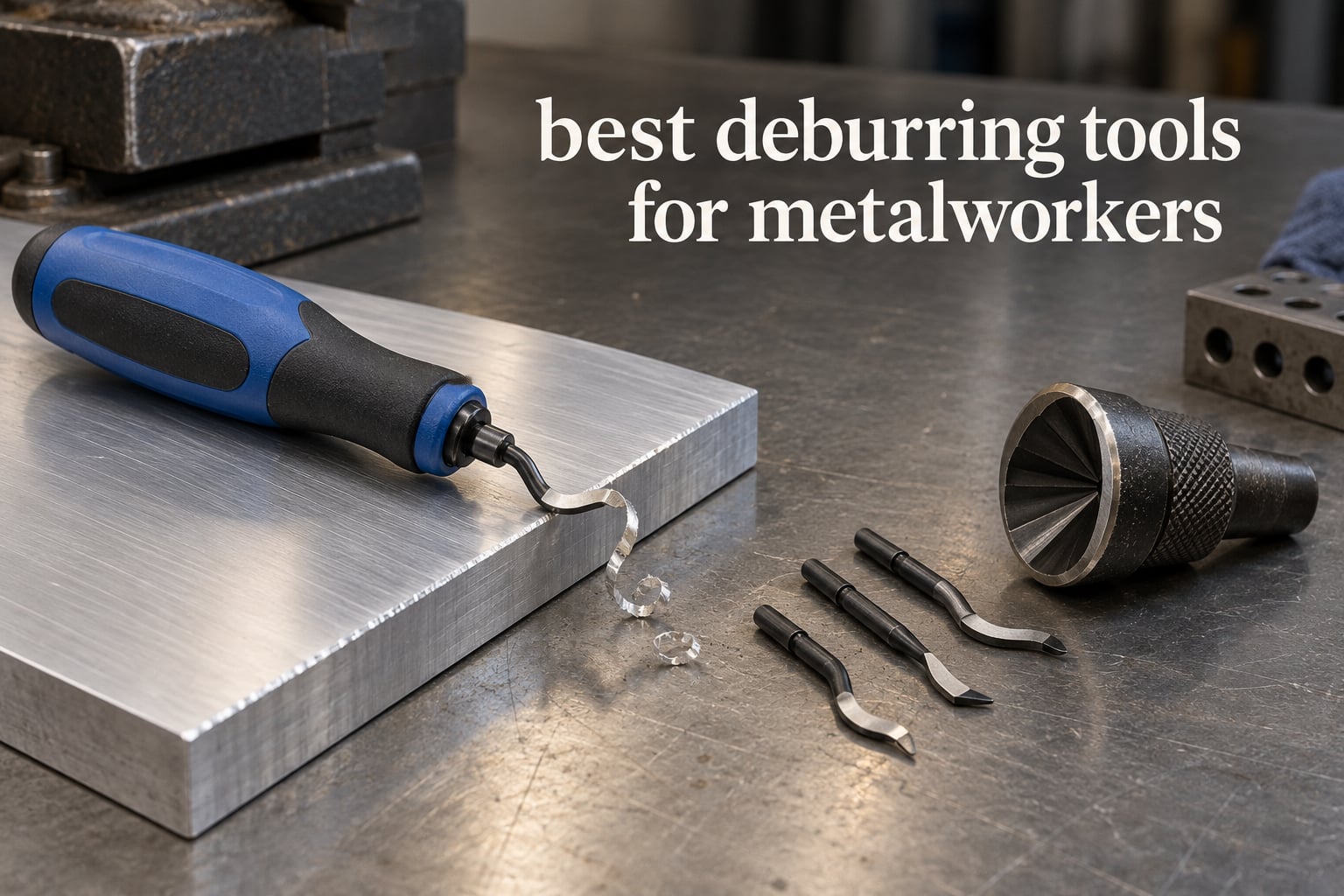
Deburring is the process of removing the sharp metal fragments, called burrs, that cutting, drilling, sawing, machining and grinding leave behind. A burr is not just untidy: it snags gloves, cuts hands, stops welds and coatings from adhering, and fails inspection. The best deburring tools for metalworkers are the ones that shear that fragment away and leave a small, consistent chamfer or radius in its place.
I have spent a lot of time on both sides of this job, and the pattern is consistent. Shop machinists want a guided blade that will not slip on hard steel. Fabricators want something fast on sheared sheet. Plumbers and fitters want a reamer that cleans a tube end in one twist. Home-shop metalworkers mostly want a handful of spare blades and a handle that does not roll out of the case.
This roundup covers twelve deburring tools across every category a metalworker actually reaches for, from pen-style swivel-blade deburrers to drill-driven tungsten carbide chamfer tools and pipe reamers. Each pick below is judged on blade life, how well it holds an edge in the material you work in daily, and how it behaves when the burr is somewhere awkward. If you want the short answer, the AFA Tooling 11-blade deburring tool is the one I would hand a machinist first.
One thing worth saying early: no hand tool reaches the back side of a cross-drilled hole. That is the single most common complaint on machinist forums, and it is a geometry problem rather than a tool-quality problem. When the burr sits on the exit side of a hole, you are looking at a back-spotfacing cutter, a small rotary abrasive, or a machine process.
Table of Contents
- Types of Deburring Tools at a Glance
- Top 3 Deburring Tools for Metalworkers
- Best Deburring Tools for Metalworkers in 2026
- 1. AFA Tooling 11-Blade Deburring Tool – The Best Overall Hand Deburr Tool
- 2. RIDGID 223S Tubing and Pipe Reamer – Best for Tube and Pipe Prep
- 3. LIBRATON Deburring Tool with 10 HSS Blades – Best Mixed-Blade Kit
- 4. PLATINUMEDGE Tungsten Carbide Chamfer Tool – Best for Damaged Bolt Threads
- 5. zhuohai NB1100 Deburring Tool Kit – Best Budget Starter Set
- 6. AFA Tooling Deburring Set with Two Hand Reamers – Best Countersinking Kit
- 7. Noga NG8150 Heavy Duty Deburr Tool – Best for Daily Shop Use
- 8. Noga DB1000 Sheet Metal Deburring Tool – Best for Sheared Sheet
- 9. WORKPRO Deburring Tool with 11 Swivel Blades – Best for 3D Prints and Mixed Hobby Work
- 10. CONQUER Tungsten Chamfer Tool – Best for Weekend Mechanics and Garage Repair
- 11. Acrux7 Hand Deburring Tool Kit – Best for Swapping Handles
- 12. WISSCOOL Inner and Outer Pipe Reamer – Best Wider-Range Budget Reamer
- How to Deburr Properly in Five Steps
- How to Choose the Right Deburring Tool for Your Work
- Frequently Asked Questions
- Final Verdict on the Best Deburring Tools for Metalworkers
Types of Deburring Tools at a Glance
This list is the quick map. Scroll to the table further down if you already know your category.
- Swivel-blade deburring tool: general purpose, works on holes and straight edges
- Double-burr sheet metal tool: cleans both sides of a sheared edge at once
- Hand countersink reamer: opens and chamfers a drilled hole mouth
- Drill-driven chamfer tool: restores damaged bolt and stud threads
- Pipe and tube reamer: cleans the inside and outside of a cut tube end
- Half-round file or mill file: for where a blade cannot reach at all
- Die grinder with flexible abrasive pad: for blend, rounding and weld cleanup
- Wire brush wheel: for aluminium and stainless parts with a heavy oxide skin
Each category has a job it does well and a job it cannot do. Files take off material and leave a surface; blades remove the burr and barely touch the face. Reamers only work on a circular hole. Die grinders are fast but they burnish instead of cutting if you lean on them.
Top 3 Deburring Tools for Metalworkers

AFA Tooling 11-Blade Deburring Tool
- 11 M2 HSS blades at HRC 62-64
- Anodized aluminum handle
- Cuts 80% longer than carbon steel
- 3 ounce weight

RIDGID 223S Pipe Reamer
- 1/4 to 1-1/4 inch capacity
- 45 inner cutting edges
- Inner and outer in one pass
- Lifetime warranty

LIBRATON Mixed HSS Blade Kit
- 10 HSS blades in three profiles
- M2 and M35 steel for soft and hard work
- Anodized handle with storage case
The AFA Tooling tool earns the top spot on blade life and review volume. The RIDGID 223S is the best-rated item in the group and the cleanest result on tube. The LIBRATON kit is the one to buy if you move between soft aluminium and hard stainless in the same week.
Best Deburring Tools for Metalworkers in 2026
All twelve picks, with the specification that matters most for each one. Every tool listed is a hand or drill-driven tool; nothing here needs a compressed air line or a dedicated finishing machine.
| Product | Specifications | Action |
|---|---|---|
| AFA Tooling 11 M2 HSS Blade Deburring Tool |
|
Check Latest Price |
| RIDGID 223S Tubing and Pipe Reamer |
|
Check Latest Price |
| LIBRATON Deburring Tool with 10 HSS Blades |
|
Check Latest Price |
 PLATINUMEDGE Tungsten Carbide Chamfer Tool PLATINUMEDGE Tungsten Carbide Chamfer Tool |
|
Check Latest Price |
 zhuohai NB1100 Deburring Tool Kit zhuohai NB1100 Deburring Tool Kit |
|
Check Latest Price |
 AFA Tooling Deburring Set with Two Hand Reamers AFA Tooling Deburring Set with Two Hand Reamers |
|
Check Latest Price |
 Noga NG8150 Heavy Duty Deburr Tool Noga NG8150 Heavy Duty Deburr Tool |
|
Check Latest Price |
 Noga DB1000 Sheet Metal Deburring Tool Noga DB1000 Sheet Metal Deburring Tool |
|
Check Latest Price |
 WORKPRO Deburring Tool with 11 Swivel Blades WORKPRO Deburring Tool with 11 Swivel Blades |
|
Check Latest Price |
 CONQUER Tungsten Chamfer Tool CONQUER Tungsten Chamfer Tool |
|
Check Latest Price |
 Acrux7 Hand Deburring Tool Kit Acrux7 Hand Deburring Tool Kit |
|
Check Latest Price |
 WISSCOOL Inner and Outer Pipe Reamer WISSCOOL Inner and Outer Pipe Reamer |
|
Check Latest Price |
1. AFA Tooling 11-Blade Deburring Tool – The Best Overall Hand Deburr Tool
AFA Tooling Deburring Tool, 11 M2 HSS Blades, CNC Anodized Aluminum Handle
11 M2 HSS blades at HRC 62-64
CNC anodized aluminum handle
3 ounces
4.7 from 8235 ratings
Pros
- M2 HSS hardened to HRC 62-64 holds an edge far longer than carbon steel
- Cuts cleanly in stainless
- aluminum and hard metals
- Compact anodized handle suits fine edge work
- Blade format is BS1010 so you rarely run dry mid-job
Cons
- Blade change takes practice one-handed
- Weaker on outside radii and corners than on straight edges
The first thing I checked on this tool was the steel. The blades are M2 high-speed steel tempered to HRC 62-64, and that number is why it outlasts the carbon steel blades most people buy first. In a shop where I am moving between 304 stainless and 6061 aluminium in the same afternoon, edge retention is the whole game.
Reviews put the blade life at up to 80% longer than standard carbon steel, and owners consistently report the blades still cut cleanly after months of interrupted use. That matters because a deburring tool is not a consumable you think about. You pick it up, take off a burr in fifteen seconds and put it down again.
The handle is CNC anodized aluminium and the whole tool weighs three ounces. At that weight you can hold it in a fingertip grip for a delicate edge or palm it for a drilled hole, and the knurl gives enough purchase that it does not roll when your hand is oily.
The learning curve is real but short. The retention button takes a moment to operate one-handed, and the first few passes on a hard workpiece need a light touch rather than a push. Once that clicks, the 360-degree rotation of the blade means the tool follows a slightly uneven surface without fighting you.
What you get in daily use on the bench
On a bench doing mixed jobbing work, this is the tool you reach for without thinking. It takes the edge off laser-cut mild steel plate, cleans the mouth of a drilled hole, and squares up a threaded rod end, and it does all three without a blade change.
The 11 included BS1010 blades cover the range of edge work most shops need. Because the spares live in the same size format as the fitted blade, you can keep a working set in a drawer and never run dry mid-job.
Where it falls short
It is a straight-edge and hole tool. On an outside radius or a sharp external corner the blade wants to ride up rather than cut, and you will end up finishing that corner with a file anyway. If most of your work is rounded profiles, a file set earns its place alongside it.
It is also still a sharp blade held in a metal handle. Grip the handle well back from the head. Several owners mention this directly, and it is the single most common way people hurt themselves with a hand deburr tool.
2. RIDGID 223S Tubing and Pipe Reamer – Best for Tube and Pipe Prep
RIDGID 29983 Model 223S Inner/Outer Tubing and Pipe Reamer for 1/4″ to 1-1/4″ Stainless Steel and Copper Tubing, Pipe and Tube Deburring Reamer with 45 Cutting Edges
1/4 to 1-1/4 inch capacity
45 inner cutting edges
Inner and outer in one pass
0.2 kg
Pros
- Highest rated tool in the group at 4.8
- Reams inner and outer edges in a single pass
- Alloy steel body holds an edge on stainless
- copper and PVC
- Backed by a RIDGID lifetime warranty
Cons
- Capacity is stated by outer diameter which confuses buyers
- Some reviews dispute the advertised 45 cutting edge count
This is the tool for anyone who cuts tube. A swivel-blade deburr tool cleans the outside of a pipe, but it cannot touch the inside bore, and the inside bore is where a fitting joint fails. The 223S reams the interior, deburrs the exterior and lays a bevel on the end in one pass.
Owners rate it at 4.8 across more than 2400 reviews, the highest score in this group. The finish it leaves is noticeably cleaner than a pen-style deburrer dragged around the outside of a cut pipe, and that is the reason plumbers and metalworkers keep buying it.
The adjustment bar reads in both imperial and metric, and the knurled body gives a solid grip with a gloved hand. For stainless and copper it behaves exactly as you would want. The interior cone carries heavy cutting edges, and it clears a bore quickly without chatter.
Capacity runs from 1/4 inch to 1-1/4 inch, with the measurement taken at the outside diameter. That single detail is the most common complaint in the reviews, so check your tube before you assume a size fits.
Why this one beats a swivel blade on tube
Because it works inside the bore. On a tube cut with a chop saw or a bandsaw, the inner wall carries a rolled burr that a blade cannot reach. Run the reamer with a light clockwise twist and it takes that burr down and chamfers the mouth for a fitting in the same motion.
The RIDGID lifetime warranty is also worth factoring in. For shop tooling this is a tool you should be able to replace rather than rebuy, and the warranty removes that question entirely.
Where the sizing catches people out
The 1-1/4 inch rating is an outer diameter, so it will not accept 1-1/4 inch schedule 40 PVC even though the wall thickness would allow the cone in. Several reviews also flag a discrepancy between the advertised 45 cutting edges and the 36 counted on the packaging. Neither issue stops the tool working, but both are worth knowing before you order.
3. LIBRATON Deburring Tool with 10 HSS Blades – Best Mixed-Blade Kit
Libraton Deburring Tool, Deburring Tool for 3D Printing with 10 HSS Blades
10 HSS blades in three profiles
M2 and M35 high-speed steel
Anodized handle with case
7.4 ounces
Pros
- Mixed M2 and M35 blades cover aluminium through stainless
- Spring-loaded retaining ring makes blade swaps fast
- Storage case keeps the ten spares organised
- Heavier handle gives steadier control on pipe work
Cons
- Fewer blades of each type than a single-blade kit
- Noticeably heavier than plastic-bodied competitors
This kit exists because most people buy the wrong blade for half their work. The kit includes ten HSS blades in three profiles, two BK3010, three BS1018 and five BS1010, in mixed M2 and M35 high-speed steel. M2 suits softer aluminium and copper, M35 holds up better on stainless and harder material.
That mix is the reason it earns a place in a shop that does not specialise. Rather than keeping two separate deburr tools on the bench, you can move from a soft alloy bracket to a stainless bracket in the same session without changing tool bodies.
Reviews specifically call out the spring-loaded retaining ring. Blade changes are quick enough that you can swap to a different profile mid-task rather than committing to one geometry for the whole job, which is a real advantage on mixed jobbing work.
The handle is anodized aluminium alloy with a knurled grip and the blades rotate through 360 degrees once installed. At 7.4 ounces it is one of the heavier hand tools in this roundup, and that weight is a feature on pipe cleanup where a light tool skates around the surface.
For shops working two or more materials
If your week is split between aluminium fabrication and stainless fittings, this is the kit that removes the argument from the bench. The three blade profiles cover both a small drilled hole and a wider edge break, and the two steels mean you are not forcing one blade to do a job it was never hardened for.
Reviewers describe it as feeling like a machinist tool rather than a hobby accessory, and the compartmentalised storage case is mentioned often because it stops the ten spares mixing together in a drawer.
What the mixed set costs you
You get fewer blades of any one type. A dedicated single-profile kit gives you ten of one blade, which is better if you have settled on a geometry and use it every day. Here you have a spread, and a shop that does nothing but stainless work will wear out the harder blades first.
The weight is the other tradeoff. Seven ounces is fine for a full day, but if you are deburring hundreds of small parts in one sitting, a lighter tool at three ounces will be less tiring over a long shift.
4. PLATINUMEDGE Tungsten Carbide Chamfer Tool – Best for Damaged Bolt Threads
PLATINUMEDGE Deburring External Chamfer Tool with 3 Tungsten Carbide Blades,Quick Release 1/4″ Hex Shank, Fits 1/8″-3/4″ (3-19mm) – Repair Damaged Bolts, Screws, Threaded Rods & Pipe
Three YG8 tungsten carbide blades
1/4 inch hex shank
Fits 3-19mm bar
0-400 RPM for spark-free cutting
Pros
- Carbide blades hold an edge on stainless and hardened steel where HSS dulls
- Quick-release hex shank fits most drills with no wobble
- Restores rusted or burred fastener threads in seconds
- Spark-free low-RPM cutting is safer than a grinder
Cons
- Drill-driven only and does nothing for hand deburring
- Low speed requirement makes it slower on large stock
This is a different category from the rest of the list. It does not deburr a drilled hole. It puts a fresh 60-degree chamfer back on the end of a bolt, screw or threaded rod, which is the quickest way to rescue a fastener that will not start because the first thread has been battered.
The three YG8 tungsten carbide blades are the reason it works on stainless and hardened steel. An HSS blade dulls in seconds on a rusted or work-hardened stud, where carbide keeps cutting through the oxide layer and into clean material underneath.
The 1/4 inch quick-release hex shank is a carbon steel body that fits most cordless drills and impact drivers without wobble. Reviews mention the rigidity of the shank connection specifically, because a flexible shank is what makes a chamfer wander and produce an inconsistent angle.
Run it at the recommended 0-400 RPM and it cuts spark-free. That matters in a garage or a fabrication bay, where an angle grinder on a threaded rod throws hot sparks at whatever is behind it.
When this is the right tool
Any time a fastener is rusted, cross-threaded or chewed by a wrench. A wheel stud that has been seized in a hub, a bolt head that has grown a burr from a poor spanner, a threaded rod end that is supposed to meet a coupling at a clean 60 degrees. It handles round bar from 1/8 inch to 3/4 inch, or 3 to 19 mm.
It also works on pipe. The same three-blade arrangement that chamfers a bolt end will put a lead-in on a tube before it enters a fitting, which saves a separate reaming step for smaller pipe.
What it cannot do
It needs a drill. There is no hand-driven version here, so if you are on a job site with no battery pack, this is not the tool. And the low speed it needs makes it slow on large diameter stock, where you are removing a lot of material to build the chamfer.
It is also a chamfering tool, not a general deburring tool. It will not clean a hole mouth or break a sheet metal edge, so keep a hand deburr tool on the bench as well if you do both jobs.
5. zhuohai NB1100 Deburring Tool Kit – Best Budget Starter Set
Deburring Tool Kit, a Anti-Slip Handle and Pack of 10 BS1010 Deburring Blades, for Wood, Metal, Plastic, Aluminum, Copper and Steel
10 BS1010 blades at 62-65 HRC
Anti-slip ABS wide-body handle
5 inch blade length
1.44 ounces
Pros
- Ten spare BS1010 blades stored in the handle
- Anti-slip wide body is comfortable over repeated passes
- Handles aluminium
- copper
- PVC and resin prints without sanding
- Lightest tool in the roundup at 1.44 ounces
Cons
- ABS handle is less rigid than machined aluminium on fine work
- Not built for continuous commercial duty
- Swivel design feels awkward for left-handed users
This is the one to hand someone who has never used a deburring tool. It is inexpensive, it comes with ten spare BS1010 blades at 62-65 HRC, and it covers the majority of the burr problems a beginner meets: sheet metal cut edges, drilled hole mouths, 3D-printed resin and light copper work.
Reviews describe it as good value with a generous spare-blade supply, which is the honest summary. The blade steel is properly hardened and the wide anti-slip body is genuinely comfortable for repeated passes, which is more than you can say for most tools at this level.
At 1.44 ounces it is the lightest tool here, and that turns out to matter more than expected. Fine sheet metal work is wrist work, and a lighter handle over a long session is the difference between finishing the job and putting the tool down.
The button-release 360-degree rotation is standard on this type. The blade length is 1.96 inch and the grip is 4.9 inch, which is a size that fits most hands including smaller ones, something the bulkier aluminium-handled tools do not always manage.
The jobs it handles best are sheet metal, prints and copper
Sheet metal cleanup, 3D-printed parts, resin castings and copper. The blade is sharp enough to shear a burr off a plastic print without taking it to a sander, and buyers mention exactly that. It is also a sensible second tool for a shop, because it lives in a drawer and gets used when the good tool is on a job.
For a home shop that occasionally cuts and drills metal, this answers the question without a serious commitment. You can learn the technique on it, because the technique is the same one you would use on a Noga or an AFA tool.
Limits to know before you buy
The body is ABS plastic rather than machined aluminium, and it is less rigid on fine metal work. It is not intended for continuous commercial duty, and both the blades and the body wear faster under that load. If you are deburring hundreds of parts a week, buy a metal-handled tool instead.
A minority of users also find the rotating head awkward as a left-hander. If you are left-handed and doing a lot of fine work, an aluminium-handled model with a tighter pivot will suit you better.
6. AFA Tooling Deburring Set with Two Hand Reamers – Best Countersinking Kit
AFA Tooling Deburring Tool Set & 2 Countersink Hand Reamers, Red CNC Handle
11 tempered HSS blades with swivel head
Two 90 degree countersink hand reamers
Knurled red CNC aluminum handle
9.9 ounces
Pros
- Bundles the deburring tool with two countersink hand reamers
- Saves buying a reamer separately
- Knurled red aluminium handle gives precise control
- Swivel head follows uneven surfaces well
- Protective case for the spare blades
Cons
- Countersink reamers add weight and bulk
- Kit is larger than a basic deburring tool in a tool bag
The case for this kit is simple. A swivel-blade tool opens a hole mouth a little, but it will not produce a clean 90-degree countersink. If you work with fasteners going into drilled holes, a hand reamer is a separate purchase, and this set includes two at HRC 62-64 alongside the deburring tool.
Reviewers who buy it are mostly machinists and plumbers, and the thing they mention most is not having to keep two tools in two places. The countersink reamers live in the same case as the eleven tempered HSS BS1010 blades and the deburring handle.
The handle is a knurled red CNC aluminium body, and the knurl is fine enough to give real control on a small countersink. The swivel head follows an uneven surface without lifting, which is useful on a part that has already been faced on a manual lathe rather than a mill.
At 9.9 ounces this is the heaviest kit in the roundup, and that is the reamers rather than the handle. The two countersink reamers also mean the kit is suited to metal, plastic and resin-based materials rather than metal only.
For whom the bundle makes sense
Anyone who drills and taps holes, fits countersunk fasteners, or repairs a hole that has been drilled to the wrong depth. The hand reamer is the traditional answer and it is still the most controllable one, because you set the angle by feel and by eye rather than by a machine feed rate.
It is also a good gift for someone building a first toolbag. The case means the blades and reamers stay together, and buyers repeatedly mention the case and the anodized finish as the things that make it feel shop-ready.
Where the bundle works against you
It is bulkier than a basic deburring tool. If you are carrying one tool around a job site and you only need to break an edge, the reamers are dead weight in the bag. The same applies if you already own a hand countersink and are happy with it.
Purchase it as a bench set rather than a portable one. The component tools are good; it is the sum of their weight that is the compromise.
7. Noga NG8150 Heavy Duty Deburr Tool – Best for Daily Shop Use
Noga NG8150 Heavy Duty Deburr Tool, with 10 S10 Blades (Original Version)
10 S10 HSS blades at 62-64 Rc
Blades stored inside the handle
Rubber-coated grip
89 g
Pros
- Blades last far longer than generic swap-in blades
- Quick simple blade changes compared with multi-part tools
- Rubber-coated handle grips positively with a gloved hand
- Works on tool steels such as 4140 and H13
Cons
- Leaves a rougher surface than a file and removes the burr fast
- Weak on outside radii and corners
- Sharp head can cause a deep cut if gripped too close
Across machinist forums, Noga and Shaviv come up constantly as the default handheld deburring names, and the NG8150 is the heavy-duty end of that range. It carries ten S10 high-speed steel blades at 62-64 Rc in an NG-1 NogaGrip handle, and the spares live inside the handle body.
Owners report multi-year blade life on daily shop use, and several buy a second as a backup rather than repair the first. That is the strongest durability signal in this roundup, and it comes from the blade steel and the positive retention lock rather than from the handle.
The rubber-coated grip is the part you notice most after an hour. It holds with a gloved hand, and the whole tool at 89 grams stays balanced in the palm while you guide a blade around a hole mouth.
It cuts 4140 and H13 in the annealed and pre-hardened state, which is the practical test of a shop deburr tool. A blade that dulls on pre-hard tool steel is not much use in a machine shop, however good it is on aluminium.
What it is genuinely good at
Removing a burr in a few seconds and moving on. That is the job. It is a fast burr remover rather than a finishing tool, and the two are not the same thing. When a part is going to be inspected, welded or coated, this is the tool that gets the edge off in seconds so the next operation can start.
Owners also rate the blade change as quick and simple, and the fact that the handle takes the whole S series 3.2mm blade format means your spare supply is not proprietary to one model.
Where it falls short
It does not leave as smooth a surface as a file. If the part has to be visually perfect or a coating has to flow across the edge, follow up with a half-round file or a stone. The tool removes the burr; it does not blend the face.
It is also weak on outside radii and corners, and the head is sharp enough to cause a deep cut if you grip the handle close to it. Set the handle back in your palm and let the blade do the work.
8. Noga DB1000 Sheet Metal Deburring Tool – Best for Sheared Sheet
Noga DB1000 Sheet Metal Deburring Tool
Deburrs both sides in one pass
N80 high-speed steel blades
0-12mm range
6.2 ounces
Pros
- Removes the burr from both sides of a sheared edge in one pass
- N80 HSS blades suit general ferrous and non-ferrous work
- Purpose-built geometry for sheet metal and metal block edges
- Single-tool answer to double-sided sheet burrs
Cons
- Specialised for sheet metal rather than a general swivel deburr tool
- N80 blade range covers 0-12mm only
A sheared sheet edge has a burr on both sides. That is the physical reality of a punch or shear operation, and a conventional swivel-blade deburr tool takes at least two passes and a re-grip to get both. The DB1000 uses a double-burr design that addresses both sides in a single pass.
For anyone running a press brake or a guillotine, that is not a small saving. It is the difference between a fast continuous pass along a cut edge and stopping the tool at every corner to turn it around.
Reviewers who fabricate sheet metal value the double-sided action for exactly that reason. The N80 high-speed steel blades are general-purpose, so the same tool handles ferrous and non-ferrous material rather than locking you into one type.
Why sheet metal fabricators buy this
Because a double burr is the most common reason a cut sheet part gets rejected at assembly. The first pass removes the top burr, the flip removes the bottom one, and if the second is missed the part will not sit flat and the edge will still cut the operator.
It also works on metal block edges, which covers bar offcuts and saw-cut ends. On a 0-12mm range it handles everything from thin sheet up to a decent plate section.
Where it is the wrong choice
It is not a general-purpose bench deburr tool. If your work is mostly drilled holes, tube and small brackets, you want a 360-degree swivel-blade tool instead, and this one will frustrate you on a round hole mouth.
The 0-12mm blade range is also a limit. Thicker plate needs a bigger blade, and there is a reason this tool is described as a specialist shop tool rather than a universal bench companion.
9. WORKPRO Deburring Tool with 11 Swivel Blades – Best for 3D Prints and Mixed Hobby Work
WORKPRO Deburring Tool with 11 Extra High Speed Steel Swivel Blades
11 M2 HSS blades at HRC 62-67
Textured aluminium handle
Retaining-ring blade lock
4.2 ounces
Pros
- All-metal construction feels durable rather than flimsy
- Large barrel handle is easy to hold steadily
- Retaining ring grips the blade firmly while letting it spin
- Eleven M2 blades cover print cleanup and metal work
Cons
- Some owners reported the end cap loosening and blades falling out
- Sharp blades bite into very soft aluminium
- Rotating head has a learning curve to control
A huge share of hand deburring searches now come from people finishing 3D prints rather than machined parts. A printed part has layer lines, a fuzzy edge and support scars, and a sharp blade takes the first two off in a single pass where sandpaper takes five.
This one comes with eleven M2 high-speed steel blades hardened to HRC 62-67 and a textured aluminium barrel handle. Buyers like the solid build and the size of the handle, both of which make it feel less like a hobby accessory than the plastic-bodied kits do.
The retaining ring locks the blade firmly while allowing full 360-degree rotation, so the blade follows a slightly uneven surface without wandering. That is the difference between a clean pass on a printed edge and a skipped section where the blade lifted over a ridge.
At 4.2 ounces it is light enough for long print-cleanup sessions, and the compact storage case means the eleven spares stay organised rather than loose in a drawer.
For print cleanup and light metal work
It suits PLA, ABS, PETG and resin prints as well as metal and PVC, and the eleven blades give you enough spares to get through a batch of parts before the first blade dulls. The textured grip stays put with slightly dusty hands, which is the normal condition when you are handling prints straight off the bed.
Plumbers and hobby metalworkers use it the same way. The handle diameter is larger than most competitors, so it is easier to control for someone with larger hands or a less precise grip.
Where it lets you down
Some owners reported the end cap loosening and blades falling out of the handle. If that happens it is usually a matter of tightening the cap rather than a failed tool, but it is worth knowing before you rely on one for a production run.
It is also a sharp blade tool rather than a scraper. On very soft aluminium a sharp blade can bite into the surface instead of shearing the burr, and reviewers note that a fixed-blade reamer suits that material better. Learn the light touch before you work a finished face.
10. CONQUER Tungsten Chamfer Tool – Best for Weekend Mechanics and Garage Repair
CONQUER Deburring External Chamfer Tool, Tungsten Blade, Fits 1/8″-3/4″
Tungsten blade on a 45 degree chamfer
1/4 inch hex shank
Spark-free at 0-400 RPM
1/8 to 3/4 inch capacity
Pros
- Restores damaged threads on studs and bolts quickly
- Spark-free low-RPM operation is safer than a grinder in a garage
- Covers 1/8 to 3/4 inch bar in one tool
- A larger tungsten variant covers bigger diameters
Cons
- Needs a drill or impact driver with careful low-speed handling
- Tungsten carbide costs more than an equivalent HSS chamfer tool
This is the garage equivalent of a thread repair kit that used to live in a toolbox. Rather than replacing a rusted wheel stud, you run this over the end of the old one for a few seconds and it comes back with a clean factory-like chamfer.
The tungsten blade is set on a 45-degree chamfer angle and the 1/4 inch quick-release hex shank fits a standard drill. Reviews emphasise two things: the quality of the chamfer it leaves, and the fact that it runs spark-free at low speed.
The material range is wide. Reviewers and the spec both list stainless, hardened and mild steel, copper, brass, aluminium, fiberglass, wood and PVC, which means one tool covers most of the fasteners and bar you will meet working on a car.
Operating at 0-400 RPM is the instruction that matters. Push the throttle hard and you get heat, sparks and a burnt chamfer instead of a clean one. Take it slowly and the blade shaves the damaged material off and leaves the thread below it intact.
Who buys this and why
Weekend mechanics and garage users. A seized wheel stud, a rusted bolt head, a threaded rod end that has been mauled by a shift. This is nearly always a faster route than replacing the fastener, and it is the same reason thread chasers and rat-tail files have been in garages for decades.
The spark-free operation is a genuine safety argument, not marketing. An angle grinder in a garage throws hot sparks toward fuel lines, upholstery and paint, and this does not.
What it will not replace
It is not a deburring tool for holes or cut edges, and it needs a battery or mains drill to do anything. If your work is garage repair, a battery is already in the van, so that is not a barrier. For shop work on tube ends and fittings, a reamer does a better job.
It is also a step up from an HSS chamfer tool for the same job. The extra cost buys the tungsten edge retention, which is what makes it work on hardened and stainless fasteners instead of dulling after one pass.
11. Acrux7 Hand Deburring Tool Kit – Best for Swapping Handles
Acrux7 Hand Deburring Tool Kit, 10pcs Rotary Deburr Blades + 1pcs Countersink Blade with Aluminum and Silicone Handle, Great Burr Remover Hand Tool for Wood, Plastic, Aluminum, Copper and Steel
10 HSS rotary blades at 47mm
One metal countersink blade
Aluminium and silicone handles
5.6 ounces
Pros
- Two handle styles let you choose the grip for a long session
- Includes a countersink blade alongside the ten rotary blades
- Covers plastic
- copper
- aluminium and soft steel
- Blades rotate 360 degrees once installed
Cons
- HSS rotary blades are for plastic and soft metals
- not hardened steel
- Two handles add bulk for a task needing only one
The distinguishing feature here is the pair of handles. You get an aluminium alloy pen-style body and a silicone-gripped body, and you can move the same blade head between them depending on how long the job is and how sweaty your hands get.
Owners like the flexibility, and it is a more useful distinction than it first sounds. The aluminium hex body is precise and good for a single part or a countersink. The silicone body is larger and softer, and it is the one you want for a long run of plastic or 3D-printed parts.
There are ten HSS rotary blades at 47mm in black finish plus one metal countersink blade, so the kit covers both edge breaking and hole work out of the box. Blades install by compressing the mounting head and then rotate freely through 360 degrees.
Best for anyone who wants a spare handle on the bench
When your volume is high and the work is repetitive. Blade changes are then a constant part of the process, and swapping the head between a light pen body and a comfortable grip over a shift is a real ergonomic gain rather than a gimmick.
It also makes sense if you share a bench with someone who prefers a different feel. The blade head is the working part, and the handle is a preference rather than a requirement.
Where the material limit bites
The HSS rotary blades are intended for plastic and soft metals. On hardened steel or stainless they will dull quickly, and no amount of technique changes that. The spec is clear about this and the reviews confirm it, so treat the kit as a plastic, aluminium and soft steel tool.
Carrying both handles is also wasted weight if you only use one. The blades and the countersink blade are the valuable part of the kit, so buy it for the blade selection if you already own a handle you like.
12. WISSCOOL Inner and Outer Pipe Reamer – Best Wider-Range Budget Reamer
WISSCOOL Inner/Outer Pipe Reamer, 1/4 to 1-5/8″, Green-4 Blades
Four hardened stainless blades
1/4 to 1-5/8 inch capacity
Green anti-slip knurled handle
5.6 ounces
Pros
- Covers 1/4 to 1-5/8 inch
- a wider range than most reamers at this level
- Cleans inner and outer pipe ends in one pass for reliable joints
- Anti-slip knurled handle is comfortable one-handed
- Small enough to live in a toolbox corner
Cons
- Four blades are fewer than premium reamers
- so it is slower on tough tubing
- Range tops out at 1-5/8 inch so larger conduit needs a bigger tool
The gap this fills is capacity. Where most reamers in this class stop at 1 inch, the WISSCOOL runs from 1/4 inch to 1-5/8 inch, so one tool covers small copper line and larger conduit without a second purchase.
Plumbers value that range and the one-pass clean. Four hardened stainless steel blades ream the interior and chamfer the exterior in the same twist, which is what makes a fitting joint seat properly instead of leaving a burr to hold up the seal.
The green knurled handle is genuinely anti-slip and sized for one-handed use, and the whole tool is under 0.38 lb. It is small enough to live permanently in a toolbox corner rather than a drawer, which is the difference between having it and not having it when you need it.
It covers copper, PVC, PPR, brass and aluminium, so it works across a domestic or light-commercial plumbing job without changing tools partway through.
When it beats the premium reamer
The wider capacity means you are not hunting for the right reamer with a torch in one hand. The inner and outer clean in a single pass is also a genuine time saving on a long run of fittings.
For a maintenance van, a plumber or a home installer doing the occasional repair, this is the sensible choice. It does one job, it does it in a wide range, and it fits in the toolbox you already own.
Where the cheaper blade count shows
Four blades against the 45 cutting edges on a premium reamer, and the difference is speed on tough tubing. On soft copper and PVC you will not notice. On a wall of stainless or a thick-walled conduit, expect to work harder and go round more than once.
Past 1-5/8 inch you need a bigger reamer, and that is a hard limit rather than a preference. Check the largest diameter you will ever run before you commit to this as your only reamer.
How to Deburr Properly in Five Steps
A technique difference is worth more than a tool difference on most parts. This is the sequence we use, and it works with any of the twelve tools above.
- Inspect the edge first. Decide whether you are removing a cut-off burr, a roll burr, a weld burr or a poise burr, because each needs a different approach.
- Clamp the work so the burr side is accessible. Deburring with the part in your hand is how cuts happen.
- Set the tool at a low angle to the surface and take light passes. Let the blade shear the burr rather than pushing through it.
- Follow the burr completely, including the point where it turns along a cross-hole. Stop, re-angle, and finish the run.
- Check with a fingertip held flat, not a pinch, and confirm the edge is no longer sharp enough to catch a glove.
The burr types matter because they behave differently. A cut-off burr stands proud and comes off in one pass with a blade. A roll burr is bent over the edge and needs a tool that can get under it. A weld burr is a hard, spiky deposit that resists a blade and wants a file or an abrasive. A poise burr is the thin fragile feather edge left where a cut-off separated, and it needs a light blend rather than a cut.
For laser and plasma cut plate, expect a heat-affected edge and a hard oxide layer under the burr. A blade alone will skate or dull, so a light abrasive pass first, then the blade, gives a much better result.
And be honest about the back side of a cross-drilled hole. No hand tool in this roundup reaches it. A small rotary abrasive, a back-spotfacing cutter, or a machine process is the correct answer, and forcing a hand blade into a bore to try will just bend the blade.
How to Choose the Right Deburring Tool for Your Work
Start with the material, then the burr location, then the volume. Everything else follows from those three answers.
Aluminium and soft non-ferrous metal. Burrs here are large and loose, and the risk is biting into the material rather than cutting the burr. A sharp HSS blade with a light touch, or a fixed-blade reamer, suits better than an aggressive carbide chamfer. Keep the feed light and the speed moderate.
Stainless steel. Work-hardening is the issue. A dull blade rubs and hardens the edge instead of cutting it, so blade steel matters more than any other factor. M2 or M35 high-speed steel is the minimum, and tungsten carbide is what you want on a hardened or oxidised fastener. Abrasives work, but expect to change them more often.
Carbon and mild steel. The most forgiving material. Almost every tool in this roundup handles it, so choose on the shape of the part rather than the material. This is where a file and a deburring tool together earn their keep.
Thin-wall sheet metal. A double-sided sheet tool is the right call, because a thin edge flexes as you deburr and a single-sided tool leaves you chasing the second burr. Keep light pressure and support the offcut side.
Tube and pipe. A reamer, not a blade. The inside bore carries a rolled burr that only a conical reamer removes, and it takes the exterior chamfer at the same time. Match the capacity to your largest diameter, and remember the rating is usually taken at the outside diameter.
Weldments. A weld burr is spiky, hard and often larger than it looks. A file or a die grinder with a small abrasive pad takes the deposit off, then a hand blade cleans the edge. For a rough bracket, doing it the other way round is faster.
Occasional work versus production work
For occasional work, a single metal-handled deburring tool with a supply of spare blades is the correct answer, and it will be in your pocket for years. For production, the argument is different: hand tools are operator-dependent, slow, and a documented source of repetitive strain injury on high-volume work. Above roughly 50 parts a month, a flexible abrasive system or a dedicated machine starts to cost less per part than your operator’s time.
Forum discussion of Timesavers-class machines reaches the same conclusion from the other side. Without volume they are overkill, and the running cost of a wide belt machine on a trickle of parts is hard to justify.
Where a die grinder fits, and the cordless question
A die grinder with a flexible abrasive pad is the right tool for blending, radius rounding and weld cleanup, and it is the wrong tool for a precision edge break. The failure mode is consistent: apply too much load and the pad burnishes the surface instead of cutting it, leaving a part that looks finished and is not.
The cordless versus pneumatic debate comes up constantly. On Practical Machinist, a machinist in Indiana reports running Milwaukee M12 straight and 90-degree die grinders for three to four years with no failures, at 24,000 RPM and four speed settings, preferring a 2-inch Roloc disc over 1-inch because the extra edge flex blends better. The same user notes the straight grinder stalls with heavy 3-inch buffing pads, so it is a light-duty tool. The preference for cordless is driven by weight, quietness and no hose rather than raw power, which matches what shop owners say about adding air lines purely for deburring.
Safety on the bench
A hand deburring tool is a sharp blade mounted in a hard handle, and it is the most common cause of a small cut in a machine shop. Grip the handle well back from the head so a slipped blade cannot reach your palm. Gloves help with grip and hot work but they do not stop a blade, and a loose glove on a rotating handle is worse than a bare hand. Wear eye protection whenever you are deburring overhead or working near someone else, and clear the chips before you change the blade rather than after.
Maintenance and blade replacement
Change a blade when it stops cutting, not when it looks tired. A dull blade is the fastest way to ruin a good handle, because it takes more force and the operator compensates. Keep a spare in the handle where the design allows it, and keep a working supply of the blade format you use. Standard formats like the Shaviv Classic B are treated as an industry default, and buying a tool that takes a common blade format means you are never waiting on a single manufacturer for spares.
Clean the handle and the retention mechanism occasionally. Metal swarf packed into a pivot is what turns a smooth swivel into a stiff one, and a stiff swivel is where blades get forced and bent. Keeping the whole kit together in one cabinet, rather than split between a drawer and a van, is the other half of that habit, and our picks for garage storage cabinets for tools cover the bench-side storage question.
Frequently Asked Questions
Which tool is used to remove burrs from metal?
A hand deburring tool with a guided swivel blade is the standard answer. The blade is held against the edge and shears the burr away, leaving a small chamfer. For a hole you use a hand countersink reamer, for a cut tube you use a pipe reamer, and for a weld seam you use a file or a die grinder with an abrasive pad before finishing with a blade.
What tools are used for deburring?
The main categories are swivel-blade hand deburrers, double-sided sheet metal tools, hand countersink reamers, drill-driven tungsten carbide chamfer tools, pipe and tube reamers, half-round and mill files, die grinders with flexible abrasive pads, and wire brush wheels. Each one suits a different burr location, and most shops need at least two of them.
How to choose the right deburring tool?
Choose by material first, then by where the burr is, then by volume. Aluminium needs a light touch and a sharp HSS blade, stainless needs good blade steel because a dull blade work-hardens the edge, and tube needs a reamer rather than a blade. Above roughly 50 parts a month, hand tools start costing more in operator time than a machine or flexible abrasive system costs per part.
What is the best deburring tool?
The AFA Tooling 11-blade tool is the best all-round hand deburr tool here, with M2 high-speed steel blades tempered to HRC 62-64, an anodized aluminium handle and 8235 ratings at 4.7. For tube and pipe work specifically, the RIDGID 223S reamer is the better answer because it is the only tool in the roundup that cleans the inside of a bore.
What is the best chamfer and deburring tool?
For chamfering and countersinking, the AFA Tooling set with two 90-degree HRC 62-64 hand reamers gives the most controlled result on a drilled hole. For repairing damaged bolt and stud threads, the PLATINUMEDGE tungsten carbide chamfer tool is the right pick because carbide holds its edge on hardened and rusted fasteners where an HSS blade dulls immediately.
What is deburring and chamfering?
Deburring removes the sharp fragments left by a cutting, drilling or grinding process. Chamfering replaces the sharp edge with a deliberate angled bevel, usually 45 or 60 degrees, so a part can be handled, inserted or joined safely. Deburring is cleanup after the cut; chamfering is a designed feature of the part.
Which tool is commonly used for manual deburring?
The swivel-blade hand deburr tool is the most widely used manual deburring tool in metal shops, and Noga and Shaviv are the names that come up most often on machinist forums. The blade is mounted so it rotates through 360 degrees and follows the surface, and a hand countersink reamer is the standard companion for hole mouths.
Final Verdict on the Best Deburring Tools for Metalworkers
If you take one tool from this roundup, take the AFA Tooling 11-blade deburring tool. M2 high-speed steel tempered to HRC 62-64, a machined aluminium handle at three ounces, and the highest review volume of anything here make it the safest general purchase for a machinist, fabricator or fitter.
Then add the one tool that covers a gap no blade can: the RIDGID 223S if you cut tube, the Noga DB1000 if you cut sheet, or the PLATINUMEDGE tungsten chamfer tool if you rescue damaged fasteners. Two tools cover almost every shop.
For a home shop, the zhuohai NB1100 teaches the technique for very little and comes with ten spare blades. For a fabricator running high volume, budget for a die grinder with a 2-inch flexible abrasive pad for blending and keep the hand blade for the final edge break. And if your parts are getting rejected at assembly, the burr is usually on the back side of a cross-hole, where no hand tool will reach.
We update this list every year as new tools land and review counts move. Whether you are building a first toolbag or replacing a handle that has seen thirty years of shop work, the picking is the easy part and the setup around it matters just as much.