
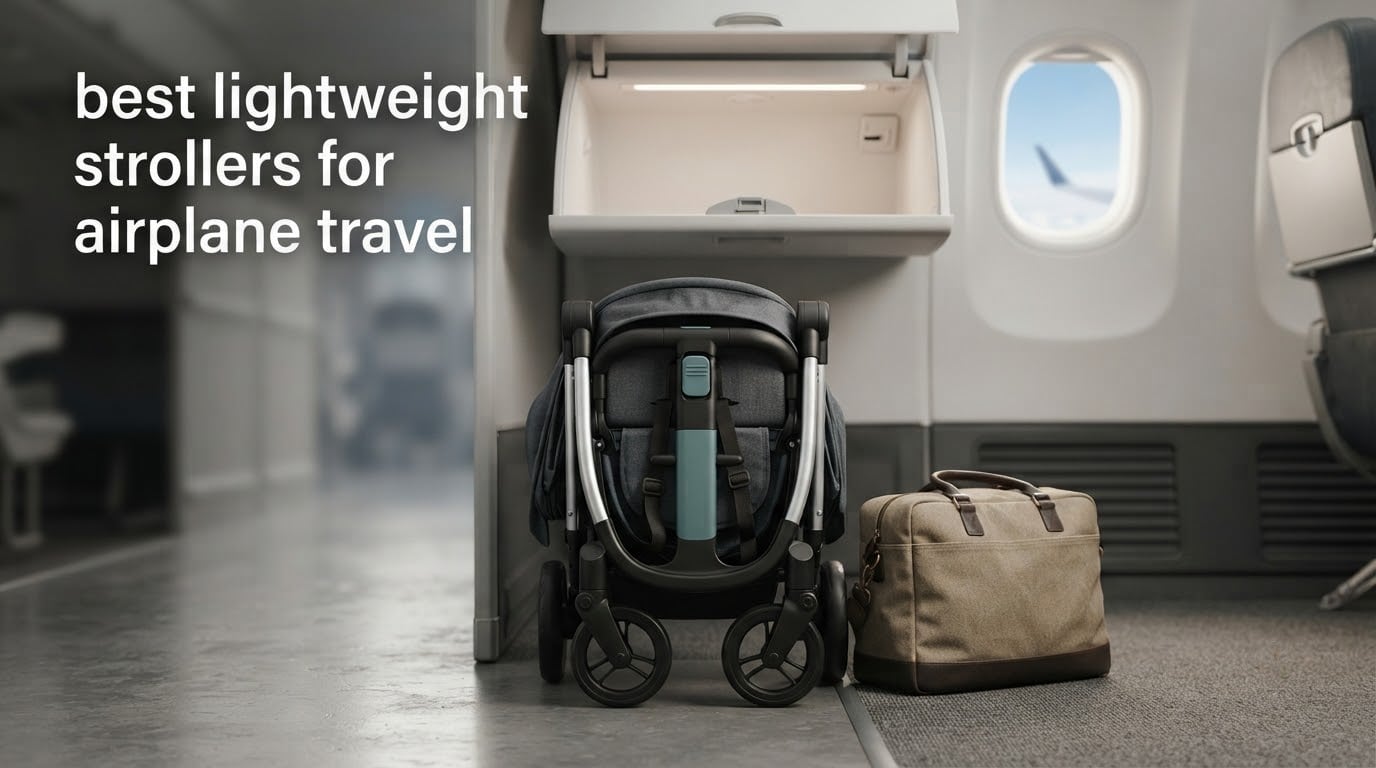
A lightweight travel stroller is one that weighs under about 15 lb (7 kg) and folds small enough for you to lift into an airplane overhead bin yourself. That single sentence is the whole buying brief: if the frame is heavy or the folded package is bulky, a gate agent hands it over at the jet bridge and you spend the next 30 to 60 minutes carrying your child while waiting at baggage claim.
The best lightweight strollers for airplane travel solve that problem in different ways, and the right answer depends on how often you fly, how old your child is, and how rough the ground is where you land. We compared ten of them side by side, weighing the published specifications and thousands of verified buyer reviews against what actually happens at the jet bridge.
Our verdict up front: the Ingenuity 3D Mini is the best lightweight stroller for airplane travel overall, because it carries a full-size padded seat at 11 lb and carries the largest review base in the group. If your child is a toddler who will outgrow a travel seat in a year, the Dream On Me Coast Rider converts into a ride-on scooter. If weight is your only priority, the Dream On Me Aero folds down at 7.2 lb.
Before the picks, it is worth being blunt about something the category keeps glossing over. “Fits in the overhead bin” is a manufacturer claim about folded size, and a gate agent’s decision about whether it fits is a separate judgement made by a person standing in a jet bridge with a full aircraft behind you. Understanding how that gap actually works will save you more stress than any feature list.
Table of Contents
- Top 3 Picks for Airplane Travel in 2026
- All 10 Lightweight Travel Strollers at a Glance in 2026
- How We Judged Airplane-Friendly Strollers
- Overhead Bin Reality and What Happens at the Jet Bridge
- 1. Ingenuity 3D Mini: The Best Lightweight Stroller for Airplane Travel Overall
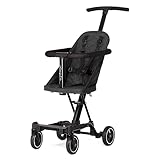
- 2. Dream On Me Coast Rider: Best for a Child Who Keeps Growing Past the Stroller Age
- 3. gb Pockit Air All Terrain: Best Value Pick with the Heaviest Seat Limit
- 4. MAMAZING Ultra Air: Best Carbon Fiber Frame for Airport and Everyday Errands
- 5. Mompush Lithe V2: Best for In-Flight Naps
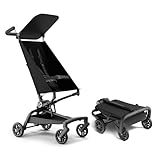
- 6. Mompush Jeto: Best for the Smallest Carry-On Package
- 7. Stokke YOYO3: Best for Overhead Bin Fit and City Use After Landing
- 8. Kolcraft Cloud Plus: Best for Storage and a Self-Standing Fold
- 9. Dream On Me Aero: The Lightest Stroller in the Roundup
- 10. Mompush Nexis: Best Full-Suspension Ride at Cabin Weight
- How to Choose a Lightweight Stroller for Flying
- Frequently Asked Questions
- The Verdict: Which Lightweight Stroller Should You Buy
Top 3 Picks for Airplane Travel in 2026


These three are not the flashiest options, and they are not the most expensive either. They are the ones where the specification sheet and the buyer reviews agree, which is a rarer thing in this category than you would expect.
All 10 Lightweight Travel Strollers at a Glance in 2026
| Product | Specifications | Action |
|---|---|---|
| Ingenuity 3D Mini |
|
Check Latest Price |
| Dream On Me Coast Rider |
|
Check Latest Price |
 gb Pockit Air All Terrain gb Pockit Air All Terrain |
|
Check Latest Price |
 MAMAZING Ultra Air MAMAZING Ultra Air |
|
Check Latest Price |
 Mompush Lithe V2 Mompush Lithe V2 |
|
Check Latest Price |
 Mompush Jeto Mompush Jeto |
|
Check Latest Price |
 Stokke YOYO3 Stokke YOYO3 |
|
Check Latest Price |
| Kolcraft Cloud Plus |
|
Check Latest Price |
 Dream On Me Aero Dream On Me Aero |
|
Check Latest Price |
 Mompush Nexis Mompush Nexis |
|
Check Latest Price |
Weights are printed in pounds because that is how the US listings state them, and ages and weight limits are taken from each manufacturer’s own listing rather than inferred.
The three lightest picks, ranked
If your question is literally which one is the lightest stroller, the answer is the Dream On Me Aero at 7.2 lb, followed by the Mompush Jeto at 9.8 lb and the gb Pockit Air All Terrain at 10.4 lb. Those three are the only frames in this roundup that come in under 11 lb, and the Aero is the one to skip if your child is over about two years old.
How We Judged Airplane-Friendly Strollers
Every stroller here was assessed on eight things, in this order of weight in our decision: published weight, folded size and whether the manufacturer claims bin compatibility, whether the fold can genuinely be done one-handed, ride quality off smooth airport flooring, sun protection, storage basket capacity, the age and weight range, and the safety certification on the listing.
- Weight. Under 11 lb is the band where lifting into a bin stops being a two-arm job.
- Folded size. The IATA cabin luggage guideline is 55 x 40 x 23 cm, roughly 22 x 16 x 9 in. Strollers rarely meet it exactly, but the closer the folded profile, the less argument there is at the jet bridge.
- One-hand fold. A fold you can trigger while holding a toddler is worth more than most comfort features.
- Ride quality. Airport carpet, jet bridge metal, cobblestones and beach sand punish small wheels.
- Canopy. UPF 50+ covers the airport tarmac and the tourist street.
- Basket capacity. A basket that cannot take a change bag is decoration.
- Age and weight limit. Many “from birth” claims quietly mean six months.
- Certification. ASTM F963, CPSC, JPMA and ASTM F833-21 all appear in this group and tell you the frame was tested, not just assembled.
We also weighted verified buyer reviews heavily, and specifically discounted recommendations from people who had never actually flown with the stroller. A parent on a parenting forum described a stroller they liked but had “not had an issue taking it on a plane yet”, and that line is treated as a weak signal in our ranking. If you want the wider picture of travel gear that has survived real flights, our guide to the best lightweight strollers for travel covers the long-haul cases in more depth.
Overhead Bin Reality and What Happens at the Jet Bridge
Yes, airlines allow strollers, and almost all of them fly a stroller free of charge as checked baggage if you hand it over at the gate. The part that trips people up is the cabin. Free to check is not the same as free to carry on, and the difference is decided at the last minute by a person you will meet once.
Here is the honest version of “fits in the overhead bin”. Bin space is not a fixed number, because it changes by aircraft rather than by airline. A wide-body on a long-haul route has generous overhead compartments. A regional jet flying a smaller aircraft has bins that a stroller which fits on the bigger plane will not fit in. If your itinerary includes a codeshare onto a smaller aircraft, treat the cabin fit as a hope rather than a plan.
The second reality is that published folded dimensions are frequently missing or inconsistent, and a good number of strollers only reach the bin after you pop the wheels off. Parents on r/travel and r/BabyBumpsCanada both describe doing exactly that to shave the folded profile down, which is a practical trick almost no roundup mentions. Our advice is to pick a stroller whose published folded size already clears the guideline so you never have to ask permission.
What to do at the jet bridge if you are forced to gate check
- Ask for the stroller back in your hands. Gate agents have discretion, and a calm, specific request (“it is carry-on sized and fits the bin, may I bring it aboard?”) works more often than an argument.
- Offer to fold it right there. Having the fold already practised turns an ambiguous decision into a simple size check.
- Tag it before you hand it over. A parent on r/americanairlines described a repeatable routine: put your name and number on the frame, the seat, and the folded bag in more than one spot.
- Put it in a padded travel bag if you have one. Gate-checked strollers arrive scuffed and occasionally broken, and a bag is the only thing that reliably prevents handle and wheel damage.
- Ask where it will be returned. On most carriers it comes back at baggage claim, not the jet bridge, so plan to carry your child from the gate to the carousel.
If an airline tells you they do not gate check strollers at all and want the stroller sent as regular checked baggage, that is a different and more annoying process: you hand it over at the ticket counter, potentially unbagged, before security. It happens, and it is worth asking about in advance if you fly that carrier often.
1. Ingenuity 3D Mini: The Best Lightweight Stroller for Airplane Travel Overall
Ingenuity 3D Mini Convenience Stroller – Lightweight Stroller with Compact Fold, Multi-Position Recline, Canopy with Pop Out Sun Visor and More – Umbrella Stroller for Travel and More, Gray
11 lb steel frame
45 lb weight limit
Multi-position recline
Storage basket and two cup holders
Pros
- Genuinely light 11 lb steel frame that is easy to lift and carry
- Compact fold that suits overhead-bin and trunk storage
- Multi-position recline with padded seat and 5-point harness
- Generous storage with basket
- rear pocket and two cup holders
Cons
- Umbrella-style frame offers less seating comfort than full-size travel strollers
- Small wheels are best on smooth surfaces rather than rough terrain
The Ingenuity 3D Mini is the pick we keep coming back to because it does something the premium travel strollers cannot: it carries a full-sized padded seat at 11 lb. That combination is unusual. Most strollers under 12 lb strip the seat down to a sling, and most full-size seats push the weight past 16 lb.
The frame is steel rather than aluminum or carbon fiber, which is the trade you make. It gives up some of the refined feel of a premium fold in exchange for a price point and a durability record that a very large number of owners have now stress-tested. Reviewers consistently report that the multi-position recline and the 45 lb limit are the two most-cited strengths, and that the padded seat back and padded 5-point harness hold up well past the first year.
Storage is the quiet surprise here. A stroller at this weight usually gives you an undersized mesh pouch, and this one has a storage basket, a separate rear storage pocket and two cup holders. Buyers packing a change bag and snacks report that the basket takes real weight, which is more than several higher-priced models in this roundup manage.
The canopy is a flip-out sun visor on a standard hood, and it is fine for an airport but not for a bright afternoon in a European square. If extended shade is a priority, look at the MAMAZING Ultra Air or the Mompush models instead.
What you should know before you buy it
The umbrella-style frame is the whole personality of this stroller. It means the seat is flatter, narrower and less padded than a conventional travel stroller seat, and it means the wheels are small. On airport carpet and terminal flooring it is genuinely easy to push. Across cobblestones, gravel or sand it is noticeably harder work, and the small wheels are the reason for most complaints about ride quality in reviews.
The 45 lb weight limit is generous for the category, and the padded 5-point harness is a real harness rather than a 3-point clip belt. If you are moving from a car seat to a stroller seat at the gate, that combination means less fiddling with straps while your hands are full.
Who should skip it
Skip it if your child naps hard on flights and you need a genuinely flat recline. The multi-position recline helps, but it is not the near-flat 175 degree position the Mompush Lithe V2 reaches, and it is not the 170 degree flat position on the Mompush Nexis. Skip it too if the destination is grass, sand or rough paving, where a larger-wheeled frame will save your back far more than the extra pound of weight costs.
For newborn travel, this is not the right stroller. It is a six-month-plus seat in practice, and parents looking for lie-flat support should look at a travel system instead. Our guide to the best travel system strollers for newborns covers that stage properly.
2. Dream On Me Coast Rider: Best for a Child Who Keeps Growing Past the Stroller Age
Dream On Me Coast Rider Lightweight Travel Stroller, 45 Lb Limit, Black
3-in-1 stroller, ride and scooter
6-36 months up to 45 lb and 37.8 in
Quick fold with storage latch
Reinforced aluminum frame
Pros
- Extremely lightweight and folds to a footprint that fits in a suitcase
- Open-concept seat keeps the child engaged and reduces tantrums
- Converts to ride and scooter modes as the child grows
- Adjustable handle height and soft-ride wheels roll well in terminals
Cons
- Upright seat is not designed for sleeping or naps
- Grass and gravel are rough to roll on
- Handle can develop wobble after heavy
- prolonged use
The Coast Rider solves a problem no other stroller on this list addresses: what happens in year three, when your child is too big for a travel seat but you do not want to buy a full-size stroller. This one folds flat, converts to a ride-on, and converts again to a scooter, so the same object covers the stroller phase and the toddler-on-the-go phase.
Owners highlight the combination of low weight, tiny folded size and multi-mode design. Multiple reviews describe taking it into overhead bins or simply stuffing it into a suitcase alongside the rest of the luggage, which is a meaningfully easier travel pattern than carrying a separate bag.
The open-concept seat design is the sleeper feature. Parents report that the seat keeps a toddler engaged rather than letting them slump, and several reviewers describe noticeably fewer tantrums on long airport waits. The adjustable handle height is another quiet win for parents of very different heights sharing one stroller.
It is Baby Safety Alliance certified and ASTM-tested across all three modes, and the listing notes theme park approval for the folded size. That is a nice signal for anyone whose travel involves a secondary destination where stroller footprints are policed.
What the specification sheet does not tell you
The seat is structured and upright by design, and it is not a napping seat. If your child falls asleep in transit, this is not where that happens. The upright position also means less head and shoulder support for a toddler who slouches, which is the trade for keeping the child alert and engaged.
Two practical warnings appear repeatedly in reviews. The small front fold button can be tricky to activate, particularly after extended use when your hand is wet or you are holding a child. And the handle can develop a wobble after heavy, prolonged use, which matters more here than on a full-size stroller because the handle is also the lift point for the bin.
Who should look elsewhere
Look elsewhere if your trips involve beaches, gardens or unpaved paths. Grass and gravel are described as rough to roll on, and the small wheels are the limitation. Also look elsewhere if you fly frequently with a child who naps on the go, since the upright seat rules this model out as a sleep solution.
The right buyer is a parent of a toddler who travels two or three times a year, wants a stroller that survives airport and hotel use, and would rather not buy a second stroller for the ride-on phase.
3. gb Pockit Air All Terrain: Best Value Pick with the Heaviest Seat Limit
gb Pockit Air All Terrain Compact Lightweight Travel Stroller, Velvet Black
10.4 lb frame
Carry-on compliant folded size
All-terrain double wheels
Seat up to 55 lb
Pros
- Very light at 10.4 lb while still supporting up to 55 lb
- Carry-on compliant so it travels in the cabin rather than the gate
- Double all-terrain wheels handle cobblestones without getting stuck
- Breathable mesh backrest keeps the child cool in hot weather
- Folds and unfolds in seconds with an automatic fold lock
Cons
- Seat is not suitable for newborn use despite the listing wording
- Small wheels are less comfortable on very rough ground than full-size all-terrain models
The Pockit Air All Terrain is the pick we recommend to anyone who asked for the lightest stroller that still feels solid. At 10.4 lb it is the third-lightest frame here, yet its seat limit is 55 lb, which is the highest in the roundup. That pairing is the reason it earns the value badge.
Buyers consistently pair two headline strengths: a genuinely carry-on-compliant folded size, and double wheels that navigate cobblestones. The double-wheel design increases comfort and usability over uneven stone, which is exactly the surface you meet in European city centres and older airport towns.
For hot-weather flying, the breathable mesh backrest is more useful than it sounds. A dark car seat and a full recline are genuinely hot, and a mesh back panel is the single feature on this stroller that addresses that directly.
The fold is a genuine strength. Owners describe folding and unfolding in seconds, with an automatic fold lock that keeps the frame shut so it does not spring open in a bag. That combination of speed and lock means it is realistic to fold at the gate, at security, or in the back of a taxi.
What the specification sheet does not tell you
Read the age wording carefully. The listing describes the seat as suitable for approximately six months to five years and mentions the seat unit in a way that suggests broader use, but buyer reviews are consistent on one point: the seat is not suitable for a newborn. If you are flying with a baby under six months, this is not the stroller.
There is no serious recline story here. The mesh backrest and the upright-forward seat are the design, and there is no lie-flat position. That makes it a good airport and pavement stroller and a poor nap machine on a red-eye.
Who should skip it
Skip it if you land somewhere with genuinely rough ground. The double wheels are good on cobblestones but are still small, and reviewers note they are less comfortable on very rough terrain than full-size all-terrain models. If your child naps heavily on long flights, the upright seat is a real limitation.
Buy it if your child is six months to five years, you mostly fly and use pavements, and you want the highest child weight limit you can get in a carry-on-compliant package.
4. MAMAZING Ultra Air: Best Carbon Fiber Frame for Airport and Everyday Errands
Mamazing Ultra Air Lightweight Baby Travel Stroller with Carbon Fiber Frame
11.6 lb carbon fiber frame
6 months to 50 lb
Adjustable UPF 50+ canopy
Under-seat storage basket
Pros
- Carbon fiber frame keeps weight to 11.6 lb while feeling sturdy enough to double as a primary stroller
- Simple fold-and-unfold mechanism that can be mastered in seconds
- Large UPF 50+ canopy provides strong shade
- Under-seat basket is surprisingly spacious for a compact stroller
Cons
- Does not recline fully flat
- Small wheels are not designed for heavy off-road or beach terrain
- Some users question long-term wheel durability
The MAMAZING Ultra Air is the highest-rated product in this roundup, and the reason is consistency rather than spectacle. Carbon fiber keeps the frame at 11.6 lb, and reviewers repeatedly describe it as rigid enough to serve as the family’s everyday stroller rather than something that lives in a closet between trips.
Several reviewers mention buying it a second time after trying cheaper alternatives, which is the clearest signal in the reviews that the frame quality holds up. The carbon fiber frame is the reason: it is lighter than aluminum without the thin, flexing feel that budget frames develop.
The canopy is adjustable across multiple positions for different sun angles and carries UPF 50+ protection, which matters on a tarmac or a bright Mediterranean afternoon. The fold-and-unfold system is described by reviewers as something you master in seconds, which is the right benchmark for a fold you need to perform while managing a boarding group.
The under-seat basket is genuinely surprising at this size. Buyers describe it as more spacious than expected and large enough for a diaper bag and snacks, which is not something you can say about most strollers in this class.
What you should check before ordering
The backrest does not lie flat. Several parents explicitly want a full recline for on-the-go naps and rule this stroller out on that basis. If your child sleeps on flights, treat this as a daytime stroller and carry a carrier as backup, or choose the Mompush Lithe V2 instead.
The wheels are the other limitation. Small wheels are not designed for heavy off-road or beach terrain, and a handful of users question long-term wheel durability after extended use. If your destination involves sand, this is the wrong tool.
Who should skip it
Skip it if napping is the priority, and skip it if you are planning beach holidays. The age range starts at six months and runs to 50 lb, so a newborn travel plan needs something else. The listing states the stroller meets or exceeds CPSC and ASTM standards, which is a reasonable baseline, but the certification detail is thinner than the JPMA and ASTM F833-21 references on some other picks here.
Buy it if you want one stroller that handles airports and the ordinary school run without feeling flimsy, and if the destination is city pavement rather than sand and track.
5. Mompush Lithe V2: Best for In-Flight Naps
Mompush Lithe V2 Lightweight Travel Stroller Snack Tray Included, Forest
17 lb frame
One-second one-hand fold
Near-flat 175 degree recline
Custom travel bag included
Pros
- One-second one-hand fold makes it manageable solo while holding a child
- Near-flat 175 degree recline supports naps and bassinet-style positioning
- Large canopy
- rain cover and retractable footcover give real all-weather coverage
- Snack tray and cup holder make it practical for long outings
Cons
- Under-seat basket is very small and holds little weight
- Small front wheels shake on cracked pavement and grass
- Seat space becomes tight for taller children
- Not the most compact folded size in the category
The Mompush Lithe V2 is the heaviest frame in this roundup at 17 lb, and we want to be upfront that it would lose a pure weight contest. It earns its place for two reasons that show up repeatedly in reviews: a one-second one-hand fold, and a mechanical three-position recline that reaches a near-flat 175 degrees.
That recline is what turns this from an airport stroller into a sleep solution. Parents on forums describe the combination they actually praise as a stroller that fully reclines for naps and still fits the overhead bin, and the Lithe V2 is the one in this group that delivers both halves of that sentence.
Owners on European carriers report successful overhead-bin use, describing it as meeting most airline cabin requirements. The frame is JPMA certified, and the all-weather kit is unusually complete for the category: an extendable UPF 50+ canopy with a ventilated peek-a-boo window, a rain cover, and a retractable footcover.
The one-second fold is a genuine one-hand fold, which means a solo parent can do it while a child is still on their hip. The removable snack tray and cup holder fold together with the frame rather than needing to be detached first, which removes one of the small frictions that makes gate-side folding go wrong.
What you should check before ordering
The under-seat basket is the most common complaint in the reviews, and it is described as very small and holding little weight. If you plan to pack a change bag, a rucksack is the safer bet. This is the same undersized-basket problem that shows up across the lightweight category.
Small front wheels shake on cracked pavement and grass, which can wake a sleeping child at the worst moment. And as your child grows taller, the seat space becomes tight, so this stroller has a shorter useful window than the 45 lb limits on some budget models suggest.
Who should skip it
Skip it if your priority is the absolute lightest possible package, because 17 lb is the heaviest here and the folded size is not the most compact in the category. Skip it if your child is tall and close to the end of the age range. Also skip it if you will routinely push over grass or broken paving, because the wheel shake is a documented issue rather than a theoretical one.
Buy it if your child naps on long flights, if you fly solo with them, or if you want a stroller that works as a proper seated nap station rather than an upright seat with a slight lean.
6. Mompush Jeto: Best for the Smallest Carry-On Package
Mompush Jeto Ultra-Lightweight Travel Stroller Only 9.8lbs
9.8 lb frame
Folds to 17.7 x 20 in
Self-standing upright fold
6+ months to 40 lb
Pros
- At 9.8 lb it is among the lightest strollers available while keeping an aluminum frame
- One-second patented fold to a handbag-size 17.7 x 20 in package
- Large 5.5 inch wheels and suspension handle cobblestones and gravel better than typical ultra-compacts
- Self-standing upright fold plus integrated carry strap
- High reclining backrest gives a comfortable position for naps
Cons
- 40 lb weight limit is lower than most travel strollers in this roundup
- Seat is best suited to babies 6 months and up
The Jeto is the second-lightest frame in this roundup and the smallest folded package we found: 17.7 x 20 in from a 9.8 lb aerospace-grade aluminum frame. If your concern is purely the bin argument, this is the model most likely to end it in your favour.
The usual objection to ultra-light strollers is that they feel flimsy and roll badly. The Jeto is the counter-example in this roundup: 5.5 inch reinforced wheels with advanced suspension take cobblestones, gravel, grass and uneven pavement, which is far more than a typical ultra-compact manages.
The folded package stands upright on its own and there is an integrated carry strap, so once it is in the bin you are not holding it for the rest of the flight. The high reclining backrest gives a comfortable position for naps, and the adjustable UPF 50+ canopy plus under-seat basket cover the basics without adding bulk.
It is JPMA certified and exceeds ASTM and CPSC standards, and the harness is a five-point with soft shoulder straps. That combination of a small package and a real safety certification is what separates it from the other sub-10 lb options.
What you should check before ordering
The 40 lb weight limit is the trade-off, and it is a real one. That is below the 45 to 55 lb limits on most other picks here, so a child approaching three may outgrow the seat sooner than you expect. The age range starts at six months and up, so it is not a newborn seat.
Review sentiment is tightly concentrated on the 9.8 lb weight and the folded size, which tells you owners bought it for those two numbers and were satisfied. It also means the frame and seat are less battle-tested than the models with review counts in the tens of thousands.
Who should skip it
Skip it if your child is already walking and heavier than about 35 lb, because the seat limit will bind before the age does. Consider it carefully if you expect long-term daily use as a primary stroller, since the smaller frame is tuned for portability rather than longevity.
Buy it if you fly solo, if you want the smallest possible bin footprint, or if you land somewhere with rough stone and want small wheels that can still handle it.
7. Stokke YOYO3: Best for Overhead Bin Fit and City Use After Landing
Stokke YOYO3 Travel Stroller from 6 Months, Easy Fold, Black/Black
Carry-on compatible frame
Folds and unfolds in seconds
From 6 months
Expands with YOYO Board or YOYO Connect
Pros
- Reliably fits in airplane overhead compartments per multiple owner reports
- Very easy to fold and unfold and light enough to carry one-handed
- Tall handle height suits tall parents
- Durable enough to have travelled repeatedly to Europe
- Roomy under-seat basket for a stroller of this size
Cons
- Fold and unfold mechanism can be confusing to learn at first
- Seat sits lower than some users would like and does not lie fully flat
- Canopy attachment can be difficult without clear instructions
The YOYO3 is the model that made cabin-approved travel strollers mainstream, and the praise in reviews centres on exactly one thing: it reliably fits in airplane overhead compartments. Multiple owners report using it across repeated trips to Europe, which is the durability signal that matters most for a travel-specific stroller.
It also does something almost none of these do. It is not only a travel frame. With the YOYO Board it becomes a ride-on board for a second child, and with YOYO Connect it becomes a double, so a single purchase can cover a family trip rather than a single-child one.
Two details make it pleasant in a terminal: the handle height suits tall parents, and the under-seat basket is described by owners as roomy for a stroller this size. The fold and unfold takes seconds, and the whole thing is light enough to carry one-handed while managing a boarding group.
The accessory range is the widest in the roundup: a YOYO bag, cup holder, footmuff, legrest, parasol, travel bag and mosquito net. For a two-week trip that covers most of what you would otherwise buy separately.
What you should check before ordering
It carries the lowest average rating of the products here, and the reason is consistent across reviews rather than random. The fold mechanism is described as confusing to learn at first, and the canopy attachment can be difficult without clear instructions. Budget five minutes with the manual in a quiet room before you need to do it at a gate.
The seat sits lower than some users would like and does not lie fully flat. If your child naps hard, the Mompush models in this roundup recline further. And the storage, while roomy for the class, is still smaller than a full-size stroller.
Who should skip it
Skip it if you fly frequently and hate a fiddly fold, because you will be doing it every single time. Skip it if a flat recline for naps is the priority. And skip it if your child is a heavy toddler who needs a high seat back with real support, since the lower seating position is a documented complaint.
Buy it if you are planning a family trip, if you want a stroller that works as a city stroller on the other end, or if cabin fit is the one thing you refuse to compromise on.
8. Kolcraft Cloud Plus: Best for Storage and a Self-Standing Fold
Kolcraft Cloud Plus Lightweight Umbrella Stroller for Toddlers with Reclining Seat, Large Storage Basket, Canopy, Infant & Parent Trays, Compact Fold for Summer Travel, Durable Frame, Slate Gray
11.8 lb frame
Self-standing fold at 18 x 12 x 34 in
Up to 50 lb
Three-tier canopy with peek-a-boo window
Pros
- Very light at 11.8 lb with a self-standing fold
- Compact 18 x 12 x 34 in folded profile suits car trunks and travel transitions
- Multi-position recline and five-point harness for children up to 50 lb
- Extended three-tier canopy with peek-a-boo window
- Large basket plus parent tray with two drink holders
Cons
- Umbrella-style frame offers limited seating comfort for long outings
- Small wheels are best on smooth sidewalks and indoor surfaces
The Cloud Plus is the storage champion of this roundup, and for long airport days that matters more than most people expect. It has a large easy-access basket, a removable child tray with a cup holder, and a parent tray with two drink holders, which is more carrying capacity than any other stroller here.
The 11.8 lb frame is light, and the fold is genuinely self-standing with one-hand steering, producing an 18 x 12 x 34 in folded profile. A stroller that stands on its own on a terminal floor is a small quality-of-life win you feel every single time you fold it.
With over twelve thousand reviews, this is one of the most reviewed products in the roundup, and the repeated theme is the combination of low weight, a self-standing fold, and a 50 lb weight limit. That last number is unusual at this size, since most frames of this weight cap out at 45 lb.
The extended three-tier canopy with a peek-a-boo window is more coverage than most strollers at this weight provide, and it is useful on long airport waits where the child is not in a seat but on your lap’s adjacent side, watching the world.
What you should check before ordering
The umbrella-style frame sets the comfort ceiling. Reviews describe limited seating comfort for long outings, which means it is an airport-and-transit tool rather than an all-day stroller. If you plan to spend hours at a destination, the seat will tell on you.
Small wheels are the other limit. They are best on smooth sidewalks and indoor surfaces, so cobblestones, grass and beach sand are outside this stroller’s comfort zone. This is the clearest ride-quality compromise in the roundup, and it is the price of the trays and basket.
Who should skip it
Skip it if your child needs deep naps, since the multi-position recline is helpful but not a lie-flat seat. Skip it if you land on rough surfaces regularly. And skip it if you are after a premium ride feel, because the umbrella frame will never deliver that at any price.
Buy it if you routinely carry a change bag, snacks and drinks through an airport, if you like the fold-and-go simplicity of a self-standing umbrella frame, or if you want the highest child weight limit available at a low frame weight.
9. Dream On Me Aero: The Lightest Stroller in the Roundup
Dream On Me Aero Travel Umbrella Stroller, 1-Hand Fold, Lightweight, Black
7.2 lb steel frame
One-hand fold with side latch
6-36 months up to 33 lb
Dual rear wheel brakes
Pros
- At 7.2 lb it is the lightest stroller in this roundup
- One-hand fold collapses quickly for tight storage
- Steel frame provides more rigidity than typical ultra-budget umbrella strollers
- Dual rear wheel brakes keep the stroller stopped when parked
- Removable canopy is easy to adjust or take off
Cons
- 3-point harness offers less restraint than a 5-point harness
- 33 lb weight limit is the lowest in the roundup
- Canopy provides light shade only
- No recline described
- so it suits awake children rather than naps
At 7.2 lb this is the lightest stroller we could find, and it is not close. If the question is purely about the weight in your hand while you navigate a terminal with a toddler, this is the answer.
It is also honest about what it is. It is a compact umbrella stroller with a 300D polyester body and a steel frame, aimed at vacations, city strolls and quick errands, and the review consensus treats it accordingly rather than pretending it competes with full-size travel strollers.
Two details are better than the category average. The frame is steel, which gives more rigidity than the typical ultra-budget umbrella stroller, and there are dual rear wheel brakes, so it stays put when you unload a bag rather than rolling away into a crowd.
It meets ASTM F833-21 and 16 CFR 1227, which is the current US standard pair for strollers and is a stronger claim than an unqualified listing. The one-hand fold uses a right-side latch that keeps the folded frame closed, so it does not spring open in a bag.
What you should check before ordering
The 33 lb weight limit is the lowest in the roundup, and it is the number that rules this stroller out for older children. Realistically it serves from six months to somewhere around two and a half years, which for many families is a shorter window than they expect.
The harness is a 3-point rather than a 5-point. That offers meaningfully less restraint, and it is the first thing to look at if your child climbs or wriggles during a long terminal wait. The canopy provides light shade only, and no recline is described, so this suits awake children rather than naps.
Who should skip it
Skip it if your child is over two, because the 33 lb limit will arrive before you are ready for it. Skip it if you want deep shade, a proper lie-flat nap position, or a 5-point harness. And skip it if you push over anything rougher than smooth terminal flooring, because these are small wheels on a light frame.
Buy it if you fly with a young baby, move through airports mostly, want the lightest possible package, and plan to keep the stroller for city errands at the destination.
10. Mompush Nexis: Best Full-Suspension Ride at Cabin Weight
Mompush Nexis Carbon Fiber Lightweight Travel Stroller, Carry-On, Forest
11.5 lb carbon fiber frame
170 degree flat recline
Full suspension with larger wheels
Shoulder strap included
Pros
- Carbon fiber frame at 11.5 lbs with carry-on and overhead-bin compliance
- Self-standing auto-fold in seconds plus an included shoulder strap for hands-free carrying
- Wide recline range from near-upright to a 170 degree flat nap position
- Full suspension and larger wheels for a smoother ride over uneven surfaces
- Spacious seat with breathable 3D mesh lining and a newborn foot barrier
Cons
- Smaller review base than most competitors in this roundup
- Bumper bar and add-ons are sold separately
The Mompush Nexis is the most complete ride in the roundup, and the specifics are what justify it. Full suspension with larger wheels, a carbon fiber frame at 11.5 lb, and a recline that runs from near-upright to 170 degrees flat, which is the deepest sleep position available here.
The auto-fold is self-standing and takes seconds, and a shoulder strap is included for hands-free carrying. That combination, carbon fiber weight with a shoulder strap, is the single most practical design detail in this whole roundup for a parent who also has a bag and a baby in their hands.
The seat is spacious and ergonomic with a breathable 3D mesh lining, and there is a newborn foot barrier plus an adjustable footrest, so the flat position is usable for a younger child rather than being a party trick. The XL UPF 50+ canopy has a mesh window, and a rain cover is included.
Feedback centres on the carbon fiber frame pairing low weight with a self-standing auto-fold and a wide recline range. It is JPMA-certified and compliant with ASTM and CPSC standards.
What you should check before ordering
The review base is smaller than most products in this roundup, so the long-term durability record is shorter. That is the honest caveat: the design on paper is excellent and the early sentiment is strong, but a parent buying for a five-year span is taking more of a bet than with a model carrying tens of thousands of reviews.
Accessories such as the bumper bar and caddies are sold separately, so the finished setup costs more than the headline. That is worth knowing before you commit if you were pricing the whole package.
Who should skip it
Skip it if you want the absolute lightest frame, because it is 1.7 lb heavier than the lightest pick here. Skip it if you plan to use it as a primary everyday stroller for years and you are uncomfortable with a shorter track record. And skip it if the destination is deep sand, where even larger wheels stop helping.
Buy it if your child naps on flights and you want a genuine flat position, if you push over cobblestones or broken paving regularly, or if you want a stroller you can carry on your shoulder rather than in your fist.
How to Choose a Lightweight Stroller for Flying
Start with the fold, because it is the feature you will use most and the one you will use badly if you have never practised it. A true one-hand fold or one-second fold is worth paying for, because you need one arm for a toddler. Test it in a shop if you can. A self-standing folded package is a bonus, since it lets you fold in a terminal without holding it upright while you gather your bags.
The weight-versus-durability trade-off nobody explains
Lighter frames are not automatically better, and they are not automatically worse. What actually happens is that the frame material changes as weight drops. Carbon fiber and aerospace-grade aluminum hold rigidity at low weight. Standard aluminum is a reasonable middle. At the bottom of the weight range you are looking at thin steel and 3D polyester bodies, which feel fine when empty and start to flex and rattle with a 30 lb child on board.
That is why we would not put a 7 lb frame at the top of this list despite it being the lightest. The weight difference between a 7 lb and an 11 lb stroller is about 2 kg, which you carry for maybe forty minutes per flight. The difference in ride quality and long-term frame life is measured in years.
Weight versus durability, by use case
- If you are only ever gate-checking anyway: buy for weight and price. The Dream On Me Aero and Kolcraft Cloud Plus make sense here.
- If you want a guaranteed overhead-bin stroller: spend the extra pound or two. The gb Pockit Air All Terrain at 10.4 lb and the MAMAZING Ultra Air at 11.6 lb are the sensible targets.
- If the stroller doubles as your city stroller at the destination: ride quality matters more than weight. The Mompush Nexis and the gb Pockit Air are the two to shortlist.
- If your child naps on long flights: recline depth beats everything else. The Mompush Lithe V2 and the Mompush Nexis are the only two here with near-flat positions.
Recline and newborns
Almost nothing in this category is truly suitable from birth, and the wording on listings is worth reading twice. Most frames here state six months as the starting age, and the gb Pockit Air is a specific case where buyers confirm the seat is not newborn-rated despite broader listing language. For a newborn, the realistic options are a carrycot-compatible frame or a carrier used for the flight, and for that stage a travel system is the right place to start.
Do you need a travel stroller, or just a second stroller?
Think about how often you fly. If it is once a year and your existing stroller folds, a lightweight travel stroller is a convenience. If you fly monthly, or you have a child under two, the travel stroller is not optional, because the alternative is gate-checking a full-size stroller every time. A useful middle ground is a stroller like the MAMAZING Ultra Air that is light enough to fly with but sturdy enough to be your everyday stroller, so you own one rather than two.
The basket is the feature parents underestimate
Ask what the basket actually holds, not just that it exists. Several very light strollers have baskets that cannot take a change bag, and the Mompush Lithe V2 in particular is documented as having a very small basket that holds little weight. The Kolcraft Cloud Plus and the MAMAZING Ultra Air are the two here that reviewers describe as genuinely usable.
One more trip cost worth planning: accessories are frequently sold separately. Bumper bars, travel bags, cup holders and adapters add up across a trip, and honest disclosure of what is included matters. The Mompush Lithe V2 and the Mompush Jeto include a travel bag or strap; the Mompush Nexis sells its bumper bar and caddies separately.
Safety certification, in one paragraph
Look for a standard, not a claim. ASTM F963 and CPSC cover stroller safety in the US, ASTM F833-21 and 16 CFR 1227 are the current pair cited by newer listings, and JPMA certification appears on several products here including the Mompush Jeto, the Mompush Lithe V2 and the Mompush Nexis. Standards matter more than usual on a plane because a stroller is being folded and lifted by a stranger who is not going to be gentle with it.
If the stroller has to survive a long journey with a heavy child rather than a single flight, our picks in the lightweight travel gear for longer distances roundup cover the durability side of the equation.
Frequently Asked Questions
What is the best lightweight stroller for taking on an airplane?
The Ingenuity 3D Mini is our pick for airplane travel overall: an 11 lb frame with a full-size padded seat, a compact umbrella fold and a 45 lb weight limit. If your child naps on flights, the Mompush Lithe V2 reclines to a near-flat 175 degrees, and if weight is your only concern the Dream On Me Aero folds down at 7.2 lb.
Do airplanes allow strollers?
Yes. Airlines fly strollers free of charge as checked baggage, and most allow a folded cabin-sized stroller in the overhead bin at the gate agent’s discretion. Bin space changes by aircraft rather than by airline, so a stroller that fits on a wide-body may not fit on a regional jet. Expect to be handed a gate-check tag either way.
Which one is the lightest stroller?
The Dream On Me Aero at 7.2 lb is the lightest of the ten we compared. It is followed by the Mompush Jeto at 9.8 lb and the gb Pockit Air All Terrain at 10.4 lb. Below about 11 lb, check the child weight limit: the Aero caps out at 33 lb, the lightest limit in the roundup.
What travel strollers fold with one hand?
Several here fold with one hand: the Dream On Me Aero, the Kolcraft Cloud Plus, the gb Pockit Air All Terrain, the MAMAZING Ultra Air, the Mompush Jeto, the Mompush Lithe V2 and the Mompush Nexis. The Stokke YOYO3 folds in seconds but reviewers describe the mechanism as confusing to learn at first, so practise it before you need it at a gate.
What are the disadvantages of lightweight strollers?
The five recurring drawbacks are small wheels that struggle on cobblestones, grass and sand, smaller storage baskets that often cannot take a change bag, shallower reclines that are unsuitable for naps, lower child weight limits, and frames that feel less solid once a child over 30 lb is sitting in them. Accessories are also frequently sold separately.
What size stroller fits in an airplane overhead bin?
The IATA cabin luggage guideline is 55 x 40 x 23 cm, roughly 22 x 16 x 9 in, and it is a useful reference for folded stroller size. Very few strollers meet it exactly. Published dimensions are also often missing, so check the folded profile before buying and confirm your itinerary does not route you onto a smaller regional aircraft.
The Verdict: Which Lightweight Stroller Should You Buy
The Ingenuity 3D Mini is the best lightweight stroller for airplane travel overall. Eleven pounds, a full-size padded seat with a five-point harness, a compact fold and a 45 lb limit, backed by the largest review base in this roundup, is a combination nothing else here matches.
Choose the gb Pockit Air All Terrain if you want the heaviest seat limit at a carry-on-compliant weight, the Dream On Me Aero if you want the lightest frame in the group and your child is young enough for its 33 lb limit, and the Mompush Lithe V2 or Nexis if in-flight naps matter more than a low weight. For napping through the whole of a long-haul flight, the Mompush Nexis adds full suspension and a deeper flat recline.
Whatever you pick, buy it, learn the fold in a quiet room, tag it in two places before any gate check, and treat the overhead bin as a strong possibility rather than a guarantee.
If you are still assembling a travel kit, our picks for lightweight hair dryers for travel and compact snorkeling fins cover the rest of what gets packed.