
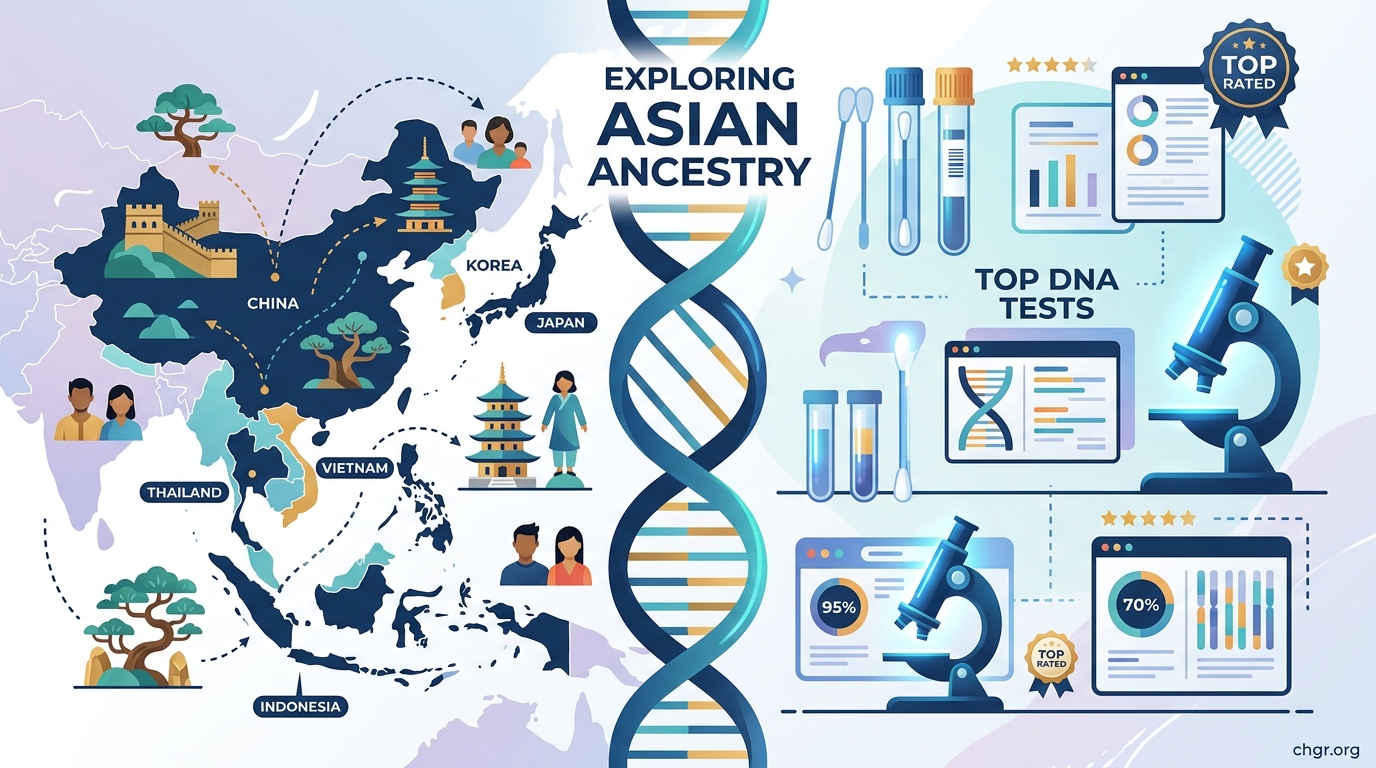
When I first started researching my own East Asian heritage, I quickly discovered that DNA testing for Asian ancestry works differently than it does for European backgrounds. Asia contains more genetic diversity than any other continent, yet most DNA testing companies built their databases primarily on European samples. This creates unique challenges for anyone seeking accurate, detailed results about their Asian roots.
In this guide, I will walk you through everything our team learned from analyzing the major DNA testing services for Asian and East Asian ancestry in 2026. You will discover which companies offer the most detailed regional breakdowns, which have the largest Asian sample databases, and how to choose the right test based on your specific goals.
Whether you are trying to connect with biological family, understand your ethnic heritage at a deeper level, or simply satisfy your curiosity about where your ancestors came from, choosing the right DNA test matters.
Table of Contents
- Why Asian Ancestry DNA Testing Is More Complex
- Top DNA Testing Services for Asian and East Asian Ancestry
- Regional Coverage by Company
- How to Choose the Best DNA Test for Your Goals
- Privacy and Data Considerations
- Traditional Asian Genealogical Records
- Frequently Asked Questions
- What is the best DNA test for Southeast Asia?
- Is 23andMe worth it for Asians?
- Which DNA test is the most accurate for ethnicity?
- Are Asians genetically closer to Europeans or Africans?
- What factors make a DNA test kit best suited for Asian ancestry?
- How accurate are DNA test kits in tracing Asian ancestry?
- Can I find relatives in Asia with these DNA test kits?
- Are there privacy concerns with DNA test kits?
- Final Thoughts
Why Asian Ancestry DNA Testing Is More Complex
Asian populations present unique challenges for DNA testing companies. The continent stretches from the Middle East to Japan, encompassing thousands of ethnic groups with distinct genetic signatures. Many people do not realize that Asia contains more genetic diversity than Europe, Africa, and the Americas combined.
The Reference Panel Problem
DNA testing works by comparing your genetic markers against reference panels. These panels contain DNA samples from populations with known geographic origins. When you submit your sample, the algorithm searches for matches and calculates your ethnicity estimates based on similarity to these reference groups.
For decades, most DNA testing companies built their reference panels primarily from European populations. This means someone with primarily European ancestry might see results breaking down into 15 different regions, while someone with Asian ancestry might receive a frustratingly vague “100% East Asian” result. The accuracy gap stems from insufficient Asian samples in the database, not from any biological difference.
Genetic Diversity Within Asia
East Asia alone encompasses dozens of distinct populations. Chinese genetic diversity spans multiple regions, from Guangdong in the south to Beijing in the north. Japanese populations show regional variations between Honshu, Kyushu, and Okinawa. Korean populations have their own unique genetic markers.
Southeast Asia adds another layer of complexity. Vietnamese, Thai, Filipino, and Indonesian populations each carry distinct genetic signatures shaped by thousands of years of migration, trade, and isolation. A quality DNA test for Asian ancestry must account for this diversity, not treat the continent as a monolithic block.
Why This Matters for Your Results
The quality of your results depends entirely on how well your testing company understands these genetic variations. A company with only 500 Chinese samples in its reference panel cannot distinguish between northern and southern Chinese ancestry. One with 50,000 samples across multiple Asian regions can provide far more specific insights.
Our research found that the best DNA tests for Asian ancestry in 2026 have invested heavily in expanding their Asian reference panels. Some now offer breakdowns into sub-regions that were impossible to detect just five years ago.
Top DNA Testing Services for Asian and East Asian Ancestry
After analyzing user reports, scientific publications, and company data, our team identified several DNA testing services that stand out for Asian ancestry research. Each offers different strengths depending on your specific background and goals.
23andMe: Most Detailed East Asian Breakdown
23andMe currently leads the market for detailed Asian ancestry breakdowns. Their reference panel includes over 71,000 samples from Asian populations, allowing them to distinguish between Chinese, Japanese, Korean, and Southeast Asian ancestry with reasonable accuracy.
For Chinese ancestry specifically, 23andMe offers regional breakdowns that can identify northern Chinese, southern Chinese, and even specific provinces in some cases. Users with Japanese ancestry report seeing distinctions between mainland Japanese and Okinawan populations. Korean users receive results that separate Korean ancestry from neighboring regions.
The 23andMe Ancestry + Traits service provides ethnicity estimates, relative matching, and trait reports. Their Health + Ancestry package adds health predisposition reports, which include some conditions more prevalent in Asian populations. The company continues expanding its Asian reference panels, meaning results may become even more detailed over time.
AncestryDNA: Largest Database for Finding Relatives
AncestryDNA boasts the largest consumer DNA database in the world, with over 25 million users. For people seeking to find biological relatives, particularly in the United States, Canada, and other Western countries, this database size provides a significant advantage.
AncestryDNA offers Asian ethnicity estimates broken down into regions including China, Japan, Korea, and various Southeast Asian populations. Their reference panel includes thousands of Asian samples, though they provide slightly less granular regional detail than 23andMe for some populations.
Where AncestryDNA truly shines is relative matching. If you are adopted or searching for biological family members who may have also tested, the probability of finding matches increases with database size. Many users report successfully connecting with biological parents, siblings, and extended family through AncestryDNA matches.
The company also integrates with Ancestry’s massive genealogical record database. While Asian genealogical records can be harder to access than European ones, Ancestry has been expanding its Asian record collections, including some Chinese and Japanese datasets.
WeGene and 23MoFang: China-Specific Specialists
For people with primarily Chinese ancestry, WeGene and 23MoFang offer specialized services that may provide more detail than Western companies. These Chinese-based DNA testing services built their reference panels specifically around East Asian populations.
WeGene focuses heavily on Chinese genetic diversity. Their database contains samples from Han Chinese populations across different provinces, allowing for more specific regional identification within China. They also offer analysis of minority ethnic groups within China, including Tibetan, Mongolian, and Uyghur populations.
23MoFang similarly specializes in Chinese ancestry but also covers broader East Asian populations. Users report receiving detailed breakdowns distinguishing between northern Han, southern Han, and various Chinese ethnic minorities. The service is particularly popular among overseas Chinese seeking to understand their specific ancestral origins.
Both services offer English-language options, though the interfaces may be less polished than Western competitors. Privacy policies differ from US-based companies, which some users view as an advantage while others prefer the regulatory oversight of American companies.
MyHeritage DNA: Affordable Alternative with Good Features
MyHeritage DNA offers a more affordable entry point into DNA testing while still providing solid Asian ancestry analysis. Their ethnicity estimates include East Asian categories, and their database, while smaller than AncestryDNA, continues growing rapidly.
The company excels at combining DNA results with genealogical record searches. Their historical record database includes resources useful for Asian ancestry research, particularly for Jewish, European, and increasingly Asian populations. They also offer a chromosome browser tool for advanced users who want to analyze their DNA matches in detail.
MyHeritage frequently runs sales that bring test prices below $60, making it an attractive option for those who want basic ancestry information without a large investment. The company also allows raw DNA data uploads from other testing services, providing additional analysis for free or low cost.
FamilyTreeDNA: Advanced Tools for Serious Researchers
FamilyTreeDNA offers the most comprehensive suite of testing options, including autosomal DNA, Y-DNA, and mitochondrial DNA tests. For Asian ancestry researchers interested in deep paternal or maternal lineage tracing, these additional tests provide information unavailable from standard autosomal tests.
Y-DNA testing traces your direct paternal line, potentially revealing ancient migration routes and connecting you with distant male-line relatives. For Asian populations, this can reveal connections to specific Y-DNA haplogroups common in East Asia. Mitochondrial DNA testing similarly traces your direct maternal line.
The company offers a chromosome browser, ancient DNA matching, and various project tools for collaborating with other researchers. Their Asian reference panels have grown substantially in recent years, improving ethnicity estimate accuracy.
GEDmatch: Free Tools for Advanced Analysis
GEDmatch is not a DNA testing company but rather a free platform that accepts raw DNA data from other testing services. For Asian ancestry researchers, particularly adoptees seeking biological family, GEDmatch provides powerful tools unavailable elsewhere.
The platform allows you to upload your raw DNA data and compare it against users from multiple testing companies simultaneously. This increases your chances of finding matches, as someone who tested with AncestryDNA can match with someone who used 23andMe through GEDmatch.
GEDmatch offers various admixture calculators specifically designed for different populations, including several that provide alternative views of Asian ancestry. The platform has been instrumental in reuniting many Chinese adoptees with biological families, making it an essential tool for that community.
The site includes both free and tiered subscription options. The free tier provides substantial functionality, while the paid tier adds enhanced matching and analysis tools.
Regional Coverage by Company
Not all DNA testing companies define “Asian ancestry” the same way. Understanding how each company categorizes Asian populations helps set realistic expectations for your results.
Chinese Ancestry Coverage
23andMe currently offers the most detailed Chinese ancestry breakdown among Western testing companies. Their results can distinguish between northern Chinese, southern Chinese, and Chinese diaspora populations in some cases. WeGene and 23MoFang provide even more specific regional breakdowns within China, sometimes identifying provincial-level ancestry.
AncestryDNA identifies Chinese ancestry but typically provides less sub-regional detail than 23andMe. MyHeritage and FamilyTreeDNA offer Chinese categories but may group some Chinese populations with broader East Asian categories depending on genetic similarity.
Japanese Ancestry Coverage
Japanese ancestry tends to be genetically distinct, making it relatively easy for DNA tests to identify. Most major companies can distinguish Japanese ancestry from Korean and Chinese populations. 23andMe and AncestryDNA both provide Japanese categories, with 23andMe sometimes offering distinction between mainland Japanese and Okinawan ancestry.
The relatively isolated nature of Japanese populations means Japanese genetic signatures are well-defined in reference panels. Users with Japanese ancestry generally report consistent results across testing platforms, though regional specificity varies by company.
Korean Ancestry Coverage
Korean ancestry is genetically distinct but shows some overlap with neighboring populations. Most testing companies can identify Korean ancestry as a separate category, though the specificity varies. 23andMe and AncestryDNA both offer Korean ethnicity categories.
Some Korean users report seeing small percentages of neighboring populations in their results, which may reflect historical migration patterns or the genetic similarity between Korean and some Chinese and Japanese populations. Companies with larger Korean reference samples tend to produce more accurate Korean-specific results.
Southeast Asian Ancestry Coverage
Southeast Asian ancestry presents the most variation in testing company coverage. Vietnamese ancestry is fairly well-represented in major databases, with most companies offering Vietnamese categories. Thai, Filipino, Indonesian, and other Southeast Asian populations may be grouped into broader categories or represented by fewer reference samples.
23andMe offers the most Southeast Asian regional categories among Western companies, including Vietnamese, Indonesian, Thai, Khmer, and Filipino categories. AncestryDNA also covers major Southeast Asian populations. Coverage for smaller ethnic groups within Southeast Asia remains limited across all platforms.
South Asian Ancestry Coverage
South Asian ancestry, including Indian, Pakistani, Bangladeshi, and Sri Lankan populations, is treated separately from East Asian ancestry by most testing companies. The genetic diversity within South Asia is tremendous, and different companies handle this region with varying levels of detail.
23andMe and AncestryDNA both offer detailed South Asian breakdowns, sometimes distinguishing between northern and southern Indian populations and identifying specific ethnic groups. For people with mixed South and East Asian ancestry, results may show both categories or intermediate populations depending on the company algorithms.
How to Choose the Best DNA Test for Your Goals
Your ideal DNA test depends on what you hope to discover. Different services excel at different objectives, and your specific ancestry background also influences the best choice.
For Detailed Regional Breakdowns
If your primary goal is understanding exactly where in Asia your ancestors came from, 23andMe currently offers the most detailed ethnicity estimates for East Asian populations. Their reference panel size and regional specificity surpass competitors for Chinese, Japanese, and Korean ancestry.
For primarily Chinese ancestry, WeGene or 23MoFang may provide even more specific regional detail. These services built their databases specifically around Chinese genetic diversity and can sometimes identify provincial-level ancestry.
For Finding Biological Family
If you are adopted, searching for biological parents, or hoping to connect with unknown relatives, database size matters most. AncestryDNA has the largest database, giving you the highest probability of finding matches. Start here if finding relatives is your primary goal.
Adoptees from China should also upload their raw DNA data to GEDmatch. Many Chinese adoptees and biological families use this free platform specifically because it works across testing companies. The platform has facilitated numerous reunions that would have been impossible within a single company’s database.
For Health Insights
If you want health information alongside ancestry results, 23andMe Health + Ancestry is the most comprehensive option. Their health reports include carrier status for various conditions, health predisposition reports, and wellness traits.
Some health conditions are more prevalent in certain Asian populations. 23andMe includes reports relevant to Asian ancestry, though you should consult healthcare providers about any health concerns rather than relying solely on DNA test results.
For Budget-Conscious Testing
MyHeritage DNA frequently offers the lowest prices, sometimes dropping below $60 during sales. While their Asian ancestry detail may not match 23andMe, they provide solid ethnicity estimates and relative matching at a budget-friendly price point.
Remember that you can often upload raw DNA data from one company to another service for additional analysis. Testing with one company and uploading to others can maximize your information while minimizing costs.
For Advanced Genetic Research
If you want to dive deep into your genetic history, FamilyTreeDNA offers the most comprehensive testing suite. Their Y-DNA and mtDNA tests reveal paternal and maternal lineages going back thousands of years. These tests are particularly valuable for understanding deep ancestry and ancient migration patterns.
The company also offers project tools for collaborating with other researchers studying specific populations or genetic lines. For serious genealogy researchers, these tools provide capabilities unavailable elsewhere.
Privacy and Data Considerations
Before submitting your DNA, understand how companies handle your genetic information. Privacy concerns are particularly relevant for Asian communities, where cultural attitudes toward genetic data sharing may differ from Western norms.
Understanding Data Usage Policies
Each DNA testing company has different policies regarding how they use your genetic data. Some may use anonymized data for research purposes. Others may share data with law enforcement under certain circumstances. Read privacy policies carefully before testing.
Most companies allow you to delete your data and destroy your physical sample. Some also offer options to opt out of research programs or law enforcement matching. Understanding these options helps you maintain control over your genetic information.
Regulatory Differences
US-based companies operate under American privacy regulations, which may differ from those in other countries. Chinese companies like WeGene and 23MoFang operate under Chinese regulations, which some users prefer and others avoid depending on their privacy priorities.
The European Union’s GDPR provides strong genetic privacy protections for EU residents. If you live in Europe, you have specific rights regarding your genetic data that companies must respect.
Protecting Your Information
Consider using a pseudonym when registering for DNA testing if you have privacy concerns. You can also use the privacy settings available on most platforms to limit who can see your profile or contact you.
Be thoughtful about what information you share in your profile. While openness helps with relative matching, you control how much personal detail to reveal. Start with minimal information and share more only as you become comfortable with the platform.
Traditional Asian Genealogical Records
DNA testing works best when combined with traditional genealogical research. While Asian record-keeping traditions differ from Western practices, valuable resources exist for those seeking to understand their ancestry.
Chinese Genealogical Records (Jiaupu and Zupu)
Chinese families maintained detailed genealogical records called jiaupu or zupu for centuries. These records trace family lines back dozens of generations, recording births, deaths, marriages, and sometimes biographical details. Many Chinese families, particularly those with notable ancestors, preserved these records carefully.
Some jiaupu have been digitized and are accessible through Chinese genealogical websites or libraries. For overseas Chinese seeking to connect with ancestral villages, these records can provide invaluable information about family origins and relationships.
Japanese Koseki Records
Japan maintains comprehensive family registry records called koseki that document family relationships going back generations. These records are maintained by local governments and can be accessed by family members or their representatives.
For Japanese Americans and others of Japanese descent, accessing koseki records may require navigating Japanese bureaucracy or hiring researchers in Japan. However, these records can provide detailed information unavailable through DNA testing alone.
Korean Family Registers (Hojok)
Korea also maintained family registry systems, though historical records were affected by various conflicts and political changes. Modern Korean family records are maintained electronically, and accessing older records may require specialized research.
Korean genealogical associations and cultural organizations sometimes maintain clan records that can help people trace their ancestry back to specific regions or clan founders.
Temple and Clan Records
Throughout Asia, temples and clan organizations maintained records of families associated with them. Buddhist temples in Japan, clan associations in China, and similar institutions across Asia preserved genealogical information as part of their religious and social functions.
These records can be challenging to access, particularly for those outside the country of origin, but they represent rich sources of information for dedicated researchers. Combining DNA results with traditional record research often yields the most complete picture of ancestry.
Frequently Asked Questions
What is the best DNA test for Southeast Asia?
23andMe currently offers the most detailed Southeast Asian ancestry breakdown among major testing companies. They provide specific categories for Vietnamese, Indonesian, Thai, Khmer, and Filipino populations. AncestryDNA also covers Southeast Asian populations but may provide slightly less regional detail. For people with mixed Southeast Asian ancestry, testing with multiple companies can help identify patterns that single tests might miss.
Is 23andMe worth it for Asians?
Yes, 23andMe is generally considered the best option for people with Asian ancestry seeking detailed regional breakdowns. They have invested heavily in Asian reference panels and can distinguish between Chinese, Japanese, Korean, and Southeast Asian populations with reasonable accuracy. Many Asian users report receiving specific regional results rather than generic East Asian categories. The health insights package also includes reports relevant to Asian populations.
Which DNA test is the most accurate for ethnicity?
Accuracy depends on your specific ancestry background. For East Asian populations, 23andMe currently leads in regional specificity. For finding relatives, AncestryDNA has the largest database and highest match probability. For Chinese ancestry specifically, WeGene and 23MoFang may provide more detailed results than Western companies. The most accurate approach combines multiple tests and uploads raw data to GEDmatch for cross-platform comparison.
Are Asians genetically closer to Europeans or Africans?
Genetically, all humans share the vast majority of DNA. However, Asian populations show greater genetic diversity within the continent than exists between any Asian population and European populations. East Asian populations cluster more closely with each other than with European or African populations, reflecting ancient migration patterns. All non-African populations share ancestry from the original human migrations out of Africa approximately 70,000 years ago.
What factors make a DNA test kit best suited for Asian ancestry?
The key factors are reference panel size for Asian populations, regional specificity offered, database size for relative matching, and privacy policies. Look for companies that specifically mention their Asian sample counts. Larger reference panels produce more accurate, specific results. For finding relatives, larger databases matter more. Some users prefer companies with strong privacy protections or specific data handling policies.
How accurate are DNA test kits in tracing Asian ancestry?
Accuracy varies by company and specific ancestry. Major companies can reliably distinguish East Asian from European or African ancestry. Distinguishing between Chinese, Japanese, and Korean ancestry is reasonably accurate with quality tests. Sub-regional specificity within countries varies significantly between companies. Results improve as reference panels grow, so testing in 2026 yields better results than tests from five years ago. Raw data uploads to multiple platforms can improve accuracy through cross-validation.
Can I find relatives in Asia with these DNA test kits?
Finding relatives currently living in Asia is challenging because most consumer DNA testing has been adopted primarily in Western countries. Your best chance comes from testing with companies popular among Asian diaspora communities. AncestryDNA has the largest overall database, increasing match probability. GEDmatch is particularly valuable for Chinese adoptees seeking biological family. As DNA testing grows in popularity across Asia, the probability of finding matches with relatives in Asia will increase.
Are there privacy concerns with DNA test kits?
Yes, genetic privacy is an important consideration. DNA data is uniquely identifiable and permanent. Companies have different policies regarding data usage, research participation, and law enforcement access. Read privacy policies carefully before testing. Most companies allow data deletion and sample destruction. Consider using pseudonyms and limiting profile information. Some users prefer companies based in jurisdictions with strong genetic privacy laws. Chinese companies operate under different regulations than American ones, which some users view positively and others avoid.
Final Thoughts
Choosing the best DNA test for Asian ancestry in 2026 depends on your specific goals and background. For detailed East Asian regional breakdowns, 23andMe leads the market. For finding biological relatives, AncestryDNA’s massive database provides the best odds. For Chinese ancestry specifically, WeGene and 23MoFang offer specialized analysis.
Remember that DNA testing represents just one tool in your ancestry research toolkit. Combining genetic results with traditional genealogical research, family stories, and historical records yields the richest understanding of your heritage. Many researchers find value in testing with multiple companies and uploading raw data to GEDmatch for comprehensive analysis.
The technology continues improving rapidly. Reference panels grow monthly, and algorithms become more sophisticated. If you tested five years ago and received vague results, consider retesting or reanalyzing your raw data. The DNA test for Asian ancestry you take today will likely provide more detail than ever before possible.