

Fins get pulled on at the end of warm-up and come off at the wall halfway through the set, and they change the way a lap feels more than almost any other piece of pool gear. A fin adds surface area to every kick, so the water pushes back harder and your legs do the work instead of your shoulders. Used the right way, that is the cheapest way to add real yardage to a week of lap swimming.
Used the wrong way, fins teach you bad habits and leave your feet aching. The difference comes down to blade length, heel type, and fit, and those three choices matter far more than brand. This guide covers the best swim fins for lap swimming in 2026, with 12 options tested and compared across rubber, silicone and foam constructions.
I have been logging pool time with a mixed bag of fins for years, mostly short-blade sets and long-blade technique work, and the same rule shows up every time. Keep your fin volume to roughly 5 to 10 percent of your weekly distance, and the gains in kick strength and body position transfer straight into unfinned swims. Swimmers on r/Swimming repeat that number often, and they are right about it.
If you also need fins for open water or travel, our guides to the best snorkeling fins for travel and the best diving fins for scuba divers cover the other end of the size and stiffness range.
Table of Contents
- Top 3 Picks for Lap Swimming Training in 2026
- Every Fin in This Roundup at a Glance
- 1. FINIS Long Floating Swim Fins – Best All-Rounder for Lap Swimming
- 2. CAPAS Short Blade Fins – Best Value for Everyday Lap Sets
- 3. Speedo Rubber Long Blade Fins – Best Budget Long Blade Trainer
- 4. FINIS Zoomers Gold – Best Classic Short Blade for Natural Kick Tempo
- 5. Speedo Switchblade – Best for Raising Kick Cadence
- 6. Arena Powerfin Pro II – Best Premium Silicone Fin for Competitive Swimmers
- 7. Speedo Silicone Training Fins – Best for Long Comfortable Sessions
- 8. FINIS Z2 Gold Zoomers – Best for Hamstring and Glute Strength Work
- 9. Sporti Long Floating Fins – Best for Beginners and Younger Swimmers
- 10. Arena Lightweight Silicone Fins – Best Lightweight Fin for Technique First Swimmers
- 11. TYR Burner 2.0 – Best for Pool Deck Safety and Short Kick Technique
- 12. TYR Flexfins 2.0 – Best Long Blade for Ankle Mobility Work
- How to Choose Swim Fins for Lap Swimming
- Why Fins Change the Way You Swim
- Fin Workouts and Sets for Lap Swimming
- Fin Care: Making Rubber and Silicone Last
- Frequently Asked Questions
- Final Verdict: Which Swim Fins to Buy in 2026
Top 3 Picks for Lap Swimming Training in 2026
Every Fin in This Roundup at a Glance
| Product | Specifications | Action |
|---|---|---|
 FINIS Long Floating Swim Fins FINIS Long Floating Swim Fins |
|
Check Latest Price |
 CAPAS Short Blade Pool Lap Fins CAPAS Short Blade Pool Lap Fins |
|
Check Latest Price |
 Speedo Rubber Long Blade Fins Speedo Rubber Long Blade Fins |
|
Check Latest Price |
 FINIS Zoomers Gold FINIS Zoomers Gold |
|
Check Latest Price |
 Speedo Switchblade Speedo Switchblade |
|
Check Latest Price |
 Arena Powerfin Pro II Arena Powerfin Pro II |
|
Check Latest Price |
 Speedo Silicone Training Fins Speedo Silicone Training Fins |
|
Check Latest Price |
 FINIS Z2 Gold Zoomers FINIS Z2 Gold Zoomers |
|
Check Latest Price |
 Sporti Long Floating Fins Sporti Long Floating Fins |
|
Check Latest Price |
 Arena Lightweight Silicone Fins Arena Lightweight Silicone Fins |
|
Check Latest Price |
 TYR Burner 2.0 TYR Burner 2.0 |
|
Check Latest Price |
 TYR Flexfins 2.0 TYR Flexfins 2.0 |
|
Check Latest Price |
1. FINIS Long Floating Swim Fins – Best All-Rounder for Lap Swimming
FINIS Long Floating Swim Fins – Adult Training Fins – Improves Kick Technique & Body Position – Blue/Yellow – XS
100% rubber
Buoyant long blade
Sizes XS-XXL
15.84 oz
Pros
- Maximum buoyancy holds legs at the surface
- Clear feedback for a longer kick
- Six sizes from XS to XXL
- Floats in fresh and salt water
Cons
- Long blade feels heavy over extended sets
- Rubber pocket can rub if sized tight
These are the fins I put on new swimmers first. The blade is buoyant enough that a relaxed kick still brings your heels up, which is the whole battle when your body position is still a work in progress. Buyers consistently credit them with easier kicking and better alignment rather than raw speed, and that matches what I see at the wall.
Eleven thousand reviewers at 4.5 stars makes this the most established trainer in the category, and the durability reflects that. Natural rubber holds up to pool chlorine year after year, and the 14 by 11 inch footprint means the blade carries real surface area without looking like a monofin.
Two things to know before you commit. First, the long blade changes your cadence. Your kick will slow down because each stroke displaces more water, so this is a technique fin, not a sprint fin. Second, size matters more here than with a short blade because the extra length has to clear the floor on every kick.
If your pool is short-course and you care about turnover, look at the short-blade picks further down. If you care about hips floating and a long, smooth kick, nothing else in this roundup does it as directly.
Who will like these fins most
Masters swimmers returning to the pool after years away, and any adult who has never held a streamline position for long. The buoyancy does the work while you relearn the basics. They also work well for underwater kicking sets where you are not swimming arms at all.
Beginner and returning swimmers are the other group. Because the fins keep the legs near the surface, the feedback loop between effort and movement is immediate, which makes them an easy confidence builder in the first month.
Where they fall short
They are wrong for race-pace work. The slow, big kick these fins encourage is the opposite of what you need for a 50 free, and trying to sprint in a 15.84 ounce long blade feels like dragging an anchor.
Long blades are also awkward on the pool deck. Walking from the car to the changing room in a 14 inch blade takes a little practice, and swimmers who do a lot of dryland between sessions sometimes prefer a short blade.
2. CAPAS Short Blade Fins – Best Value for Everyday Lap Sets
CAPAS Swim Training Fins, Short Blade Pool Lap Swimming Fins with Mesh Bag
Soft silicone pocket
Short blade
Closed heel
Sizes XS-XXL
Pros
- Soft silicone pocket stays comfortable
- Short blade builds ankle flexibility
- Six sizes XS to XXL
- Mesh storage bag included
- 4.6 stars from over 5400 reviewers
Cons
- Identical fins for both feet rather than mirrored
- Less buoyancy for body position work
This is the pair I recommend when someone asks for one fin that handles most lane sessions. The closed heel stops your foot from over-flexing during the kick, and the silicone pocket takes the sting out of a 400 free that would otherwise leave red marks across the top of the foot.
The rating tells the story. A 4.6 average across more than 5,400 reviews, with roughly 77 percent five-star ratings, is unusual consistency for pool gear. Reviewers mention the short-blade training feel and the comfort of the pocket far more often than anything negative.
The short blade means your kick tempo stays close to your natural unfinned rate. That is the point for most lap swimmers: you get resistance and leg strength without teaching yourself a slow, sweeping kick. My 8 by 100 fin sets feel natural in these because the mechanics barely change between finned and unfinned lengths.
Sizes run XS through XXL, which is unusually generous coverage from a single pair, and that matters for masters swimmers with wider feet. The included mesh bag is a small thing that stops wet rubber from sitting in a gym bag for a week.
Who will like these fins most
Regular lane swimmers doing one fin set a week. The fit holds up across hundreds of laps and the blade length suits a normal kick cadence. Beginners who want resistance without changing their stroke will find the closed heel reassuring, since it stops the ankle bending past where it should.
It is also a sensible first pair for anyone who has never swum in fins, because the learning curve is close to zero. Put them on, swim 400, take them off.
Where they fall short
Both fins are identical rather than shaped separately for each foot. Competitive swimmers who rotate legs may notice that one ankle gets a slightly different angle than the other, but for straight freestyle laps it makes no measurable difference.
The trade-off with any short blade is buoyancy. If your main goal is getting the hips up near the surface while you build technique, a floating long blade does more for you here.
3. Speedo Rubber Long Blade Fins – Best Budget Long Blade Trainer
Speedo Unisex-Adult Swim Training Fins Rubber Long Blade
100% natural rubber
Long blade
Soft orthopedic pocket
Pros
- Long blade adds power per kick
- Soft rubber stays flexible
- Orthopedic pocket suits long sessions
- Works for all levels
Cons
- Long blades are bulky on the pool deck
- Sized as a youth product
Over 6,000 reviews at 4.4 stars for a straightforward long-blade trainer. The soft orthopedic foot pocket is the detail that sets it apart from cheaper long blades, and it is why people keep these for a full hour rather than swapping them after 20 minutes.
The 100 percent natural rubber construction stays flexible in cold pool water and does not stiffen the way some rubber blends do by mid-season. Buyers mention durability more than any other feature, which is what you want from a fin you will leave in your swim bag year round.
Who will like these fins most
Anyone building leg strength for the first time, and swimmers coming back from a break who want a high-output fin without a premium price. The long blade generates plenty of resistance per kick, which keeps the set productive even at a comfortable pace.
Teaching and coaching settings work well here too, since the pocket is forgiving across a range of foot shapes. Sizes run from X-Small through XX-Large.
Where they fall short
It is listed as a youth product, and adult swimmers should expect to size up. Check the size chart against your shoe size rather than your age, which is the most common source of disappointment with long blades.
Long blades are simply bulkier to walk in. If you carry fins from a gym bag to the pool deck in sandals, plan for the extra few seconds.
4. FINIS Zoomers Gold – Best Classic Short Blade for Natural Kick Tempo
FINIS Zoomers Gold Swim Training Fins – Short Blade Design for Speed & Conditioning – Soft Natural Rubber Fit – Size D
Short blade
Soft natural rubber pocket
Euro size equivalents
Pros
- Encourages a fast efficient kick
- Soft rubber pocket is secure
- Improves range of motion
- Suit fitness and competitive swimmers
Cons
- Sizing runs narrow for some feet
- Listed weight is 0.7 kg
The Zoomers have been on pool decks for longer than most swimmers have been swimming, and for good reason. A short blade keeps your kick cadence honest, so the work you do in them carries over to unfinned freestyle without much translation.
More than 3,400 reviewers at 4.4 stars center on the same two things: the soft natural rubber pocket and the way the fin encourages a faster kick. The listing notes they are good for cardiovascular conditioning and speed work, which matches how most lane swimmers actually use them.
My fin-based descending sets, eight 100s coming down from around 1:15 per 100 to 1:05, are built around fins that do not fight the swimmer. The Zoomers sit in that pocket of resistance where you feel your legs working but your technique stays intact.
One caution on fit. Reviews repeatedly mention the sizing running narrow, so if you are between sizes or have a wide forefoot, consider sizing up and pairing with neoprene swim socks on the first few sessions. That combination is the most commonly repeated blister workaround in pool communities.
Who will like these fins most
Competitive swimmers and triathletes who want a fin that trains speed without slowing their tempo. The short blade keeps your kick rate close to race pace, so sets stay specific to the goal you are training for.
Fitness swimmers who want a fin light enough to forget about will also like the short profile. It packs flat into a bag and adds almost nothing to your walk from the car.
Where they fall short
Narrow fit is the recurring complaint. Wide forefoot swimmers should read the size chart carefully and expect to size up, otherwise the pocket presses on the widest part of the foot.
They do very little for body position. If your hips sink when you swim, you want a floating long blade instead, because buoyancy is the only thing that fixes a low hip position.
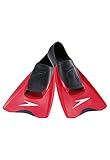
5. Speedo Switchblade – Best for Raising Kick Cadence
Speedo Unisex-Adult Swim Training Fin Rubber Medium Blade
10 degree angled blade
Extended foot pocket
Natural rubber
Pros
- Angled blade raises cadence safely
- Extended pocket suits long swims
- Soft rubber avoids blisters
- Compacts into a swim bag
Cons
- Size chart runs small
- Heel material reported to degrade with pool use
The Switchblade is built around a 10 degree blade angle, and that angle is the whole point. It maximizes the down kick segment so you get more propulsion per stroke, which is what lets you raise your cadence without your technique falling apart halfway through the set.
At 4.3 stars from more than 2,600 reviews, it is the lowest-rated fin in this roundup, and the gap between the love and the complaints is about fit rather than design. People who size correctly tend to rate it very highly on comfort, because the extended foot pocket handles 30 to 60 minute swims well.
For sprint and race-pace work this is the fin I would reach for when the goal is turnover. A short blade plus a directional angle gives you the sensation of pushing water without the huge drag of a long blade, so 50 free and 100 free sets stay sharp.
A small number of long-term pool users report the black heel degrading and tearing with regular use. If you swim four times a week, check the heel material every couple of months and replace early rather than working around a crack.
Who will like these fins most
Sprinters and anyone doing race-pace sets where cadence is the target. The angled blade is specifically designed to let a swimmer kick faster without sacrificing technique, which almost nothing else at this level of support does.
Coaches looking for a fin that will not break a good habit are well served here. The angle rewards a down kick rather than letting swimmers cheat with a slow sweep.
Where they fall short
The size chart is the main trap. Several buyers needed to size up, and if you order on the borderline you will know immediately. Treat the published chart as a starting point and expect to move up one.
At 4.3 stars this is the least universally loved option here, mostly on heel durability. If you have bought before and had heel problems, a silicone fin will age better.
6. Arena Powerfin Pro II – Best Premium Silicone Fin for Competitive Swimmers
Arena Unisex Adult Powerfin Pro II Swim Training Fins Men and Women Silicone Short Blade Flippers Left/Right Customized, Black, Size 9.5-10.5
PVC-free silicone
Open heel
Hydrodynamic slits
800 g
Pros
- Shaped separately for each foot
- Open heel frees the ankle
- Silicone cuts blister risk
- Top tier technique tool
Cons
- Heavier than basic short blade trainers
This is the fin I put on a competitive swimmer who is already moving well and wants to refine the kick rather than build it from scratch. The molded shaping for each foot and the open heel together give a genuinely different down kick, and you can feel your ankle articulate through the full range instead of fighting a closed pocket.
Roughly 80 percent of more than 2,200 reviewers give five stars, the highest five-star share of any fin in this roundup. The recurring theme is that it does not create blisters even through intensive training, and long-life silicone is the reason.
The hydrodynamic slits on the top surface and the side grooves with bottom rib notches do real work. Water moves along the blade instead of churning at it, and the sloping surface gives you better control of where your fin is pointing at the bottom of the kick.
It is listed at 800 grams, which is noticeably heavier than a basic short-blade trainer, and that weight is the honest trade-off. You get a premium, purpose-built blade and a fit designed for technique; you give up some of the feather-light feel of an EVA foam fin.
Who will like these fins most
Club and collegiate swimmers working on kick mechanics, especially anyone whose coach has told them to feel the down kick. The mirrored shaping and open heel give real ankle freedom, and the sizes run 4.5 to 13.5 with paired sizing.
Swimmers with blister problems on stiff rubber should look here first. Long-life silicone is the single most effective change you can make if your feet get raw in rubber fins.
Where they fall short
It is the heaviest and most expensive option in the group, and that combination makes it a hard sell for a casual lane swimmer who swims 1,000 metres a week.
Open heel also means it will not hold your foot in place the way a closed pocket does. Swimmers who need the ankle held stable should test it in a shallow end first.
7. Speedo Silicone Training Fins – Best for Long Comfortable Sessions
Speedo Unisex-Adult Swim Training Fins Silicone
SILFORM silicone
Reverse V Rail
Universal foot cavity
Pros
- Soft silicone reduces fatigue
- Quick on and off cavity
- Works for pool and bodysurfing
- Reverse V Rail aids kicking
Cons
- Universal cavity suits a narrower foot range
The soft SILFORM material is the headline here. Around 1,400 reviews at 4.5 stars with 74 percent five-star ratings, and the word that keeps coming up is fatigue, not power. Swimmers report finishing long sessions with their feet in noticeably better shape than with stiffer rubber.
The universal foot cavity is the other thing I appreciate on a lap-swimming schedule. Fins that slip on and off quickly matter more than they sound like they should, because the friction of wrestling a foot pocket on a wet pool deck is what makes people skip fin sets.
Reverse V Rail technology is the design detail worth understanding. The rails give the fin a controlled torque through the kick so it stays aligned with your leg, and the center drain chute disperses water evenly instead of letting it slosh and pull the fin out of shape.
It is also a genuinely versatile fin. The brand positions it for fitness swimming and bodysurfing, and swimmers do use it in open water, where the softness over the top of the foot is a real advantage when you are in a wetsuit.
Who will like these fins most
Anyone doing high-volume fin sessions in one sitting. If your plan is 2,000 to 3,000 metres in fins across a workout, comfort matters more than maximum resistance, and this is the pair I would pick.
It is also a good crossover fin for open water swimmers who do not want a second specialised pair. The silicone is soft enough for rocks, wetsuit use and long days on the water.
Where they fall short
The universal cavity fits a narrower range of foot shapes than a fin with a full anatomical pocket. If you have a particularly wide or narrow foot, expect less precision than a custom-shaped silicone fin.
It does not float. For swimmers whose main goal is lifting the hips at the surface, that rules it out in favour of a buoyant long blade.
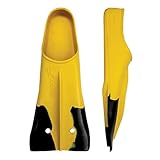
8. FINIS Z2 Gold Zoomers – Best for Hamstring and Glute Strength Work
Finis Youth Zoomer Z2 Fins, Gold – E
Short blade
Flex box and fluid separator
Closed heel
0.45 kg
Pros
- Targets hamstrings and glutes
- Fluid separator cuts quad fatigue
- Closed heel adds range of motion
- Natural rubber build
Cons
- Smaller buyer base than flagship FINIS fins
The Z2 is the strength fin in the FINIS range, and the mechanism is specific. A flex box on the underside of the blade targets the hamstrings and glutes, while a fluid separator on the top reduces the load your quads take on the down kick. That combination is why swimmers use it for kick sets rather than for technique refinement.
About 1,265 reviews at 4.4 stars. Owners specifically like the reduced quad fatigue on the down kick, which is the complaint I hear most from swimmers who train hard in long blades and feel their knees by Thursday.
At 0.45 kilograms listed, it is the lightest specification among the short-blade natural rubber options here. Light enough that you can do repeated 50s at race pace without the fin dragging, which is exactly what a strength fin needs to be useful.
The closed heel is doing something useful for you too. It holds the foot in a fixed relationship to the leg, which lets you isolate the kick without the ankle compensating, and the brand links this to improved flexibility and range of motion.
Who will like these fins most
Swimmers whose legs need building but whose quads fatigue first. The fluid separator exists precisely for that pattern, and it makes high-volume kick sets far more survivable.
Six sizes are offered, and the short blade makes this a good pick for anyone who wants resistance without the buoyancy distraction. It is a good fin for masters swimmers doing strength-oriented kicking work.
Where they fall short
The buyer base is smaller than the flagship FINIS long fins, so there is less long-term feedback and a weaker sales rank. You will not find the same volume of multi-year owner reports.
It is a strength tool rather than a technique tool. If your problem is that your hips sink, this fin will not address it, because it does not float.
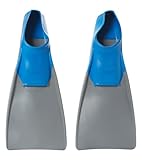
9. Sporti Long Floating Fins – Best for Beginners and Younger Swimmers
Sporti Essential Floating Swim Fins (Color) – M 7-8 / W 8-9 (Greyblue)
Angled long blade
Midfoot flex points
Color-coded sizes
Pros
- Angled blade drives the down kick
- Midfoot flex points reduce cramping
- Extended pocket suits long sessions
- Sizes span toddler to adult
Cons
- Soft pocket may arrive out of shape
Buoyancy is the headline here, and it is the reason these are such a good beginner fin. The blade floats in both fresh and salt water, so your legs stay near the surface even when you are swimming slowly enough to think about your position.
A 4.6 average from 515 reviews, with about 81 percent five-star ratings. That is the highest five-star share in the group, and the reviews mention the angled blade and the extended pocket most often.
Two design details are worth knowing. The midfoot flex points are advertised to reduce cramping, which matters more than it sounds because a cramped foot ends a lap session early. The sculpted side rails are meant to engage hip rotation, and that is where the extra down kick drive comes from.
Sizing is colour-coded and you order by shoe size rather than age, which is far more useful than most brands manage. The range runs from toddlers through adults, so one pair covers a whole family. Listed at 2.1 pounds.
Who will like these fins most
Beginners and anyone whose hips drop in the water. Long floating fins are the standard recommendation for a reason: they make correct position feel easy while the strength to hold it is still developing.
They are also good for kick sets in shallow water, because the blade keeps your feet from dragging along the bottom when the depth is marginal.
Where they fall short
A light coating of silicone oil or white powder on rubber products is normal, and a few buyers thought the soft pocket had arrived misshapen from the packaging. Check the shape before your first swim and let the pocket relax if needed.
Long blades are never ideal for race-pace work. If you want turnover, use these for technique and go short blade for speed.
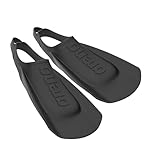
10. Arena Lightweight Silicone Fins – Best Lightweight Fin for Technique First Swimmers
Arena Unisex Adult Comfortable Lightweight Swim Training Fins for Men and Women Silicone Short Blade Flippers Open Heel Design, Black, 11-12
PVC-free thermoplastic elastomer
Open heel
Short blade
700 g
Pros
- Light and comfortable for long sets
- Short blade lifts kick frequency
- Open heel moves naturally
- Beginner to advanced
Cons
- Not built for maximum propulsion
- Fit runs snug at first
This is the fin that does least for you in the water and most for you in the process. It adds resistance and light propulsion without letting you cheat your technique, and around 79 percent of 218 reviewers give it five stars.
The material is thermoplastic elastomer rather than silicone or natural rubber, and it is explicitly PVC-free. The brand describes it as long-lasting soft material that reduces blister risk, and reviewers back that up by calling it comfortable for extended sets.
At 700 grams it is lighter than the premium silicone fin above it, and the open heel construction means it moves with your ankle instead of pinning it. For a swimmer learning to feel the kick, that freedom usually helps more than extra surface area.
The hydrodynamic slits and smooth surfaces are intended to enhance power and technique, and the brand also positions it as reducing overstrain and cramping. Sizes run from 4.5 to 13.5 in paired sizing.
Who will like these fins most
Technique-focused swimmers who want feedback without propulsion. If you are worried that fins are letting you hide a bad catch or a sinking hip, this is the fin least likely to let you get away with it.
Beginners moving up from a purely instructional stage also suit this. It is light, forgiving and easy to move in.
Where they fall short
It is not designed for maximum propulsion, so anyone chasing power or speed in fins will find it underwhelming. Buy it for control, not for output.
Fit runs snug at first and can require stretching, and a few reviewers found the ankle strap loosens on certain sizes. Check the strap before you trust it in a set.
11. TYR Burner 2.0 – Best for Pool Deck Safety and Short Kick Technique
TYR Unisex Adult Burner Fins 2.0 Footwear, Black/White, Large US
100% natural rubber
Thickened foot pocket
No-slip grip heel
16 oz
Pros
- Thickened pocket for long sets
- Rounded edges reduce rubbing
- No-slip grip heel base
- Colour-coded sizes XS to XL
Cons
- Sizing between sizes is a guessing game
- Not built for maximum propulsion
The Burner is built for short, quick leg and foot movement, which is exactly the emphasis most lane swimmers want from a training fin. You get a compact blade that promotes a tight kick pattern rather than a long sweep, and the whole thing stays close to your foot.
368 reviews at 4.4 stars, with buyers highlighting two things: the thicker foot pocket and the no-slip grip on the heel base. The 2.0 revision specifically thickened the pocket to prevent discomfort in longer sessions.
Who will like these fins most
Swimmers who walk barefoot around a wet pool deck with fins on. The universal no-slip grip heel base and rounded edge design reduce both slipping and rubbing, which is unusual attention to detail for a trainer.
Technique work suits it too. Because the blade is compact, this is a good fin for drills where you want to feel your foot and ankle rather than your legs.
Where they fall short
The most common question in reviews is how to size between a large and an extra-large foot, and there is no perfect answer. Order on shoe size and be prepared to size down rather than up, since a long rubber pocket on a big foot is what creates blisters.
It will not give you meaningful propulsion, so it is a poor choice for endurance kicking where you want resistance.
12. TYR Flexfins 2.0 – Best Long Blade for Ankle Mobility Work
TYR Flexfins 2.0 – Unisex Natural Rubber Fins for Swim Training, X-Large
Natural rubber
Long blade
Full-foot fit
16 oz
Pros
- Long blade builds leg strength
- Full-foot rubber suits long swims
- Colour-coded sizing from XXXS to XXL
- Good for focused kick sets
Cons
- Bulky to walk in around the pool
The Flexfins are the long-blade option for anyone whose goal is ankle flexibility and foot range rather than buoyancy. The brand links regular training in these to improved foot flexibility, and a long blade that flexes properly does stretch the ankle through a much wider arc than a bare foot ever does.
361 reviews at 4.3 stars, tied for the lowest average in this roundup, and the feedback is consistent. Swimmers like the long blade for kick mechanics and the full-foot natural rubber, and they mention bulk when carrying the fins around the pool.
At 19.7 inches long and 16 ounces, these are the largest blade footprint here, and that length is the point. You feel every kick because the fin resists it, and the resistance is what teaches the ankle to move through a full range.
Colour-coded sizing runs from XXXS through XXL, one of the wider ranges on the market and a genuine advantage for masters swimmers with larger feet who struggle to find fins in their size.
Who will like these fins most
Swimmers working on ankle mobility and leg strength, and anyone returning to swimming after a break where the ankle has stiffened up. A few minutes in these on a kick set does more for flexibility than a stretch on deck.
Long-blade fans who want size options will like the XXXS to XXL colour-coded range, which covers small children through very large feet.
Where they fall short
Bulk is the recurring complaint. Nineteen inches of blade is genuinely awkward on a pool deck and in a locker room, so these work best for swimmers who change at the side of the pool.
Like all long blades, they slow your cadence, which makes them a poor match for sprint or race-pace work.
How to Choose Swim Fins for Lap Swimming
The single most common mistake is buying the wrong blade length for your goal. Lap swimmers fall into two camps and want opposite things from a fin. If your hips sink and you are still building position, you want buoyancy. If your kick is solid and you want more speed or leg strength at race tempo, you want resistance.
Short blade vs long blade fins for lap swimming
Short blades are better for most lap swimming because they keep your kick tempo close to your natural unfinned rate, which means the strength you build transfers directly. Long blades are better for beginners, body position work and kicking drills because the buoyancy holds your hips at the surface while you learn.
Short blade fins measure roughly around the length of your foot. Long blades extend well past the heel and add meaningful propulsion per kick, which slows your cadence and makes sprint work nearly impossible.
Silicone vs rubber vs foam fins
Silicone is the softest option and the best answer if you blister in rubber. It is more expensive, and it does not always float. Natural rubber is the traditional trainer: durable, chlorine resistant, widely sized, and firm enough to feel resistance. Foam is the lightest and cheapest, but it compresses with use and loses its shape fastest.
If your feet get raw in stiff rubber, changing material solves more problems than changing brand. Soft silicone and thermoplastic elastomer options are the ones built specifically to reduce blister risk.
Open heel vs closed heel fins
A closed heel holds your foot in a fixed position and inhibits hyperflexion, which helps swimmers who need a stable platform. An open heel frees the ankle so you can articulate through a full range and push harder on the down kick, and it slips on and off faster.
Competitive swimmers usually prefer open heel for ankle freedom. Beginners and anyone doing technique work often prefer closed heel because it prevents the ankle bending past where it should.
Blade flex, stiffness and weight
Stiffer blades create more resistance, which builds strength faster. Softer blades are more comfortable and better for high-volume work. Listed weights in this roundup run from 0.45 kilograms for the FINIS Z2 Gold Zoomers up to 800 grams for the Arena Powerfin Pro II, and that spread changes how a set feels more than most buyers expect.
Heavier fins are not automatically better. A heavier fin feels powerful on the first few kicks and tiring by the tenth lap, so match weight to set length rather than to ambition.
Sizing and fit: how to stop blisters before they start
Order by shoe size, not by age. That single rule eliminates most sizing complaints across this category, and several brands in this roundup state it explicitly on the listing.
Size up if you are between sizes, especially for a closed heel pocket. Then wear neoprene swim socks for the first few sessions and drop them once the rubber takes the shape of your foot. Breaking in rubber fins gradually is the most repeated blister workaround swimmers share.
Watch for hot spots on the top of the foot rather than the toes. That is where rigid rubber presses hardest, and it is the reason the thickened pockets and silicone models on this list exist.
Fins for beginners, masters swimmers and bad knees
Beginners should start with a floating long blade. The buoyancy removes the hardest part of learning to swim, which is staying level, and lets you concentrate on breathing and arm stroke.
Masters swimmers should prioritise size range above everything else. Brands that run colour-coded sizing from XXXS to XXL give you far more choice than a narrow range, and a wide forefoot is best served by a silicone fin with an anatomical pocket.
For bad knees or ankles, a buoyant long blade that keeps the legs at the surface reduces the load on the joint. Avoid stiff, heavy, high-resistance fins when a joint is the problem, because they force you to work harder for the same result.
Why Fins Change the Way You Swim
Fins earn their place in a weekly plan for five reasons, and they are worth understanding before you spend anything. Understanding what a fin actually trains is the difference between a useful tool and a swimming crutch.
Body position first. A buoyant fin keeps your hips and heels near the surface even at low intensity, which means you get feedback on your position while you are still building the strength to hold it. Fixing a low hip position by feel alone is slow; fixing it in a floating fin is fast.
Kick strength is the second. Each kick displaces far more water, so your quads, hamstrings and glutes work against real resistance. Over a set, that is the equivalent of adding weight to your legs, and the muscles that fire hardest are the ones that finish a 1,500 free strong.
Shoulder load is the third and the least obvious. Long sets with poor kicking let your arms take over, and tired shoulders are what keeps swimmers out of the pool. Strong legs take the load off your shoulders on every single length, which is why experienced swimmers treat fin work as injury prevention rather than speed work.
Ankle mobility is the fourth. A blade that flexes properly takes your ankle through a much wider arc than a bare foot does. That range of motion is what lets you point your toes and finish each kick cleanly, and it is the mechanism behind the flexibility claims attached to natural rubber trainers.
Race pace transfer is the fifth, and it depends entirely on blade length. Short-blade fins let you hold a fast cadence, so sets stay specific to what you need on race day. Long-blade fins slow you down, which makes them excellent for technique and poor for speed.
None of that works if you swim every length in fins. The strength gains need unfinned time to consolidate, and a finned set at the end of a hard workout teaches you to kick with whatever technique you happen to have when you are tired.
Fin Workouts and Sets for Lap Swimming
How much of your workout should be in fins? Keep it to roughly 5 to 10 percent of your weekly distance. Beyond that, fins start masking weak technique, because you can swim a poor catch as long as your legs are producing.
A typical week for me looks like this. Three sets of 8 by 100 with fins on a descending interval, roughly 1:15 per 100 down to 1:05, for leg strength at race pace. One set of 4 by 200 with fins for a longer aerobic pull. Everything else unfinned.
For technique, short blade fins suit drill work because the mechanics barely change. Use long blades for body position, where buoyancy is the whole purpose, and keep the finned portion of the set short so you have energy left to fix what you just felt.
Weaning off fins without losing the speed is the question r/Swimming raises most, and the answer is sequencing. Put your unfinned swims before the fin set in the session rather than after, and keep the fin set at race pace so you are training speed, not just endurance in a high-resistance shell.
Fin Care: Making Rubber and Silicone Last
Swim training fins fail from three things: chlorine, heat and being left folded. Rinse your fins in fresh pool water while you are still at the pool rather than putting them straight into a wet bag, and let them dry flat away from direct sun.
Never leave rubber fins in a hot car. Natural rubber becomes brittle when it bakes, and silicone deforms under sustained heat, which is exactly how the heel cracks reported on one model in this roundup start.
Track lifespan by months in the water rather than by years on the shelf. If the blade no longer springs back to shape, or the pocket has developed shiny worn spots, replace the pair before it starts teaching you bad feedback.
Frequently Asked Questions
What are the best swim fins for a lap swim?
Short-blade fins suit most lap swimming because they keep your kick tempo close to your unfinned rate. A soft silicone short-blade pair is the safest all-round choice for regular lane sets, while a floating long blade is better for beginners and for swimmers whose hips sink. Our editor’s choice for all-round training is the FINIS Long Floating.
Are short or long flippers better?
Short blades are better for most lap swimming because your kick rate stays close to normal, so strength builds and transfers. Long blades are better for beginners and body position work, because the buoyancy holds your hips at the surface while you build the strength to hold that position yourself.
How much faster do fins make you swim?
Fins make you faster per kick, not per set. They are a training tool, and the gain shows up later in unfinned swims through stronger legs, better body position and less load on your shoulders. Swimming an entire workout in fins can hide a weak catch, so keep finned distance to roughly 5 to 10 percent of your weekly volume.
What are the disadvantages of swimming with fins?
The main risks are masking a poor catch, slowing your kick cadence on long blades, and blisters from stiff rubber. Fins can also make a technically weak swimmer feel faster than they are, delaying correction. Long blades are heavy over long sets and awkward to carry on the pool deck.
How do I know my fin size?
Order by shoe size rather than age, and size up if you are between sizes, especially for a closed heel pocket. If you blister, wear neoprene swim socks for the first few sessions and break the rubber in gradually. Sizing charts vary between brands, so check each listing rather than assuming sizes match.
Should I use fins for every lap?
No. Fins belong in a small slice of your week, roughly 5 to 10 percent of your total distance. Most swimmers get the most from descending sprint sets with a short blade, plus one longer kick set. Swim the unfinned lengths first so the fin set does not reinforce a fatigued technique.
Final Verdict: Which Swim Fins to Buy in 2026
The best swim fins for lap swimming are the FINIS Long Floating if you want buoyancy and body position, the CAPAS short blade pair if you want one fin for everyday sets, and the Arena Powerfin Pro II if you are a competitive swimmer refining an already strong kick. All three handle the same pool water very differently, so the honest answer depends on what your kick still needs.
My own default is the FINIS Long Floating, because body position is the thing that holds every other gain back, and it is the fin with the largest body of long-term owner feedback at 4.5 stars from more than 11,000 reviews. Whatever you pick, keep finned distance to a small slice of your week, order by shoe size, and break new rubber in before you trust it for a full set.