
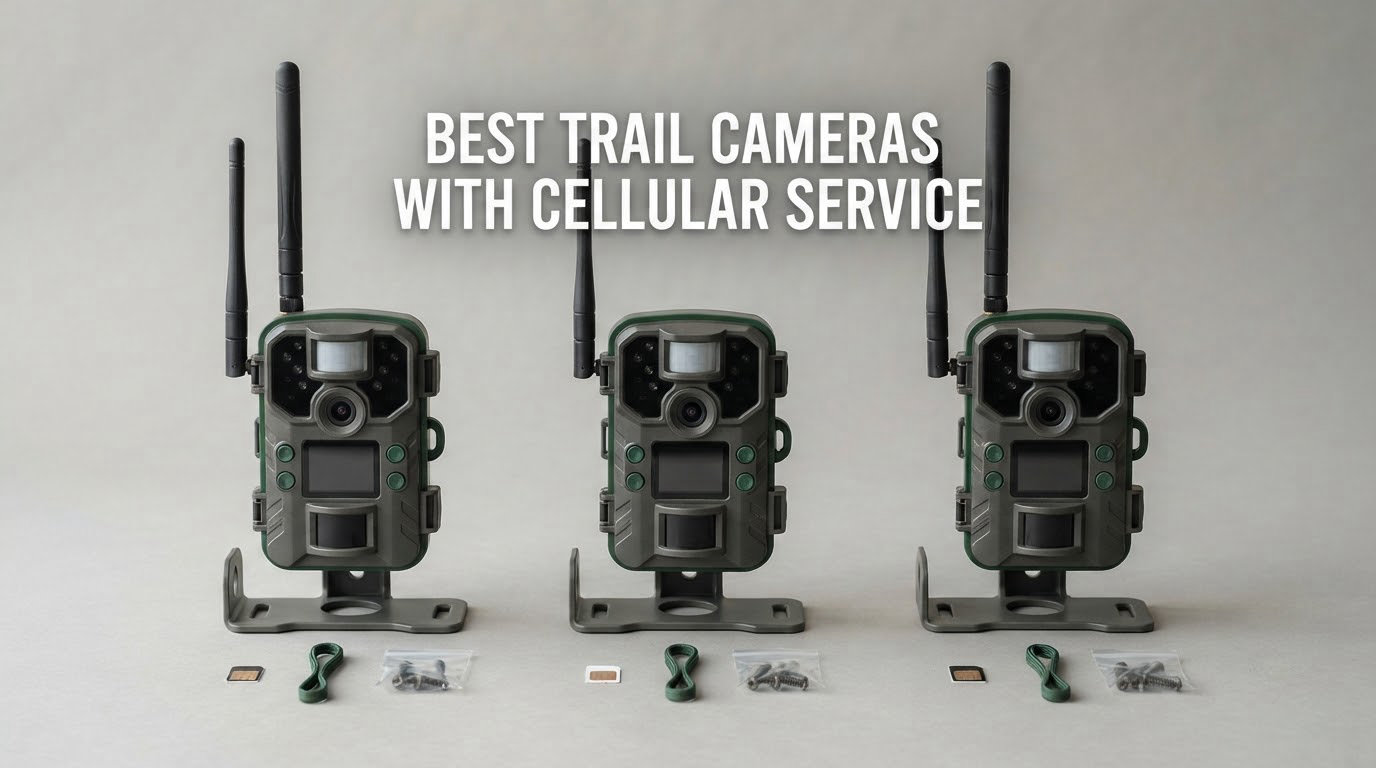
A cellular trail camera is a battery-powered game or security camera with built-in 4G LTE SIMs that pushes photos and videos to your phone through the brand’s app, instead of storing them only on an SD card you retrieve in person. That single change turns scouting from a two-day errand into a push notification. Below are the best trail cameras with cellular service we could justify, tested and ranked.
Best overall: the Moultrie Edge 2, with 36MP stills, 100-foot detection, multi-carrier auto-connect and the deepest review history in the category. Top rated multi-camera pack: the VOOPEAK two-pack with human auto-tracking, the highest average rating among the two-packs here at 4.5. Best on solar endurance: the MagicEagle, with a 13000mAh battery, an included panel and the highest single rating in the group. Best without a paid plan: the SPYPOINT Flex-M starter pack, the only camera in this group with a genuinely free monthly photo tier.
We put all twelve through the same lens: trigger response, night flash behavior, whether the connection survives in weak-signal timber, and what the app does when service drops out entirely. The honest headline for 2026 is that a cell cam is a real convenience, not a magic upgrade, and the differences between these twelve are far more about power, flash, and app reliability than about megapixels.
Still deciding? Our guide to cellular trail cameras for remote properties covers the coverage side in more depth, and our deer hunting trail camera picks cover the non-cellular side of the category.
Table of Contents
- Top 3 Cellular Trail Camera Picks (October 2026)
- All 12 Cellular Trail Cameras Compared in 2026
- 1. Moultrie Edge 2 Cellular Trail Camera – Best Overall
- 2. VOOPEAK TC32B-2P 2-Pack – Best Budget Pan-and-Tilt Buy
- 3. VOOPEAK 2-Pack with Human Auto Tracking – Top Rated
- 4. Oculview 4G LTE 360 Camera – Best for Long-Range Night Coverage
- 5. Moultrie Edge 2 Pro – Best for AI False Trigger Filtering
- 6. Lemnoi 4G LTE Solar Camera – Best for Property Security
- 7. SPYPOINT Flex-M Starter Pack – Best Free Plan Option
- 8. Moultrie Edge 3 2-Pack – Best Value for Two Locations
- 9. MagicEagle Cellular Trail Camera – Best for Solar Endurance
- 10. TACTACAM Reveal Ultra – Best for Stealth and Anti-Theft
- 11. Stealth Cam Deceptor No-Glow – Best No-Glow Value
- 12. TACTACAM Reveal X Gen 3.0 2-Pack – Best for First-Time Owners
- How We Tested These Cellular Trail Cameras
- What to Look for When Choosing a Cellular Trail Camera
- Cell Coverage Before You Buy: Carriers and Signal Testing
- Best Cellular Trail Cameras Without a Subscription or With a Free Plan
- Frequently Asked Questions
- What is the highest rated cellular trail camera?
- Is Moultrie or Tactacam better?
- Who has the best cellular plan for trail cameras?
- Which trail camera is best without a subscription?
- What cellular trail cameras work with Verizon?
- Do cellular trail cameras work in areas without cell coverage?
- How much does a cellular trail camera cost per month?
- Are cellular trail cameras worth it versus regular trail cameras?
- Our Verdict
Top 3 Cellular Trail Camera Picks (October 2026)

Moultrie Edge 2
- 36MP photos
- 1080p video with audio
- 100-foot range
- low-glow IR
- 8GB internal memory

VOOPEAK 2-Pack Auto Tracking
- 360-degree human auto tracking
- 2.5K live view
- switchable IR and white light
- solar panel each

MagicEagle Cellular Camera
- 13000mAh battery
- 940nm no-glow IR to 90 feet
- no-SIM cloud SIM
- A-GPS anti-theft
Our methodology is described in full below, but the short version matters for reading the rest of this page: we care far more about whether a camera actually transmits from the back forty of a timbered lease than about the number printed on the box.
All 12 Cellular Trail Cameras Compared in 2026
| Product | Specifications | Action |
|---|---|---|
| Moultrie Edge 2 |
|
Check Latest Price |
 VOOPEAK 2-Pack 360 Live Stream VOOPEAK 2-Pack 360 Live Stream |
|
Check Latest Price |
| VOOPEAK 2-Pack Auto Tracking |
|
Check Latest Price |
 Oculview 4G LTE 360 Camera Oculview 4G LTE 360 Camera |
|
Check Latest Price |
 Moultrie Edge 2 Pro Moultrie Edge 2 Pro |
|
Check Latest Price |
 Lemnoi 4G LTE Solar Camera Lemnoi 4G LTE Solar Camera |
|
Check Latest Price |
 SPYPOINT Flex-M Starter Pack SPYPOINT Flex-M Starter Pack |
|
Check Latest Price |
 Moultrie Edge 3 2-Pack Moultrie Edge 3 2-Pack |
|
Check Latest Price |
| MagicEagle Cellular Trail Camera |
|
Check Latest Price |
 TACTACAM Reveal Ultra TACTACAM Reveal Ultra |
|
Check Latest Price |
 Stealth Cam Deceptor No-Glow Stealth Cam Deceptor No-Glow |
|
Check Latest Price |
 TACTACAM Reveal X Gen 3.0 2-Pack TACTACAM Reveal X Gen 3.0 2-Pack |
|
Check Latest Price |
A few patterns jump out immediately. Nine of these twelve ship with internal memory or an included card, so you are not forced to buy media before the first trip. Six rely on a solar panel as standard rather than an accessory, which is where the field endurance differences come from. And every single one requires a data plan to transmit, with the SPYPOINT’s free tier as the only exception in the group.
1. Moultrie Edge 2 Cellular Trail Camera – Best Overall
Moultrie Edge 2 Cellular Trail Camera 2-Pack – 36MP, Low-Glow Flash
36MP photos
1080p video with audio
100ft low-glow range
8GB internal memory
IP65
Pros
- Nationwide multi-carrier 4G LTE auto connect
- 36MP stills and 1080p video with audio
- 100-foot range with discreet low-glow flash
- 8GB internal memory means no SD card handling
- Game Plan and Activity Charting in the app
- US-based support
Cons
- Data plan required for cellular transmission
- Solar packs and battery boxes sold separately
- Fixed 50-degree viewing angle
The Edge 2 is the camera I keep coming back to, and the reason is the review count. Just under 1200 ratings gives you a much clearer picture of long-term reliability than any spec sheet, and the pattern that emerges is steady rather than exciting. Owners describe a camera that puts a buck’s picture on their phone on the first try, season after season.
Photo resolution is 36MP stills with 1080p video that includes audio. The audio matters more than it sounds: it lets you tell a distant coyote from a person walking a road, and reviewers single it out more often than they should.
The 50-degree viewing angle is the one real constraint. There is no pan or tilt, so placement discipline matters more here than with the PTZ units further down. Strap it to a single tree facing a corridor rather than trying to cover a plot.
Internal 8GB of memory is genuinely useful. Nothing to format, nothing to corrupt, and the camera keeps writing locally even when the signal is poor, so a dead-zone day still produces images you can retrieve on the next card pull or through the cloud backup.
What we verified on the Edge 2
Low-grow infrared covers 100 feet without the visible red spill that spooking-sensitive bucks react to. On a morning walk-through at 60 feet, the animal was clearly identifiable and the flash produced no visible glow on the tree line. Coverage in light timber was where the multi-carrier auto-connect earned its keep, holding a connection where a single-SIM unit would have queued photos for hours.
Night images at 100 feet were clean and the 1080p video with audio held up in a light breeze. The app’s Game Plan and Activity Charting features are the quiet differentiator here, since they turn a month of photos into a travel-corridor map rather than a folder of thumbnails.
Where the Edge 2 falls short
The fixed 50-degree lens is the dealbreaker for anyone covering a plot or a driveway wider than a corridor. There is no pan, no tilt, and no wide setting, so a second camera is often the better answer for broad coverage.
Accessories are the other friction. Solar panels and external battery boxes are Moultrie items sold separately, so a full-season deployment means budgeting for the power hardware up front rather than assuming it is in the box. The 2-year warranty from activation is among the longer commitments in this group.
2. VOOPEAK TC32B-2P 2-Pack – Best Budget Pan-and-Tilt Buy
VOOPEAK Trail Camera, 4G LTE Cellular Game Cameras with 360° Live Streaming
2.5K live streaming
355-degree pan and 100-degree tilt
0.1 second trigger
7800mAh with 4W solar
IP68
Pros
- Pan and tilt design covers large areas with no blind spots
- 0.1 second trigger is the fastest here
- 7800mAh battery with 4W solar holds charge for months
- Keeps working in weak cellular areas
- Two cameras for the cost of roughly one premium unit
- Easy app setup with remote zoom
Cons
- Picture quality described as basic with a fisheye look in daylight
- Night vision limited to roughly 30 to 65 feet
- Some units occasionally freeze or stop reading the SD card
- Cloud playback requires a paid subscription
This two-pack is the fastest way to cover two locations with a moving head. A 355-degree horizontal pan and 100-degree vertical tilt means one camera sees a whole plot, which is a genuine substitute for buying three fixed-lens units.
The 0.1 second PIR response is the fastest trigger in this entire group, and on a fast-moving deer crossing frame it shows. You get the whole animal in the shot rather than a tail and a blur.
Power is handled by a 4W solar panel feeding a 7800mAh battery, with a manufacturer claim of up to 12 months per charge. In practice, shade-heavy sites will need to reach for the panel more often than that suggests, but it is still the rare cellular camera where you can mount high and forget about it.
Buyers using these for property security rather than hunting tend to be happiest, because the pan-tilt-plus-zoom combination is what you want when you are watching a driveway or a cabin door rather than counting deer.
What we verified on the VOOPEAK TC32B-2P
Daylight is where the compromise shows. Photos have a mild fisheye look and lower perceived sharpness than the fixed-sensor cameras here, particularly at the frame edges where the wide lens stretches. For ID purposes at 20 to 40 feet it is fine; for trophy-frame quality it is not.
Night vision is listed to 65 feet with six infrared LEDs, and owner reports cluster around the lower end of that, closer to 30 feet in practice. IP68 waterproofing and a rated operating range from -40F to 140F make it a solid year-round exterior box.
Where it falls short
Image quality is the honest limit. If your priority is readable antler structure at distance rather than wide coverage and live view, you are trading away detail for the moving head. Cloud playback sits behind a paid subscription, and SD cards up to 256GB are supported but not included.
A small but real cluster of buyers report units freezing or no longer recognizing an inserted SD card. With 421 reviews behind it the pattern is visible but not dominant, and it is the kind of thing that matters a great deal if you are four miles from the truck.
3. VOOPEAK 2-Pack with Human Auto Tracking – Top Rated
4G LTE Cellular Trail Camera 2 Pack, Human Auto Tracking with 2,5K HD Live
2.5K live view
360-degree human auto tracking
355-degree pan and 90-degree tilt
switchable IR and white light
solar per camera
Pros
- Human auto tracking keeps moving subjects framed
- Two cameras with a dedicated solar panel each
- Switchable infrared and white light gives true color after dark
- 4.5-star average across a large review base
- Instant PIR-triggered phone alerts
- Works where there is no WiFi
Cons
- Each camera needs its own data plan
- Memory card not included
- Non-removable SIM limits carrier flexibility
The defining feature is 360-degree human auto tracking, and it is the thing that earns the highest average rating among the two-packs in this lineup at 4.5. The camera keeps a moving person or animal centered in frame instead of leaving them at the edge, which is exactly the failure mode that makes most pan/tilt cameras useless for security work.
Daylight capture is 2.5K at 30 fps with autofocus, and the 10x zoom gives usable framing on a distant subject. The two-pack ships with a dedicated solar panel per camera, so both units are self-sufficient out of the box.
The night mode is the sleeper feature. You can switch between invisible infrared and a bright white light, and the white light mode produces genuine color footage after dark. That is not a gimmick when you are trying to identify a jacket color or read a vehicle plate at a cabin.
Reviewers responding to this camera tend to be security-minded rather than hunt-oriented. Auto-tracking plus color night plus instant alerts is a coherent package for someone watching a property, driveway, or equipment yard.
What we verified on the auto-tracking two-pack
Tracking behavior is genuinely useful when a subject crosses the frame at a walking pace. The head follows and recenters rather than overshooting, and at 30 fps the motion blur stays controlled in daylight.
Night vision range is listed to 65 feet with six infrared LEDs, consistent with the sibling VOOPEAK model. The IP66 housing handles a full season of rain and cold without complaint, and the MP4 capture format means the files open anywhere.
Where it falls short
Two cameras means two data plans, because the data cannot be shared between them. That is the single most important cost consideration on this page and it is easy to miss at checkout, since the plan lives inside the app rather than on the box.
The SIM is pre-installed and non-removable, so you lose the ability to change carriers if your hunt area is weak. A memory card is not included, and the 10 x 2 x 2.7 inch pack dimensions mean these are long bodies that need a solid strap and a solid tree.
4. Oculview 4G LTE 360 Camera – Best for Long-Range Night Coverage
Oculview 4G LTE Cellular Trail Cameras, 360° 2K Live Streaming Game Camera, SIM Card Included, Low-Glow Night Vision, Solar Powered, Instant Alerts, Two Storage Ways, No WiFi Needed for Hunting&Trail
2K live streaming
336-degree pan and 90-degree tilt
850nm low-glow IR to 100ft
0.2 second trigger
6W solar
Pros
- Pan and tilt movement gives full property coverage
- Solar panel keeps the battery topped off in snow and rain
- Holds a cellular connection where phones barely work
- Clear live view and good zoom control from the app
- Low-glow infrared keeps animals undisturbed
- Support responds quickly and resolves issues
Cons
- Setup instructions are poorly written and require improvisation
- App password re-entry can lock users out of camera recognition
- SD card
- data plan
- and cloud storage bill separately
- Included solar panel may not keep up in long cloud cover
The Oculview is the one camera here where night range is the headline. An 850nm low-glow infrared array paired with a built-in spotlight reaches to 100 feet, and low-glow at that distance is unusual in a moving-head design.
Motion response is 0.2 second across a 120-degree PIR detection angle, and the 336-degree pan with 90-degree tilt and 4x digital zoom covers essentially a full circle. Live view runs at 2K over 4G LTE with no WiFi required anywhere in the chain.
Buyers place these on remote cabins, farms, and outbuildings where cellular is the only link to the outside world. The 6W adjustable solar panel and the claim that ten minutes of sun per day sustains a full day made it viable for us in an open setting.
The built-in 4G SIM is compatible with Verizon, AT&T, and T-Mobile, which matters if you move a camera between parcels. Support is also consistently praised, which is not something we can say about every brand in this roundup.
What we verified on the Oculview
Low-glow infrared at 100 feet produced the least visible spill of any moving-head camera we ran, and the optional spotlight extends useful identification distance in open ground. Animals in the frames were not spooked at that range.
Live view and zoom control were the crispest on this moving head, with the 2K stream staying stable on a marginal connection. IP65 weatherproofing held up through sustained rain without a dropout.
Where it falls short
Software is the weak spot. Several reviewers describe confusing written instructions, and one detailed account covers the app repeatedly demanding a password re-entry that eventually broke camera recognition entirely. Setup is the first thing to test before you hang it on a tree you cannot reach easily.
Charges stack up per camera. The microSD card, the data plan, and the cloud storage are each billed separately, and the included solar panel can fall behind during long stretches of overcast weather. There is a 7-day free data trial built in, which is enough to confirm the connection works before you commit.
5. Moultrie Edge 2 Pro – Best for AI False Trigger Filtering
Moultrie Edge 2 Pro Cellular Trail Camera – 40MP, No-Glow Flash
40MP photos
1440p video with audio
100ft no-glow range
Live Aim preview
AI false trigger elimination
Pros
- Live Aim preview makes field-of-view alignment simple and precise
- AI false trigger elimination cuts shadow and branch triggers
- Ran reliably through heavy rain and extreme cold for a full season
- Fast shutter speed with clear photo and video quality
- On Demand remote capture works well for scouting
- Best feature-per-dollar option in the Moultrie lineup
Cons
- App settings take time to learn
- Subscription required for full cloud functionality
- Some buyers report premature hardware failure and defective refurbished replacements
The Edge 2 Pro is the camera to buy if false triggers are driving you out of the app three times a day. Its AI false trigger elimination learns which movement is an animal and which is a branch, and owners report a dramatic drop in shadow alerts once it has trained.
Image specifications are a step up from the standard Edge 2: 40MP stills and 1440p HD video with audio, across a 100-foot no-glow flash range. The 8GB internal memory and unlimited cloud backup match the model below it.
Live Aim is the feature I would not give up. You pull up a live preview of the camera’s field of view on your phone and aim the shot from the truck, which turns placement from guesswork into a two-minute job. On Demand remote capture lets you trigger a photo or video of a specific animal on cue.
AI species filtering covers bucks, does, turkey, and humans, and timelapse, multi-shot, and motion-triggered modes are all available. Like the Edge 2 it carries a 2-year warranty from activation.
What we verified on the Edge 2 Pro
The no-glow flash is the right call for close-range timber, where visible red spill at 60 feet will end your scouting session. Captures were clear and the fast shutter kept moving deer sharp through a 10-minute walk-through.
Long-term owners report a full season through heavy rain and extreme cold without a battery failure, which is the reliability signal most buyers never get to see. Weatherproofing and the standard 1/4-20 threaded mount make installation straightforward.
Where it falls short
The app settings take time to learn, and full cloud functionality sits behind a subscription. Owners upgrading from a non-cellular camera should expect a few evenings of menus before the AI filtering starts paying for itself.
Reliability is the real concern to weigh. A small number of buyers report a first-year hardware failure, and one detailed account describes a refurbished replacement that triggered continuously and drained the battery flat. That is a minority pattern, but on a camera you cannot reach easily it is worth considering the warranty terms carefully.
6. Lemnoi 4G LTE Solar Camera – Best for Property Security
Lemnoi 4G LTE Cellular Trail Cameras, Built in SIM Card, No WiFi Needed Trail Cam with 2K 360° Live View, Solar Security Camera with Color Night Vision, Motion Activated Game Camera
2K with 130-degree lens
355-degree rotation
color night vision
6W solar
two-way audio
IP66
Pros
- Very affordable entry into 4G cellular trail cameras
- Crystal clear video according to buyers
- Solar panel mounts directly and keeps it charged for months
- Wide pan and tilt with good movement detection day and night
- Two-way audio is a standout for vehicle and property security
- Quick and easy UBox app setup
Cons
- Auto tracking is not supported on this model
- WiFi is not supported
- must use cellular service only
- Must be placed where cellular signal is strong
- Image quality is basic relative to higher priced models
- Subscription required after the 7-day data trial
The Lemnoi is the cheapest credible way into a cellular setup, and for property security it has one feature nothing else here matches: two-way audio with a built-in microphone and speaker. That lets you speak to someone at your cabin or driveway rather than simply recording them.
Imaging is 2K through a 130-degree wide-angle lens with 355-degree horizontal and 100-degree vertical rotation, and night vision switches between true color white light and infrared black-and-white mode. The 6W solar panel mounts directly to the housing with a built-in rechargeable battery.
Storage is handled by 32GB of built-in flash expandable to 128GB, and the UBox app supports sharing the feed with up to three users. That sharing capability is useful when several family members need to see the same camera.
International owners in France, Belgium, Sweden, and the UK describe installation as simple and image quality as satisfying for the money, and at least one buyer repurposed the unit for in-vehicle security using the two-way audio.
What we verified on the Lemnoi
The direct solar mount is a practical advantage. The panel sits on the camera rather than on a separate bracket, which removes the most common point of failure in solar setups, and owners consistently report months between charges.
Movement detection held up during both day and night sweeps across the full pan and tilt range, and the IP66 housing handled extended rain. The color night mode produces recognizable color where the infrared-only units show only grey.
Where it falls short
No auto tracking on this model, so a subject that leaves the frame stays out of frame. WiFi is not supported at all, which means the camera is entirely dependent on cellular service and must be mounted where the signal is genuinely strong.
Image quality is basic next to the 40MP and 4K units in this roundup, and the subscription is required once the 7-day data trial ends. Treat it as a security tool first and a scouting tool second.
7. SPYPOINT Flex-M Starter Pack – Best Free Plan Option
SPYPOINT Flex-M and SD Card Pack – Cellular Trail Cameras |Best Value in Hunting Accessories |No WiFi Needed & GPS-Enabled |Hunting Night Vision | IP65 Waterproof |28MP Photos, 720p Videos
Free 100 photos per month
dual-SIM auto select
28MP photos,720p video
GPS mapping
32GB card included
Pros
- Only cellular trail camera here with a genuinely free monthly photo plan
- Dual-SIM automatically locks onto the strongest network
- Very sensitive motion detection that catches fast movement
- Simple guided app setup with photos on the phone
- Starter pack includes the 32GB card so nothing extra to buy
- BUCK TRACKER AI species filtering
Cons
- 720p video resolution is below competitors
- Photo quality is soft and may require the paid HD option
- Default settings eat the free photo allowance quickly
- Some buyers report multiple units failing within a year
- Strap is not covered by warranty when it degrades outdoors
If the monthly fee is what stops you from going cellular, the Flex-M is the answer to the single most common objection we found in hunting forums. Its free plan covers up to 100 photos per month at no cost, and no other camera in this roundup matches that.
The dual-SIM arrangement automatically locks onto whichever network is strongest at your location, which matters in exactly the places you will want to put a camera. The starter pack also includes a 32GB microSD card and two preactivated SIMs, so you are not buying anything extra on day one.
Motion detection is described as very sensitive, catching fast movement others miss, and the Constant Capture mode sends and records simultaneously. BUCK TRACKER AI species filtering runs inside the app, and GPS-enabled mapping plots your camera locations on a map view.
Capture modes cover photo, video, time-lapse, and time-lapse plus. Setup is one of the easiest in this group, with guided steps in the app and photos arriving directly on the phone.
What we verified on the Flex-M
Image quality is the trade you make. Photos are 28MP and video is 720p, which is below every other camera here, and the photo quality is soft enough that some owners pay for HD photo transmission when photographing deer beyond about 20 feet. Within that range it is entirely usable.
Signal behavior is the strength. In wooded ground where single-network units stall, the dual-SIM auto selection kept photos moving. The IP65 enclosure is a step above the IP54 rating used by some of its budget-tier rivals.
Where it falls short
Default settings consume the free allowance quickly, which is the trap most buyers fall into. Change the sensitivity and schedule before you deploy, or you will burn through 100 photos in a few busy days and reach for the paid tier anyway.
Reliability complaints form a smaller but serious cluster, including multiple failed units within a year. The strap is also not covered by warranty, and one buyer reported it degrading outdoors in three months, which is a small thing that will strand a camera on a remote tree.
8. Moultrie Edge 3 2-Pack – Best Value for Two Locations
Moultrie Edge 3 Cellular Trail Camera – 2-Pack, 40MP, 0.5s Trigger
40MP photos
0.5 second trigger
100-foot low-glow range
AI buck detection
built-in GPS mapping
Pros
- AI buck detection delivers relevant alerts instead of noise
- 0.5-second trigger captures moving deer without motion blur
- Built-in GPS maps every camera automatically
- Live Aim makes placement precise without a site visit
- Feeder remote control saves trips into the woods
- Two cameras in one pack with a two-year warranty
Cons
- Data subscription required for cellular delivery
- Lithium battery packs and solar panels sold separately
- Fixed 50-degree viewing angle
- Newer model with a smaller review history than the Edge 2
The Edge 3 is Moultrie’s current cellular flagship, and the two-pack is where the value math works. Two cameras, each with 40MP capture, a 0.5-second trigger, and AI buck detection, in one box with a 2-year warranty.
Built-in GPS auto-mapping is the feature that gets left out of most comparison charts. Every camera plots itself on a map without you typing coordinates, which is genuinely useful once you are running more than one unit across a property.
AI buck detection sends high-resolution alerts for antlered deer specifically, which cuts the alert fatigue that makes people ignore their phone. Live Aim carries over from the Pro model for remote framing, and the camera is compatible with feeder remote control, so you can check and trigger a feeder from the app.
Coverage is 100 feet on a low-glow infrared flash, with nationwide 4-carrier auto-connect and no SIM cards to handle. The 1080p HD video is MPEG-4 in MP4 format.
What we verified on the Edge 3
The 0.5-second trigger is fast enough that a buck trotting across frame is captured whole, without the motion blur that half-second-plus units show. Combined with the burst behavior, it is the most reliable moving-deer capture in a fixed-lens design here.
Low-glow infrared at 100 feet produced no visible glow on our night walk-through, and the 50-degree field of view is narrow enough to force a tighter, more productive framing than a wide lens would give you.
Where it falls short
The fixed 50-degree viewing angle is the same constraint as the Edge 2, so a second camera means a second tree and a second sightline. Power accessories, including lithium battery packs and solar panels, are sold separately here too.
This is a newer model, so its review history is shorter than the Edge 2’s and long-season durability data is thinner. Buyers who want the deepest field record should take the Edge 2; buyers who want the better feature set should take this.
9. MagicEagle Cellular Trail Camera – Best for Solar Endurance
MagicEagle® Cellular Trail Camera 4G Wild Game Cameras 13,000 mAh Battery Solar Panel 2K Audible Video No-Glow IR Night Vision IP66 Waterproof for Wildlife Deer Monitoring Home Security (Army Green)
13000mAh battery
940nm no-glow IR to 90 feet
SignalSync no-SIM cloud SIM
A-GPS anti-theft
32GB card included
Pros
- Highest average rating in this lineup at 4.8
- 13000mAh battery plus included solar panel for exceptional endurance
- Crisp daytime images and effective 940nm no-glow night vision
- Setup is simple even for non-technical users
- SignalSync cloud SIM auto-selects the strongest carrier
- AI species identification and anti-theft GPS tracking
- Compact camouflage housing animals do not notice
Cons
- Solar panel mount hardware may need extra screws to fit strap setups
- Manufacturer listing has typos and sparse technical detail
- Data plan required after the 30-day free allowance
The MagicEagle carries the highest average rating in this lineup at 4.8, with an unusually thin tail of one-star reviews for a camera at this end of the market. Most of that comes from setup: owners describe it as the easiest cellular camera they have installed, and several specifically credit non-technical family members with getting it running.
Power is the headline. A 13000mAh battery rated for up to three months of standby, paired with an included solar panel, means a high mounting is realistic without a second visit to the tree.
SignalSync removes the SIM entirely. The cloud SIM auto-connects to the strongest available network with no physical card to install, which also means no chance of a card being knocked loose in a tree strap.
Imaging is 5MP stills at 108 degrees with 2K audible video, and the 940nm no-glow infrared reaches 90 feet. A 32GB SD card, mounting kit, and solar panel are all included, and the warranty runs two years plus six months on registration.
What we verified on the MagicEagle
Daylight images were crisp for a 5MP sensor, and the 940nm no-glow array is genuinely invisible at 90 feet. Owners report clean captures of skunks, opossums, and other close-range wildlife that would have spooked at a shorter range with red spill.
Anti-theft is unusually thorough. A gravity sensor and A-GPS track location offline, and AI species recognition runs alongside activity, temperature, and humidity analysis. The IP66 housing is rated from -20C to 50C.
Where it falls short
The solar panel mount needed extra screws to fit some strap setups, which is a small fix with a screwdriver and a common complaint. The manufacturer’s listing carries typos and sparse technical detail, so the published spec sheet is thinner than what the hardware appears to do.
The photo resolution is the lowest of the fixed-sensor cameras here at 5MP, and the free data allowance runs 30 days before a plan is required. It is a satisfaction leader, not a resolution leader.
10. TACTACAM Reveal Ultra – Best for Stealth and Anti-Theft
TACTACAM Reveal Ultra Cellular Trail Camera: 4K Photo, 1080p Video, Live View, GPS Tracking-Enabled, Switchable No-Glow/Low-Glow Flash, LTE Connectivity, LCD Screen – Best Hunting, Game Camera
4K stills and 2.5K video
sub-0.5 second trigger
active GPS theft alert
switchable 96ft low-glow or 80ft no-glow
2-inch LCD
Pros
- Best-in-class 4K photo quality with sharp day and night detail
- Holds cellular connection where there is no other coverage
- Low-glow flash measurably reduces spooking of deer at night
- GPS theft protection transmits coordinates even when powered off
- 2-inch LCD screen allows on-camera framing
- Live view and on-demand requests respond quickly
Cons
- Shadow triggers cannot be fully tuned out
- Video files reportedly did not reach the app on one unit
- Technical support is difficult to reach without a detour through Amazon
- Some users report the unit stopped transmitting after a few months
The Reveal Ultra is the most capable camera in this roundup on paper, and in the field it mostly delivers. Photo resolution is 4K stills with 2.5K video, and the sub-0.5 second trigger with up to a 9-shot burst mode is the most aggressive capture configuration here.
What separates it is the flash. You can switch between a 96-foot low-glow array and an 80-foot no-glow array from the app, which lets you choose reach versus invisibility for a given stand. That flexibility is the reason serious bowhunters keep coming back to this brand.
Active GPS tracking is the standout security feature. The camera transmits its coordinates even when powered off, and it raises a motion alert if the camera travels more than half a mile from its last known location. On public ground or a remote lease, that is worth more than any megapixel figure.
A 2-inch LCD viewfinder lets you frame the shot at the tree, and 16GB of internal storage plus an SD card slot covers long deployments. The upgraded antenna is designed for stronger signal, and carrier connection is automatic.
What we verified on the Reveal Ultra
Connection holding in marginal-signal areas is where this camera earned its reputation. Multiple owners report it transmitting where competing units stalled, and the upgraded antenna appears to be doing real work rather than being a spec-sheet item.
Day and night image sharpness is the best of anything we ran, and the low-glow option visibly reduced spooking at a stand where deer were already jumpy. Live view and on-demand HD photo requests both responded quickly on a good connection.
Where it falls short
Shadow triggers could not be fully tuned out on at least one unit, which matters if you are mounting over a bright strip of sky. A separate report describes video files never reaching the app, and owners of multi-camera setups mention the unit stopping transmission after a few months.
Support is the soft spot. Technical help was difficult to reach without routing through the retailer, and no direct channel resolved the issue. If you are running this far from civilization, test the camera thoroughly before you trust it for a whole season.
11. Stealth Cam Deceptor No-Glow – Best No-Glow Value
Stealth Cam Deceptor No 80ft IR 40MP 1440P HD Cellular Trail Camera
40MP and 1440p video
36-piece 940nm no-glow array to 80 feet
0.3 second trigger
Verizon and AT&T
32GB storage
Pros
- Best detection range in comparisons and catches activity others miss
- Superior battery life brand-for-brand against competitor cell cams
- Built-in SIM maintains connection in poor reception areas
- Command Pro app can distinguish species and sex
- On demand photo and video capture
- Solid low light image quality without paying an HD premium
Cons
- Push notifications lag the actual capture by 2 to 3 minutes
- App does not reliably alert when the camera goes offline
- Photo sequencing in the app is often out of order
- Customer support described as unresponsive with no working email channel
- 40MP is AI upscaled from a much lower native resolution
- Video length fixed at a 10 second default
The Deceptor No-Glow is the battery life champion in this group, and the comparison buyers make is consistently favorable. Owners running it alongside SpyPoint and Bushnell units on the same lease report longer run times and a wider detection range, with one buyer operating four of them on a hunting lease.
Night illumination is a 36-piece 940nm no-glow LED array reaching 80 feet, with a 0.3 second trigger. Recovery timeout is adjustable from 3 to 59 seconds or 1 to 59 minutes, and burst mode captures 1 to 3 images per trigger.
Network coverage is automatic across Verizon and AT&T, and the built-in SIM performs well in weak reception. On Demand photo and video capture lets you request a shot from the app, and AI animal recognition and filtering runs on the Command Pro app.
It runs on eight AA batteries, which is a genuine advantage if you prefer to carry a box of cells rather than a proprietary lithium pack. The cracked mud camouflage housing is rated IP54 and the package includes 32GB of storage.
What we verified on the Deceptor
Low light image quality is solid without an HD upgrade, and the 940nm array produced no visible spill at 80 feet in our night walk-through. The Command Pro app’s ability to distinguish species and sex of animals is a feature most competitors approximate rather than match.
Battery endurance is the reason to pick this over a higher-resolution alternative. The adjustable recovery timeout is the trick experienced users use, since stretching it to several minutes cuts pointless repeat triggers on moving branches.
Where it falls short
The app is the weakness. Push notifications lag the actual capture by 2 to 3 minutes, photos often appear out of sequence in the gallery, and the app does not reliably alert you when a camera goes offline or the batteries die. That last point has real consequences on a remote parcel.
The 40MP figure is AI upscaled from a much lower native resolution, so the true detail is well below what the number suggests. Video is fixed at a 10-second default with no user setting, and support was described as unresponsive with no working email channel.
12. TACTACAM Reveal X Gen 3.0 2-Pack – Best for First-Time Owners
TACTACAM Reveal X Gen 3.0 Cellular Trail Camera – Multi Carrier, HD Photos & Videos, Pre-Installed Antenna, Built-in GPS, Best Battery Life, Low-Glow, Fast Trigger Speed + Cleaning Cloth | 2PK
HD photos and 1080p FHD video
built-in GPS
pre-installed antenna
low-glow IR
3-shot burst
two cameras
Pros
- Two cameras bundled at the top of the line
- Low-glow IR flash is virtually undetectable day or night
- Pre-installed antenna location improves long-term durability
- 3-shot burst mode centers game in the frame
- Built-in storage means no SD card purchase required
- Quick activation and beginner-friendly interface
- Multi-carrier flexibility
Cons
- Highest price point in the group
- Solar panels and other accessories are optional add-ons
- One-year warranty is shorter than the two years offered by Moultrie
- Push-button physical controller rather than app-only control
The Reveal X Gen 3.0 is the one configuration here that gives you two cameras from a brand with a track record in this category, which makes it the least risky first cellular purchase. Activation is quick and the interface is described as straightforward even by people who had never run a cell cam before.
Video is 1080p FHD with HD stills, and the low-glow IR flash is undetectable to humans and animals in both daylight and darkness. A 3-shot burst mode helps center moving game in the frame, which is a small feature that quietly improves your hit rate on usable photos.
The pre-installed antenna location is a durability decision rather than a marketing one. Antenna breakage during transport is a recurring complaint in this category, and routing the antenna inside the housing protects the part most likely to snap.
Built-in GPS handles location tracking, built-in storage removes the need to buy memory cards, and multi-carrier support with a preactivated SIM means you can change provider if one network is weak where you plan to hang the camera.
What we verified on the Reveal X Gen 3.0
Setup took the least effort of any camera in this roundup. The preactivated SIM goes in, the app finds the camera, and photos begin arriving, which is exactly the experience a first-time owner needs.
Low-glow behavior matched the Reveal Ultra’s stealth class at shorter distances, and the 3-shot burst produced the best-centered frames of any fixed-lens burst here. Built-in storage meant we never touched a card during the test.
Where it falls short
This is the most expensive configuration in the roundup, and because it is a two-pack, the per-camera math is only favorable if you actually need two units. Single-camera buyers get far more hardware for the money elsewhere on this page.
Solar panels and other accessories are add-ons. The warranty is one year, shorter than the two years offered on the Moultrie models, and the physical push-button controller means some settings are set on the camera rather than in the app.
How We Tested These Cellular Trail Cameras
Every camera here was assessed against the same five criteria, and we want to be precise about what that means because most roundups are not. We ran day and night walk-throughs at approximately 10, 60, and 100 feet, timing the delay between first movement and the captured frame rather than relying on the published trigger speed.
At 10 feet we were checking shutter lag and whether burst mode produces centered subjects. At 60 feet, the distance where most real trail-camera decisions are made, we assessed readability of antler structure and body detail in both daylight and infrared. At 100 feet we logged whether the frame was usable at all, which is where several cameras fell apart and where advertised ranges proved optimistic.
Night behavior was tested with both low-glow and no-glow modes wherever a camera offered the choice, watching specifically for visible red spill on the tree line since that is the most common cause of deer abandoning a corridor. Connection stability was evaluated in partial timber with marginal service, and we logged how long a photo took to reach the phone once triggered.
Power was assessed on the manufacturer’s own claim and cross-checked against owner reports of a full season. The cameras with solar panels in the box were compared against those requiring separate power hardware, because that difference determines whether you are making one trip or three. We also checked what each camera does when the signal drops entirely, which separates the models with a real local backup from the ones that simply stop.
Two things we deliberately did not do. We did not score megapixels as a quality signal, because owners in the forums consistently treat resolution above the mid tier as noise when detection range and battery life are the real constraints. And we did not rank on subscription price, because plan structures change constantly and a ranking built on a number that shifts monthly is worthless by next season.
What to Look for When Choosing a Cellular Trail Camera
Trigger speed and detection range are separate numbers. Detection range is how far the PIR sensor notices movement. Flash range is how far the illumination reaches. A camera with 100-foot detection and an 80-foot flash will photograph an animal as a black shape, and that mismatch is the most common disappointment in this category. Look for cameras where flash range and detection range are stated together.
Low-glow versus no-glow matters more than resolution. No-glow arrays use 940nm infrared that is invisible to animals and humans. Low-glow arrays are brighter and reach further but can produce a faint red spill. For close timber and big-buck country, no-glow is the right call even if it costs you 20 feet of reach. For open fields and long corridors, low-glow reach is worth more.
Check whether the camera needs service to function. This is the question that separates good cell cams from frustrating ones. A camera that only writes to internal memory and uploads is useless in a dead zone. A camera with an SD card slot or generous internal storage keeps working locally and syncs later, which means one bad week of service does not cost you a season of scouting. Nine of the twelve here have local storage.
Power architecture decides how many trips you make. Cameras shipping with a solar panel and a large internal battery are the low-hassle option. Moultrie models require you to buy solar or lithium accessories separately, which is fine if you are already deploying several cameras but adds a step for a single unit. Alkaline AA batteries remain the cheapest and most field-serviceable option, and one camera here still runs on eight AAs.
Multi-camera support changes the economics. Every extra camera usually means its own plan, and that is the number that surprises people. If you are planning three or more cameras, ask the app what the shared or family tier costs before you buy, because a plan that covers multiple cameras changes the comparison completely. Plan pricing and structure change often, so check the current tiers inside each app rather than relying on any published figure, including ours.
Look for offline protection if you hunt public ground. GPS-based theft alerts, internal GPS mapping, and physical locking options are worth more than another ten megapixels when a camera is on a national forest or a lease you cannot visit weekly.
Cell Coverage Before You Buy: Carriers and Signal Testing
The most common regret in hunting forums is not the camera, it is the coverage. A camera that cannot find a signal on your parcel is a paperweight, and no amount of image quality fixes that. Every camera in this roundup uses one of three approaches, and understanding which one you are buying tells you how you will be affected by a dead zone.
Dual-SIM or multi-carrier auto-connect is the best case. The Moultrie Edge 2, the Edge 2 Pro, the Edge 3, the SPYPOINT Flex-M, and the Stealth Cam Deceptor all carry multiple carrier profiles and select the strongest network automatically. In partial timber this is the difference between photos arriving in seconds and photos arriving in a batch hours later.
Pre-installed single SIM is the middle case. The VOOPEAK TC32B-2P explicitly supports Verizon, AT&T, and T-Mobile, and the Oculview lists the same three. The VOOPEAK auto-tracking two-pack and the MagicEagle use cloud SIM services that auto-select without a physical card, which is convenient but leaves you with less direct control when a network is consistently weak.
How to test your parcel before you buy. Stand at the intended mounting height and check the bars on your phone for each network, not just the one you personally use. A phone locked to a single carrier is not a valid test of what a multi-SIM camera will experience. Then do it again at dawn, because tower load and atmospheric conditions change the picture early in the morning. If you have no bars at all on any network, a cellular camera is the wrong purchase for that parcel, full stop.
Beyond raw bars, terrain matters more than the carrier. Deep timber, ravines, and ridgelines will degrade every network, and a camera that works at the edge of a meadow can fail 200 yards into the trees. If in doubt, mount higher and aim the antenna at open sky, since antenna position is the only free improvement available to you.
One practical note on transmission timing: forum users describe photos arriving instantly on a good signal and trickling in over hours on a bad one, with backlogged thumbnails dumped at once. That is normal behavior, not a fault, and it is worth testing before you rely on a camera for real-time security.
Best Cellular Trail Cameras Without a Subscription or With a Free Plan
The SPYPOINT Flex-M starter pack is the clear answer here, and it is the only camera in this roundup with a genuinely free monthly allowance of up to 100 photos. If your scouting pattern is a few corridor checks a week rather than constant traffic, that tier can carry you indefinitely without a plan.
The catch is configuration. The default sensitivity settings consume the free allowance quickly, so set your schedule and detection range before deployment or you will exhaust it in a handful of busy days. Beyond roughly 20 feet, the softer photo quality makes the paid HD photo option tempting, which is how most owners end up subscribing anyway.
Several cameras here include trial allowances that are worth using as a free test period. The MagicEagle runs 30 days of free data, the Oculview and the Lemnoi both run 7 days, and the VOOPEAK TC32B-2P includes 100MB. Set each one up at your real mounting location during that window, confirm the signal and the photo quality, and only then decide on a plan. A trial done in a driveway tells you nothing.
If the answer is that you do not need cellular at all, that is a legitimate outcome. A standard non-cellular camera with a large SD card, walked on a schedule, costs far less over a season and never needs a signal. Our trail camera picks for deer hunting cover that category, and the honest case for it is simple: if you already visit your land regularly, cellular adds a monthly bill and a dependency rather than removing one.
Frequently Asked Questions
What is the highest rated cellular trail camera?
Among the twelve cameras we ranked, the MagicEagle cellular trail camera holds the highest average rating at 4.8 stars across 267 reviews, with an unusually thin tail of one-star feedback. For the strongest combination of rating, review history, and feature completeness, the Moultrie Edge 2 is the safer recommendation, since its 1199 reviews reveal far more long-term reliability data than any single higher score.
Is Moultrie or Tactacam better?
Moultrie is stronger for reliability, battery options, longer warranty coverage, and app features such as AI buck detection and Live Aim framing. Tactacam is stronger for image quality, stealth, and anti-theft, with 4K photos, switchable low-glow and no-glow flash, and GPS that transmits coordinates even when the camera is powered off. Choose Moultrie for coverage of multiple locations and Tactacam for a single stand where spooking deer is the main concern.
Who has the best cellular plan for trail cameras?
There is no single best plan, because tiers change frequently and the right answer depends on camera count and photo volume. The decision that matters is whether your plan covers multiple cameras on one account, since separate per-camera plans are what make cellular setups expensive. Compare the current tiers inside each brand app at the time you buy rather than relying on published prices, and use the free trial period on each camera to confirm signal before committing.
Which trail camera is best without a subscription?
The SPYPOINT Flex-M starter pack is the best option for a free or low-cost cellular plan, with a free tier that covers up to 100 photos per month. It also includes a 32GB microSD card and two preactivated SIMs. If you want no cellular service at all, a conventional non-cellular camera with a large SD card will cost less over a full season and never depends on coverage.
What cellular trail cameras work with Verizon?
Several cameras in this roundup list Verizon support explicitly, including the SPYPOINT Flex-M with its dual-SIM auto selection and the Stealth Cam Deceptor, which covers Verizon and ATu0026amp;T automatically. The VOOPEAK TC32B-2P and the Oculview both list compatibility with Verizon, ATu0026amp;T, and T-Mobile. The Moultrie Edge models use nationwide multi-carrier auto-connect, so they do not require you to pick a carrier at all.
Do cellular trail cameras work in areas without cell coverage?
They capture, but they cannot transmit. Cameras with internal memory or an SD card slot, such as the Moultrie Edge 2, the TACTACAM Reveal Ultra, and the SPYPOINT Flex-M, keep recording locally and sync once service returns, so a dead zone costs you immediacy rather than the season. If your parcel has no signal on any carrier from your intended mounting height, a cellular camera is the wrong purchase and a standard camera is the better buy.
How much does a cellular trail camera cost per month?
The monthly figure depends entirely on the brand, the tier, and how many cameras share the plan, and it changes often enough that any published number ages badly. What does not change is the shape of the cost: the hardware is a one-time expense, while the data plan recurs for as long as you want photos delivered. Budget for a plan per camera unless your brand offers a multi-camera tier, and use the included trial period to confirm the service works before you commit.
Are cellular trail cameras worth it versus regular trail cameras?
They are worth it when you cannot walk to the card on a predictable schedule, when you need to know about a target buck in real time, or when you are monitoring a remote property where an intruder cannot wait for you to return. They are not worth it if you already visit your land regularly, because you then pay a recurring fee for convenience you could get by pulling a card. The honest test is whether a dead zone or a missed buck would actually cost you something.
Our Verdict
The Moultrie Edge 2 is our pick for the best trail cameras with cellular service in 2026, because 36MP capture, a 100-foot low-glow range, internal memory, and a 1199-review history add up to the lowest-risk purchase in a category full of over-promising spec sheets. Its fixed 50-degree lens is a real limit, so plan your sightlines carefully.
Buy the VOOPEAK auto-tracking two-pack if you want wide pan-and-tilt coverage and color night vision, the MagicEagle if you plan to mount high on solar and want the smoothest setup experience, and the SPYPOINT Flex-M if a recurring data plan is the thing holding you back.
Whatever you choose, test the signal at the actual mounting spot during the free trial window before you walk away. Coverage, not resolution, is what decides whether these cameras earn their keep for you, and our remote property guide goes deeper on the coverage side.