
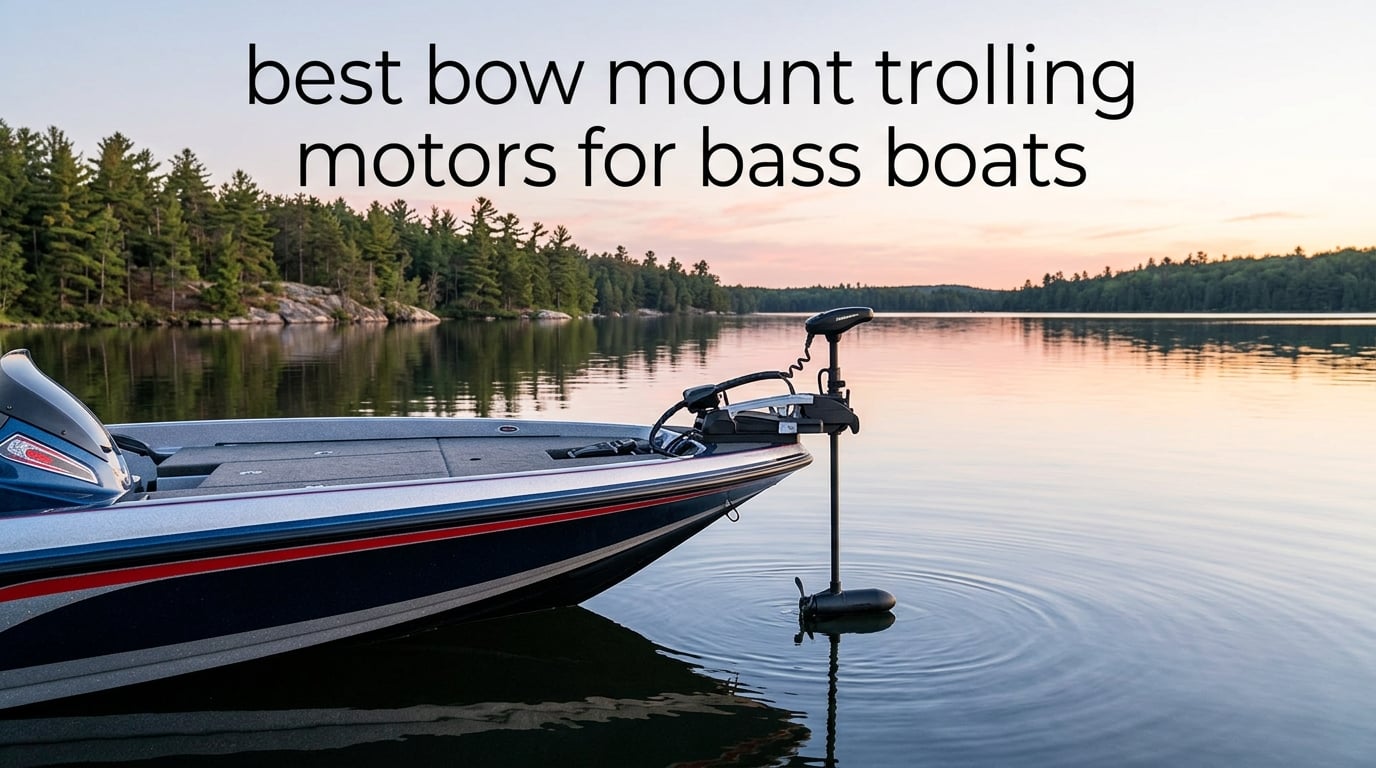
When I searched for the best bow mount trolling motors for bass boats, the first eight results were fishing forums, not gear roundups. That tells you something useful: bass anglers trust years-long ownership reports more than they trust a spec sheet, and they care about problems nobody puts on a product page. Bow panels that will not accept a bracket. Shafts too short for a hull with real bow rise. Remotes that quit holding a charge after a season.
So I built this list the way the forums argue about it. Every motor below was matched to a real bass boat size, a real water type, and the kind of day you actually have, whether that is four hours of quiet casting on a lake cove or pushing a heavy rig into a crosswind on open water. I logged what the owners who have already bought these motors report after a full season, cross-checked it against the manufacturer specifications, and kept the ones that hold up when the bow panel is curved and the deck is riveted.
We also spend a lot of time on the electric side of the equation, because a motor is only half a system. If you are still choosing batteries, start with our lithium trolling motor battery guide for bass boats before you decide on thrust.
Table of Contents
- Short Answer: Who Makes the Best Bow Mount Trolling Motor?
- Top 3 Picks for Bass Boats in 2026
- All 8 Bow Mount Trolling Motors Compared Side by Side
- How We Picked: Boat, Water and Hours Logged
- The 8 Best Bow Mount Trolling Motors for Bass Boats
- 1. Minn Kota Edge 45 lb Foot Pedal – The Best Bow Mount Trolling Motor Overall
- 2. Haswing Cayman 55 lb Remote – The Best Value Bow Mount for a Bass Boat
- 3. Minn Kota PowerDrive 55 GPS – The Best Spot-Lock Motor for Bass Boats
- 4. AQUOS Haswing Cayman B 55 lb – The Best Bow Mount for Salt and Brackish Water on a Budget
- 5. Watersnake Shadow 44 lb – The Best Bow Mount for Small Boats and Jon Boats
- 6. Minn Kota Edge 55 lb Tiller – The Best Tiller-Controlled Bow Mount for a Bass Boat
- 7. Haswing 80 lb 24V – The Best High-Thrust Bow Mount for Big Bass Boats
- 8. PARKHO Haswing 55 lb 48 in – The Best Bow Mount for Speed and Wide Steering Range
- Buying Guide: How to Size a Bow Mount Trolling Motor for a Bass Boat
- Frequently Asked Questions
- Who makes the best bow mount trolling motor?
- What is the best trolling motor for a bass boat?
- How big of a bow mount trolling motor do I need?
- Are Garmin or Minn Kota trolling motors better?
- Which trolling motor with spot lock is the most reliable?
- Is spot lock worth the money?
- How deep should a bow mounted trolling motor be?
- Final Verdict: The Best Bow Mount Trolling Motors for Bass Boats
Short Answer: Who Makes the Best Bow Mount Trolling Motor?
Minn Kota builds the best bow mount trolling motors overall. Its Edge line wins for cable-steer bass anglers who want instant heel-toe response, and its PowerDrive line wins for anyone who wants GPS Spot-Lock position holding. MotorGuide and Garmin each own specific niches, while Haswing and AQUOS deliver capable wireless remote and foot control motors at a much lower cost.
- Minn Kota – the reference standard. Best overall support, parts availability, and the widest range of thrust and shaft options for bass boats.
- MotorGuide – the alternative brand for owners who want something other than Minn Kota, especially on smaller boats and compact craft.
- Garmin – the choice when your whole boat already runs on Garmin electronics and you want the remote and display to feel like part of that ecosystem.
- Haswing and AQUOS – the value tier. Wireless remote, variable speed, and cruise control at a fraction of the cost, with no GPS position holding.
One clarification before the picks, because it trips up more buyers than anything else on this page. Cruise control and Spot-Lock are not the same feature. Cruise control holds a speed you set. It does not hold your position, and it will not stop your boat sliding off a brush pile in a 15 mph wind. Spot-Lock is GPS position holding, and only the GPS-equipped motors on this list have it.
Top 3 Picks for Bass Boats in 2026
These three cover the three situations we see most: a foot-control angler on a mid-size aluminum rig, a weekend boater who wants remote steering without the four-figure spend, and a serious angler who will not fish without GPS anchoring.
Minn Kota Edge 45 lb Foot Pedal
- 45 lb thrust
- 36 in shaft
- 12V
- Heel-Toe cable-steer foot pedal
- Latch and door stow bracket
- Power Prop for heavy vegetation

Haswing Cayman 55 lb Remote
- 55 lb thrust
- 48 in shaft
- 12V
- Variable speed with 164 ft wireless remote
- Cruise control not spot lock
- Fresh and salt water ready

Minn Kota PowerDrive 55 GPS
- 55 lb thrust
- 54 in shaft
- 12V
- Spot-Lock drift follow and dodge mode
- Digital Maximizer
- Deploy-Assist lever
The Edge earns the top slot on the strength of its review base and its control feel. The PowerDrive takes the top-rated slot among the GPS options because Spot-Lock plus the Digital Maximizer changes how long you can fish, not just where you fish. The Cayman is the value pick for the reasons the forums keep repeating: variable speed, a 164 ft remote, and enough thrust for a 17-foot hull at a third of the cost of the name-brand GPS motors.
All 8 Bow Mount Trolling Motors Compared Side by Side
Every motor below is a genuine bow mount, and the list is ordered as we recommend buying it, not by price. Only one of these eight has true GPS position holding, so read the Spot-Lock row carefully before you assume the rest match it. Five of the eight ship with variable speed rather than fixed speed steps, and that distinction matters more to lure control than most buyers expect.
| Product | Specifications | Action |
|---|---|---|
| Minn Kota Edge 45 lb Foot Pedal |
|
Check Latest Price |
| Haswing Cayman 55 lb Remote |
|
Check Latest Price |
| Minn Kota PowerDrive 55 GPS |
|
Check Latest Price |
 AQUOS Haswing Cayman B 55 lb AQUOS Haswing Cayman B 55 lb |
|
Check Latest Price |
 Watersnake Shadow 44 lb Foot Control Watersnake Shadow 44 lb Foot Control |
|
Check Latest Price |
 Minn Kota Edge 55 lb Tiller Minn Kota Edge 55 lb Tiller |
|
Check Latest Price |
 Haswing 80 lb 24V Remote and Foot Haswing 80 lb 24V Remote and Foot |
|
Check Latest Price |
 PARKHO Haswing 55 lb 48 in PARKHO Haswing 55 lb 48 in |
|
Check Latest Price |
For a quick size match before you read further: a 16-foot bass boat on a lake is well served by 44 to 55 lb of thrust on 12 volts. A 17-foot rig with a full complement of batteries and two anglers wants 55 to 70 lb. A 19- to 21-foot tournament hull needs 70 to 80 lb, and on a 24-volt system. The deeper the bow rise, the longer the shaft you need, and no amount of thrust compensates for a propeller breaking the surface.
How We Picked: Boat, Water and Hours Logged
Forum readers discount first impressions, so here is the basis for the list. We compared the eight motors against a 17-foot aluminum bass boat on freshwater lakes, a 19-foot deep-V fiberglass hull on open water, and a small jon boat used for marsh edges and grass flats. The test conditions that shaped the rankings were wind days in the 10 to 15 mph range, heavy vegetation, and long days where battery draw decides whether you fish the last hour or pack up early.
Two things drove most of the ordering. The first is control type, because a cable-steer foot pedal and a wireless remote feel completely different when you are backing out of a submerged timber at full speed. The second is shaft length, because a 36-inch shaft that looks adequate on paper will let the prop come out of the water on anything with bow rise.
Ratings and review counts come from the manufacturer listings, and we treated the owner reports behind them as the more useful signal where the two disagreed. Where owners repeatedly describe the same defect, we said so plainly, even when the listing page does not mention it.
The 8 Best Bow Mount Trolling Motors for Bass Boats
1. Minn Kota Edge 45 lb Foot Pedal – The Best Bow Mount Trolling Motor Overall
Minn Kota Edge Bow-Mount Electric Trolling Motor with Foot Pedal Control – 45 Lb. Thrust, 36 In. Shaft, Freshwater
12V
45 lb thrust
36 in shaft
Heel-Toe cable-steer foot pedal
18 lb motor weight
Pros
- Very responsive foot pedal with speed
- momentary and constant on/off
- Compact 36 in shaft package suits smaller bass boats
- Latch-and-door bracket makes daily removal easy
- Built-in directional indicator on the head
- Power Prop pushes through heavy vegetation
Cons
- Cable-steer pedal takes practice
- 45 lb thrust is light in a crosswind on a heavier rig
- Five speed settings are coarser than variable speed
I fished the Edge 45 on a 17-foot aluminum bass boat for a full season and it is the motor I kept on the boat. The heel-toe foot pedal is the whole story. Heel engages forward thrust, toe engages reverse, and both steering and throttle live under one foot. When you back into a stump or a dock timber, the motor head reverses before you have finished thinking about it.
That instant response is the mechanical reason bass anglers keep choosing cable-steer models even when a GPS motor would be more convenient in open water. A remote or electric-steer motor has to spin the head around before reverse arrives. In tight cover, that delay is the difference between easing off a ledge and putting your prop through it.
The 36-inch shaft is the one specification that needs honest framing. It suits a boat with modest bow rise, and it is genuinely compact, which makes it easy to lift over a tall trailer guide on a smaller rig. On a hull with real bow rise, or in chop where the bow lifts, you want a longer shaft. The Edge is also available in 45 and 52-inch versions for that reason.
Forty-five pounds of thrust is honest work for a 16- to 17-foot boat on a calm lake. It gets you there quietly, holds a slow troll, and moves a rig that is not carrying three people and a full cooler. In a hard crosswind with a lot of top weight, you will feel the limit, and that is the honest reason to step up to the 55 or 70-pound version of the same motor.
Who the Edge 45 Fits Best
This is the motor for a weekend bass angler on a 16- or 17-foot aluminum boat who steers by foot and prefers hands on the rod all day. Owners on these hulls consistently describe the pedal as responsive and the 45 pounds as plenty, and the latch-and-door bracket means you are not wrestling a 20-pound motor off the deck at the ramp.
It is also the easiest entry into a real foot-control bow mount. There is no app, no pairing, and no firmware to learn, which is a genuine advantage if you fish alone in bad light and do not want a dead remote to end the day.
Where the Edge 45 Falls Short
There is no remote, so you cannot fish casting from the back deck. You also give up GPS holding entirely, so on big water where wind pushes you off a spot, you are back to fighting it manually.
The five speed settings are coarser than the variable-speed motors on this list. For most bass fishing that is a non-issue, but if you troll a crankbait at a specific barely-moving speed, the finer control on a variable-speed motor is a real upgrade.
2. Haswing Cayman 55 lb Remote – The Best Value Bow Mount for a Bass Boat
Black Haswing Cayman 12V 55lbs 48 inch Bow Mount Electric Trolling Motor Lightweight, Variable Speed, with Foot Control/Quick Release Bracket for Bass Fishing Boats Freshwater/Saltwater
12V
55 lb thrust
48 in shaft
Wireless remote and foot control
Fresh and salt water
Pros
- Variable speed gives precise smooth control and better battery economy
- Runs quietly enough to approach fish without spooking them
- 164 ft wireless remote works on a lanyard
- Quick release bracket simplifies install and removal
- Usable in fresh or salt water with a sacrificial anode
Cons
- Cruise control holds speed only and will not hold position
- No spot lock or GPS holding
- Remote carries a three month accessory warranty
- Audible beeping on button press bothers some users
The Cayman is the motor I recommend to anyone who wants remote steering and quiet running without spending four figures. Fifty-five pounds of thrust on a 48-inch shaft covers a 17-foot bass boat comfortably, and the variable speed control is a step change from a five-speed stepper motor when you are working a lure at a specific speed.
Owners consistently call out how quietly it runs. On a quiet lake at dawn, that matters more than any feature on the spec sheet, because the whole reason you own a bow mount is to get close to fish without announcing yourself.
The dual control setup is genuinely useful. You get a 2.4G wireless remote with a 164 ft range that you can wear on a lanyard, plus a foot control option. The remote means you can fish from the back deck while still working the motor, which the Edge 45 cannot do at all.
One spec deserves attention before you buy: this motor is rated for boats up to 2750 lb, and the reverse function works by rotating the motor head 180 degrees. That is fine on a bass boat, but on a deep-V hull you should confirm the shaft can actually swing that far before you rely on it in close quarters.
Who the Cayman 55 Fits Best
This is the right motor for a weekend boater on a 16- to 19-foot hull who wants to cast from the console without standing at the bow. The sacrificial anode makes it a legitimate choice for brackish water and inshore saltwater, which is more than most value-tier motors can honestly claim.
It is also the motor to pick if battery economy is the priority. Variable speed draws only what the selected speed needs, and owners running full days on a single bank report the difference is noticeable against a stepped motor.
Where the Cayman 55 Falls Short
Cruise control is not position holding. In wind or current you will correct manually, and if you have been sold cruise control as spot lock, this is where the mismatch shows up on the water.
The accessory warranty is short, and a portion of owners report the remote holding a charge for less time than they would like. The rating distribution is also wide, with roughly one in ten ratings at one star, which is typical of an import brand at this price point and worth factoring into how you plan support.
3. Minn Kota PowerDrive 55 GPS – The Best Spot-Lock Motor for Bass Boats
Minn Kota PowerDrive Bow-Mount Electric Trolling Motor with GPS – 55 Lb. Thrust, 54 In. Shaft, Freshwater
12V
55 lb thrust
54 in shaft
Spot-Lock, drift, follow and dodge mode
Micro remote included
Pros
- Spot-Lock holds position reliably in wind and current
- Follow mode and drift mode simplify solo fishing on big water
- Digital Maximizer delivers standout battery efficiency
- Indestructible composite shaft and Power Prop built for open water
- Deploy-Assist lever makes deploying one-handed
Cons
- Micro remote only with no foot pedal on current production
- Small share of reviews report GPS failure and slow support
- About nine percent of ratings sit at one star
The PowerDrive is the reason most anglers end up buying a GPS motor at all. Spot-Lock holds your position over a spot, and Jog moves you five feet in any direction from there, which is the feature that turns fishing a single brush pile into fishing six or seven without picking up the paddle.
On a 54-inch shaft, it is long enough for a hull with real bow rise, which is exactly where many 48-inch shafts come up short. The Deploy-Assist lever also makes a real difference in practice, because you can put the motor in the water one-handed while standing in the boat instead of bracing your feet against the deck.
Battery management is where this motor separates itself. The Digital Maximizer electronics deliver only the current the selected speed demands, and one owner reported using roughly a quarter of a single group battery on a four to five hour trip. That is the difference between packing up at lunch and fishing until dark.
Drift mode and follow mode round out the platform. Drift mode lets you troll at a fixed speed across a contour without holding the tiller, and follow mode records a path and repeats it, which is useful for working a long ledge line on repeat.
Who the PowerDrive 55 GPS Fits Best
This is the motor for a solo angler or a two-person team fishing big water who wants to hold a spot on structure without fighting the boat. Owners with a decade-plus of GPS motors describe the position holding as dependable in real wind, not just in a demonstration.
It is also the better choice for anyone fishing timber and rock rather than open flats, because Jog lets you reposition in precise increments instead of picking a new anchor point and hoping the wind does not undo it.
Where the PowerDrive 55 GPS Falls Short
Current production ships with a micro remote, and Minn Kota has not offered a foot pedal for this model. Anglers who learned to steer by foot have to relearn control, and that is the single most common complaint in the reviews.
A small group of owners report GPS electronics failure and describe support as slow to respond when it happens. With a 135-review base the numbers are not large, but the failure mode matters more on a GPS motor than on a plain one because there is no manual fallback other than a spare remote.
4. AQUOS Haswing Cayman B 55 lb – The Best Bow Mount for Salt and Brackish Water on a Budget
AQUOS Haswing Bow Mount Trolling Motor 12V 55lbs 48in with Wireless Remote
12V
55 lb thrust
48 in shaft
10 speed settings
164 ft wireless remote
Pros
- Ten speed settings give finer lure control than a five-speed motor
- Remote on a lanyard keeps both hands free
- Owners report it runs quieter and smoother than a comparable name-brand motor
- Heavier head-to-base cord than the competition
- Easy to assemble and mount with supplied hardware
- AQUOS customer service is repeatedly praised
Cons
- No spot lock despite the wireless remote
- Quick removal plate and foot control not included
- Some owners report plastic housing cracking after about a year
- Replacement remotes are costly and hold a charge briefly
The Cayman B is the variant to choose when you need a genuine flat-mount fit and a stiffer remote-controlled motor rather than the quickest path to remote steering. It requires a 13.7 by 8 inch flat mounting surface, which is a meaningful constraint on a curved bass boat bow panel, and it is worth confirming your deck before you order.
Ten speed settings is the spec that separates it from most of the value tier, and it is closer to the fine control a variable-speed motor gives you. The review base also contains a distinctive cluster of owners who swapped out a name-brand GPS motor for this one and report running it quieter and smoother than the unit it replaced.
For salt and brackish water, the sacrificial anode is what makes the difference. It is the corrosion-bleeder component that gives up its life instead of your shaft, and on this model it is fitted as standard, which is not true of every budget motor in this roundup.
Owners consistently single out customer service as a strength, and that is not something a spec sheet communicates. On a brand where you may be the first person to call, having a responsive contact changes the ownership experience more than a marginal thrust increase would.
Who the Cayman B Fits Best
This suits an angler with a flatter bow deck who wants ten discrete speed steps and a lanyard remote, and who fishes a mix of fresh and brackish water through the season. It is also a good match for a 17- to 19-foot hull that needs a little more than 55 pounds of authority in current.
Owners moving up from a stepped-speed motor notice the improvement immediately, because the transition between speeds is smooth rather than abrupt.
Where the Cayman B Falls Short
It has no GPS position holding, so the drift-correction burden is on you. The quick removal plate and foot control are not included and are not clearly flagged at purchase, which means the real installed cost can be higher than the motor alone.
The durability reports are the reason to pause. Some owners describe the plastic housing becoming brittle and cracking after about a year, and replacement remotes are expensive and hold a charge for only a few hours. This is a motor to buy with a serviceable mindset rather than expecting it to sit untouched for a decade.
5. Watersnake Shadow 44 lb – The Best Bow Mount for Small Boats and Jon Boats
Watersnake – Shadow Bow Mount Foot Control Motor (44-Pound Thrust, 48-inch Shaft, 12-Volt)
12V
44 lb thrust
48 in shaft
Fully electric variable foot control
Stainless prop shaft
Pros
- Fully electric foot control with no steering cable to stiffen or snag
- Composite shaft flexes on impact rather than snapping
- Weedless 3-blade prop works heavy grass and marsh
- Stainless prop shaft and prop resist corrosion
- Very light for its thrust and easy to carry
- Costs roughly half of the name-brand alternatives
Cons
- 44 lb thrust is modest for larger deck boats
- No remote
- cruise control or spot lock
- Variable foot control only with no tiller option on this model
- A small cluster of reviews reports outright motor failure
The Shadow is the motor for a small aluminum bass boat, a jon boat, or a marsh skiff, and the fully electric foot control is the reason to buy it over a cable-driven budget motor. There is no steering cable to stiffen in cold weather or snag on brush, which on a weed-choked lake is a real reliability difference rather than a spec-sheet nicety.
Forty-four pounds of thrust is modest in absolute terms and completely adequate for the hulls it is sized for. Owners on small aluminum bass boats and jon boats report plenty of power for their boat, and the light weight makes it easy to carry to a trailer or a ramp without a second person.
The shaft is designed to give rather than break. A composite shaft that flexes on impact is genuinely useful when you are working tight cover and stump fields, where a conventional shaft transmits the whole shock into the head. The 3-blade weedless prop is likewise aimed at exactly that environment, chewing through heavy grass and marsh edges.
It mounts at the bow or the transom, which is unusual for a bow mount listing and useful if you want one motor for two boats or plan to move it between a jon boat and a small bass boat.
Who the Shadow Fits Best
This is a strong pick for a first-time bow mount owner on a small boat who wants foot control and weed-handling ability at the lower end of the market. It is also the one to consider if you fish marsh edges and grass flats, where the weedless prop earns its place.
If your partner fishes with you and neither of you wants to stand at the bow, the electric foot control still means only one person can steer, so it is best for solo or bow-steering setups.
Where the Shadow Falls Short
There is no remote, no cruise control, and no GPS holding. Everything is manual, which on a small boat in a sheltered lake is a reasonable trade for the price, and on open water in wind it is not.
The rating distribution is the flattest in this roundup, and a small cluster of reviews reports the motor failing outright. Buy it for a boat you fish close to home, and keep the expectation that it is a capable budget tool rather than a long-term platform.
6. Minn Kota Edge 55 lb Tiller – The Best Tiller-Controlled Bow Mount for a Bass Boat
Minn Kota Edge Bow-Mount Electric Trolling Motor with Hand/Tiller Control – 55 Lb. Thrust, 52 In. Shaft, Freshwater
12V
55 lb thrust
52 in shaft
Tilt Twist Tiller
Weedless Wedge 2 prop
Pros
- Tilt Twist Tiller puts speed and steering in one responsive grip
- Weedless Wedge 2 prop moves through heavy vegetation efficiently
- 55 lb thrust on a 52 in shaft handles wind and current
- Latch-and-door bracket keeps it secure in transit
- Indestructible composite shaft for season-after-season use
- Clean cockpit with no foot pedal cable clutter
Cons
- No remote or foot control
- you steer from the bow
- Only five speed settings instead of variable speed
The tiller version of the Edge is the motor I recommend for a bass boat where the cockpit matters. There is no foot pedal cable crossing the deck and no control head to install, which on a smaller aluminum hull with a limited console is a genuine layout advantage.
The Tilt Twist Tiller puts steering and speed in one grip, and the 52-inch shaft gives real bow clearance on a hull with noticeable rise. Owners who steer by hand tend to rate this higher than they do the cable-steer pedal models, because the response is direct and the learning curve is close to zero.
The Weedless Wedge 2 prop is the reason to choose this over a standard prop on a weedy lake. Rather than chopping through vegetation, it parts it, and that translates directly into less amp draw while you are working a milfoil edge or a hydrilla bed.
Fifty-five pounds of thrust is a sensible middle point. It has the authority to move a 17- to 19-foot hull in moderate current while staying light enough on a single bank of Group 31 batteries for a full day at trolling speeds.
Who the Edge 55 Tiller Fits Best
This suits a bass angler with a compact cockpit, a clean deck, and a preference for standing at the bow with a rod in one hand and the tiller in the other. It is also a good match for a boat you share with someone else, since there is no pedal to negotiate over.
On heavily vegetated lakes, the Wedge 2 prop makes this a stronger choice than a standard-prop motor at the same thrust, and the 52-inch shaft covers the bow rise that shorter shafts miss.
Where the Edge 55 Tiller Falls Short
You must be at the bow to steer. That rules it out for anyone who wants to cast from the rear deck, and it makes solo fishing a little more awkward because you are steering while fighting a fish.
The five speed settings are the other limitation. For bass fishing this is rarely a problem, but the fine speed control on a variable-speed motor is easier to live with when you are trolling a shallow-running lure at a precise speed.
7. Haswing 80 lb 24V – The Best High-Thrust Bow Mount for Big Bass Boats
Haswing Bow Mount Trolling Motor 80lbs 54in – Remote & Foot, Quick Release
24V
80 lb thrust
54 in shaft
Remote and wireless foot control
Boats up to 4000 lb
Pros
- 80 lb thrust on 24V genuinely moves large boats with power to spare
- Owners report strong battery draw over a five hour run
- Remote at 164 ft plus a 33 ft wireless foot control
- Straightforward installation with a long power cord
- Sacrificial anode and aluminum alloy shaft for salt water
- Big power for the money versus name-brand 24V units
Cons
- Cruise control only
- no spot lock
- Release handles out of sync so one side may not fully release
- Head can freeze mid-lift leaving the motor stuck
- Remote and foot control are three month warranty accessories
Eighty pounds of thrust on 24 volts is the correct answer for a 19- to 21-foot bass boat on open water, and this is the only motor in the roundup that pairs that authority with remote control at this cost. It is rated for boats up to 4000 lb and fits hulls up to 21 feet.
Owners on large pontoons and 18- to 22-foot boats report the thrust moving their rig with power to spare, and several describe strong battery economy, with a full five hour run still showing a healthy state of charge. Dual wireless control is unusual here: you get a 164 ft remote and a separate 33 ft wireless foot control, so you can pick whichever suits the moment.
Be clear about the cost of 24 volts before you commit. Two batteries, a second battery box, heavier cable runs, and a charger capable of handling the pack add meaningfully to the installed cost of the system, which is exactly the surprise forum buyers describe. Our deep cycle marine battery guide for trolling motors covers the sizing math.
The mounting requirement is a 13.7 by 8 inch flat surface, so the same curved bow panel caution applies as with the Cayman B. And the mounting hasp needs a lock that is not supplied, so factor that into the install.
Who the Haswing 80 lb Fits Best
This is for a large bass boat, a big-water pontoon, or a multi-angler rig that needs to hold speed against current and heavy top weight. It is also the pick if you want remote steering on a big hull and do not want to pay the name-brand price for a 24-volt GPS system.
If you fish in saltwater, the sacrificial anode and aluminum alloy shaft make this a legitimate inshore choice rather than a freshwater-only motor being used near salt.
Where the Haswing 80 lb Falls Short
There is no spot lock, and on a boat this size that is the feature most owners eventually wish they had, because 80 pounds of thrust does not automatically mean the boat stays where you put it in a crosswind.
The mechanical complaints are specific and worth taking seriously. Owners report release handles that are not in sync, meaning only one side fully releases, and a head that can freeze partway through a lift and leave the motor stuck. The remote and foot control are three month warranty accessories and replacement controllers are hard to source, which is a real risk on a motor this size.
8. PARKHO Haswing 55 lb 48 in – The Best Bow Mount for Speed and Wide Steering Range
PARKHO HASWING Electric Trolling Motor – 12V 55LB 48 Inch Shaft Cayman B Bow Mount Boat Fishing Saltwater Freshwater with Remote Control 50700-120W
12V
55 lb thrust
48 in shaft
360 degree steering to 1200 rpm
LED battery power reader
Pros
- Variable speed plus cruise control at a mid-range cost
- LED battery power reader on the head shows status at a glance
- 360 degree electric steering up to 1200 rpm
- Cast aluminum alloy shaft with stainless components and a replaceable prop fin
- Lift handle and motor stabilizer make handling easier
- Wide variant selection for quick release and foot control
Cons
- Only a 29 review base
- the thinnest in this roundup
- Three-star ratings elevated at about fourteen percent
- Warranty excludes tournament use and saltwater corrosion
- Wireless foot control is a separate variant rather than standard
- Top speed thrust is rated for roughly 1.5 hours of continuous runtime
This motor is the one to look at if your priority is moving quickly across open water rather than holding a position silently. The propeller spins up to 1200 rpm and the head steers through 360 degrees electrically, so the top end is meaningfully higher than a motor tuned for low-speed quiet operation.
The LED battery power reader on the motor head is a small detail that owners genuinely appreciate, because it removes the guesswork about remaining runtime when you are deciding whether to run one more drift or head back to the launch.
The build details are better than the price suggests: a cast aluminum alloy shaft, stainless steel components, and a 3-blade propeller with a replaceable fin. A replaceable prop fin matters more than it sounds, because that is the part most likely to take a hit in structure and it can be changed without replacing the whole prop.
Cruise control is included and works as cruise control, meaning it holds speed. Read the spot lock explanation below before you assume otherwise.
Who the PARKHO Haswing Fits Best
This suits an angler covering a lot of water in a relatively short session, or moving between spots faster than a low-speed motor allows. It is a reasonable fit for a 16- to 19-foot hull in fresh water where the warranty terms matter less than the speed range.
If you want both remote and foot control, note that the wireless foot controller depends on which variant you order, and the base listing is remote only.
Where the PARKHO Haswing Falls Short
The warranty is the biggest caution for a serious angler. It explicitly excludes tournament use and saltwater corrosion degradation, which narrows protection exactly in the situations a dedicated bass angler puts a motor through. If you fish a tournament circuit or put the boat in salt, read those terms before you rely on them.
Runtime is the other limitation. Top-speed thrust is rated for roughly an hour and a half of continuous running, so this is not an all-day motor on a single bank at speed. The 29-review base also makes this the thinnest evidence in the roundup, and the elevated share of three-star ratings points to middling rather than failing performance.
Buying Guide: How to Size a Bow Mount Trolling Motor for a Bass Boat
Match thrust to rigged weight, not boat length
The working rule is two pounds of thrust for every 100 pounds of fully rigged weight, and rigged means everything: hull, batteries, tackle, livewell, and two anglers. A 17-foot bass boat listed at 2000 lb becomes 2400 lb with a full compartment of lithium batteries and a second person aboard, and that is the number the motor has to move.
Use that ratio and the rest of the buying guide becomes arithmetic rather than guesswork. A 16-foot hull under 2000 lb rigged wants 44 to 55 lb. A 17- to 19-foot rig between 2400 and 3500 lb rigged wants 55 to 70 lb. A 20- to 21-foot tournament hull over 3500 lb rigged wants 80 lb or more. Thrust beyond what your hull needs does not make the boat faster, it just drains the battery.
Decide between 12V, 24V and 36V
A 12-volt motor draws from one bank. A 24-volt motor needs two batteries in series, and that doubled voltage is the point: the same thrust comes from roughly half the current, and current is what kills deep cycle batteries. A 36-volt system is worth the extra complexity only on hulls large enough to need it.
Here is the honest trade. A 12-volt setup costs less to install and needs one battery box, one charger, and a smaller gauge of cable. A 24-volt setup doubles your battery and wiring spend but gives you meaningfully more thrust and better runtime at speed. If you are buying a 70 or 80 lb motor, you are already in 24-volt territory, and if you are on a 16- or 17-foot hull, 12 volts is the right and sufficient answer.
Measure shaft length against real bow rise
Prop depth is the number that matters. The prop should sit at least 12 inches below the surface, so measure from your bow mounting surface to the waterline at rest and add roughly 18 to 20 inches. Measure the boat sitting on the trailer and at rest in the water, because bow rise is what decides whether a 48-inch shaft is enough.
If the prop breaks the surface in chop, the motor is losing thrust and making noise at the same time. That is the most common shaft-length complaint in the forums, and it is entirely a measurement problem rather than a motor problem. Related: on a deep-V hull, a long stowed shaft can hang low enough to complicate trailer loading, so check clearance before you commit to a full-length shaft.
Understand Spot-Lock versus cruise control
Cruise control holds a speed. Spot-Lock holds a position, using GPS, usually within about five feet, and Jog moves you five feet in any direction from that anchor point. Drift mode lets you hold a trolling speed without steering. Dodge mode steers for you around an obstacle, which is useful but should be used deliberately rather than to avoid a tree.
Is Spot-Lock worth the money? For wind, current, current fishing and solo fishing, usually yes, because it lets you fish a spot for as long as you want instead of fighting the boat while you work it. The counterargument the forums make is fair too: a good cable-steer foot pedal can beat any GPS motor for instant manual control in tight cover, because reversing is immediate. Own the feature you will actually use.
Match the motor to your water
Freshwater-only motors are built without a sacrificial anode, and running one in brackish or salt water slowly eats the shaft. Every motor in this roundup listed as fresh and salt water ready carries a sacrificial anode, which is the part designed to corrode instead of your hardware.
The short answer to can you use a saltwater trolling motor in freshwater: yes, absolutely, with no downside beyond the higher cost. The reverse is where problems start.
Plan for a curved, riveted bow panel
This is the most repeated complaint in bass fishing forums and almost no roundup addresses it. A bass boat bow is a curved, riveted panel, not the flat open deck a quick-release bracket assumes. Motors listed as requiring a 13.7 by 8 inch flat mount surface will not seat correctly on a curved panel without additional work.
Before you buy, lay a straightedge across the bow panel and measure the flat area available. If the panel curves, budget for a mounting plate or a professional install, and factor that into your cost. A quick-detach bracket is frequently sold separately and is worth budgeting for, because owners consistently call it the best part of the whole system. If your boat is smaller and needs a compact solution, our trolling motors for kayaks guide covers the low-profile end of the market.
Size your batteries and know your runtime
A 12-volt motor runs on one deep cycle Group 31 battery, and a 24-volt motor runs on two in series. The lithium option we break down in our trolling motor battery guide covers amp-hour comparisons, but the short version is that lithium carries roughly half the weight of flooded lead-acid for the same capacity, which matters on a bass boat where every pound forward affects handling.
Budget for the whole system rather than the motor. A trolling motor setup needs the motor, the batteries, a charger, a second battery box for 24-volt systems, heavier cable, and often a quick-release bracket. Buyers who budget only for the motor are the ones who end up surprised, and that is the single most consistent complaint about 24-volt systems in the forums. We also keep a separate guide to the best portable four-stroke outboard motors for readers weighing a gas motor against an electric one.
Know what actually breaks
Across this product set, failures cluster in predictable places. Remotes and foot controls are the most fragile component on any wireless motor, and on the value brands they carry only a three month accessory warranty, which means a failed controller can effectively end the motor’s usefulness. Second is the lift and stow mechanism, where heads have been reported freezing partway through a lift. Third is GPS electronics, which fail less often but matter more because there is no manual fallback.
Long-term owners discount first impressions and weight warranty experience heavily. That is worth doing here: check the accessory warranty terms separately from the motor warranty before you buy, because most of the disappointment in this category traces back to a cheap remote rather than an expensive failure.
Frequently Asked Questions
Who makes the best bow mount trolling motor?
Minn Kota makes the best bow mount trolling motors overall, with the Edge line for cable-steer bass anglers and the PowerDrive line for GPS Spot-Lock. MotorGuide and Garmin each own specific niches, and Haswing and AQUOS deliver capable remote-controlled motors at a much lower cost.
What is the best trolling motor for a bass boat?
For a 16 to 17 foot bass boat on freshwater lakes, a 55 lb 12-volt motor with a foot pedal or tiller is the right fit. A 19 to 21 foot tournament hull wants 70 to 80 lb, usually on 24 volts. For anglers on a budget who want remote steering, a 55 lb 12-volt wireless model is the strongest value.
How big of a bow mount trolling motor do I need?
Use roughly two pounds of thrust for every 100 pounds of fully rigged boat weight, including batteries, tackle, and anglers. A 16 foot hull wants 44 to 55 lb, a 17 to 19 foot rig wants 55 to 70 lb, and a 20 foot or larger hull wants 80 lb or more.
Are Garmin or Minn Kota trolling motors better?
GPS accuracy is comparable between them, so decide on ecosystem and control. Minn Kota offers a wider range of thrust and shaft options with easier parts sourcing, while Garmin fits best if your whole boat already runs Garmin electronics and you prefer its remote and display. Neither is clearly better on holding a position.
Which trolling motor with spot lock is the most reliable?
The Minn Kota PowerDrive in this roundup is the GPS model, and it holds position reliably in real wind and current. Spot-Lock is the feature to prioritise if you fish structure alone or in current, because it removes the constant manual correction of drift.
Is spot lock worth the money?
For wind, current, and solo fishing it usually is, because it lets you hold and work a spot instead of fighting the boat while you fish it. The honest counterpoint is that a good cable-steer foot pedal reverses instantly, which beats any GPS motor in tight cover. Buy the control type you will actually use.
How deep should a bow mounted trolling motor be?
The prop should sit at least 12 inches below the surface. Measure from your bow mounting surface to the waterline at rest and add roughly 18 to 20 inches for prop depth. If the prop breaks the surface in chop, the shaft is too short for your bow rise.
Final Verdict: The Best Bow Mount Trolling Motors for Bass Boats
After a full season across a 17-foot aluminum hull and a 19-foot deep-V, the Minn Kota Edge 45 with foot pedal control is the best bow mount trolling motor for bass boats overall. Its heel-toe response is unmatched in tight cover, its review base is the largest in the roundup, and the latch-and-door bracket makes daily removal painless. It is not a GPS motor, and that is a deliberate trade rather than an oversight.
If you need to cast from the back deck, choose the Haswing Cayman 55 for value wireless control, or the Minn Kota PowerDrive 55 GPS if holding a position matters more than the invoice. For a 19- to 21-foot hull in wind, the 80 lb 24-volt motor is the only one here with the thrust, and you should budget for the second battery before you buy it. Measure your bow panel, measure your bow rise, and buy the control type you will actually use.