
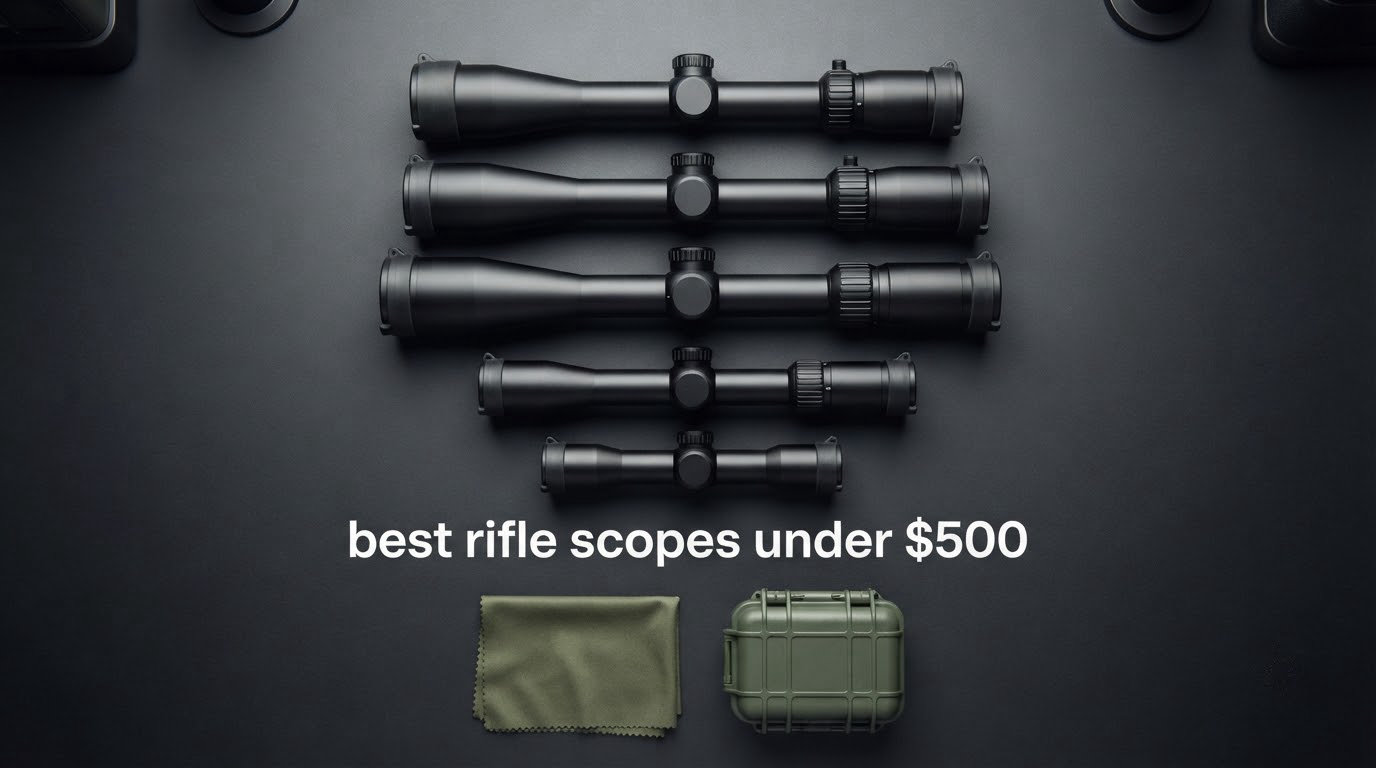
Here are the best rifle scopes under 500 dollars in 2026, ranked after we put twelve of them through the same checklist: glass clarity and color at dawn and dusk, zero retention under recoil, how positively the turrets click, parallax behavior, eye relief, and what the warranty actually covers when something breaks four seasons into a hunt.
Five hundred dollars used to buy a blurry 3-9×40 with a stiff magnification ring and turrets that wandered under recoil. That era is over. In 2026 the money buys genuinely sharp glass, exposed target turrets, first focal plane mil grids, illuminated low power optics and scopes that hold zero across a season without complaint. Every scope below was chosen against the same hard ceiling, and each carries a manufacturer warranty that travels with the scope if you sell the rifle.
Before the reviews, the short version by use case:
- Best overall rifle scope under 500 dollars: Vortex Strike Eagle 1-6×24 — a 1x to 6x range that covers everything from indoor to 400 yards, an illuminated BDC3 reticle and a thread-in throw lever, and the most-reviewed optic we tested.
- Best first focal plane precision pick: Vortex Venom 5-25×56 — a 34mm tube with 85 MOA of travel, true subtensions across the whole range, and a RevStop zero ring in the box.
- Best for 500 to 700 yard target work: Vortex Viper HS-T 6-24×50 — exposed target turrets, a CRS zero stop, and a VMR-1 MOA reticle with a fiber optic 18x marker.
- Best for AR platforms with illumination: SIG SAUER Tango-MSR 1-6×24 — 11 brightness levels and a factory-installed cantilever mount.
- Best classic 3-9×40 hunting scope: Leupold VX-Freedom 3-9×40 — roughly 12 ounces, designed and assembled in the USA, backed by a full lifetime guarantee.
- Best entry 3-12x for a new shooter: SIG SAUER Buckmasters 3-12×44 — a 3:1 zoom, holdover dots to 500 yards, and flip-back lens covers in the box.
- Best low light hunting scope under 500 dollars: Leupold VX-3HD 3.5-10×40 — Elite Optical System glass and the Custom Dial System for dialing holds.
- Best biggest magnification under 500 dollars: SIG SAUER Tango-SPR 6-24×52 on a 30mm tube with an exposed zero-stop dial.
- Best bang for the buck at long range: Athlon Argos BTR GEN2 6-24×50 — a true first focal plane mil grid, 0.1 MIL clicks and 18 MIL of adjustment.
- Best 3-9×40 on a tight budget: Bushnell Banner 3-9×40 — argon purged, IPX7 sealed, and the most forgiving eye relief we found at 6 inches.
Not sure which bucket you are in? Three questions narrow it fast: are you shooting a bolt gun, a lever gun or an AR-style platform; what caliber is your rifle chambered in; and what magnification range do you expect to live in. Answer those and the twelve picks below collapse to two or three realistic candidates.
Table of Contents
- Top 3 Picks for the Best Rifle Scopes Under $500 in 2026
- How We Evaluated Rifle Scopes Under $500
- All 12 Rifle Scopes Under $500 at a Glance
- 1. Vortex Strike Eagle 1-6×24 — Best Overall Rifle Scope Under $500
- 2. Vortex Venom 5-25×56 FFP — Best First Focal Plane Precision Scope Under $500
- 3. Vortex Viper HS-T 6-24×50 — Best for 500 to 700 Yard Target Work
- 4. SIG SAUER Tango-MSR 1-6×24 — Best Illuminated LPVO for AR Platforms
- 5. SIG SAUER Tango-SPR 6-24×52 — Best 30mm Scope for 300 to 500 Yard Work
- 6. Leupold VX-Freedom 3-9×40 — Best Scope for Lightweight Hunting Rifles
- 7. SIG SAUER Buckmasters 3-12×44 — Best Entry-Level 3-12x Scope
- 8. Bushnell Banner 3-9×40 — Best Budget 3-9×40 Hunting Scope
- 9. Athlon Argos BTR GEN2 6-24×50 — Best Mil-Dot Precision Scope Under $500
- 10. Burris Droptine 4.5-14×42 — Best Scope for Big Game Under 400 Yards
- 11. Monstrum G3 6-24×50 FFP — Best Complete Boxed Package
- 12. Leupold VX-3HD 3.5-10×40 — Best Low Light Hunting Scope Under $500
- Rifle Scope Buying Guide: Getting More From a Scope Under $500
- Magnification by use case
- First focal plane versus second focal plane
- Reticle types and the BDC warning
- Objective lens diameter and low light performance
- Tube diameter and adjustment travel
- Turrets, click values and zero stops
- Eye relief and scope bite
- Matching the scope to your caliber
- Vortex versus Leupold under $500
- Rings, mount height and torque
- What You Give Up Staying Under $500, and When to Move Up
- Frequently Asked Questions
- What is the best rifle scope for the money under $500?
- What is the best budget rifle scope?
- What is the best hunting rifle scope for the money?
- What’s better, Vortex or Leupold?
- What is the best night vision or low light scope under $500?
- Should I buy FFP or SFP for hunting?
- How much eye relief do I need on a rifle scope?
- What rings or mounts do I need for my scope?
- Final Recommendations
Top 3 Picks for the Best Rifle Scopes Under $500 in 2026
The Vortex Strike Eagle is the scope we would put on a general rifle and stop thinking about. It carries a 116.5 foot field of view at 1x, an illuminated reticle, and a throw lever, and more than a thousand owners have logged their experience with it. That combination of range, simplicity and warranty coverage is why it takes the top slot.

Vortex Strike Eagle 1-6×24
- 1-6x24 SFP with BDC3 illuminated reticle
- Thread-in throw lever
- Fast focus eyepiece dial
Vortex Venom 5-25×56 FFP
- 5-25x56 FFP with EBR-7C MOA reticle
- 34mm tube with 85 MOA travel
- XD low dispersion glass
Vortex Viper HS-T 6-24×50
- VMR-1 MOA SFP reticle
- Exposed target turrets with CRS zero stop
- XR and Armortek lens coatings
How We Evaluated Rifle Scopes Under $500
Every optic here was judged on the same seven criteria, in this order.
- Glass clarity and chromatic aberration. How clean the image stays at the edges of the group and how much color fringing shows up at the long end of the zoom.
- Zero retention. Whether the scope stays where you put it after a full magazine, a hard cheek weld, and a few thousand rounds.
- Turret tracking. Whether clicks feel positive and repeatable, or whether you count revolutions to get back to zero.
- Parallax behavior. Does the scope have an adjustable objective, and does it cover the range you actually shoot in.
- Eye relief and eye box. Comfort matters more than any spec sheet, especially on a bolt gun with a heavy stock.
- Weight and ring height. A scope that will not balance on a mountain rifle or fit above an AR receiver is the wrong buy no matter how good the glass is.
- Warranty. Lifetime warranties from Vortex and Leupold, Burris Forever, and see-manufacturer terms from the rest.
We also cross-checked owner feedback on r/Hunting, r/longrange and Rokslide, where scope questions get argued in more detail than most magazines ever print them. Our picks for AR-style rifles line up with our AR-15 scope roundup, and for big game we use the same yardage logic as our deer hunting scope guide.
All 12 Rifle Scopes Under $500 at a Glance
| Product | Specifications | Action |
|---|---|---|
| Vortex Strike Eagle 1-6×24 SFP |
|
Check Latest Price |
| Vortex Venom 5-25×56 FFP |
|
Check Latest Price |
| Vortex Viper HS-T 6-24×50 SFP |
|
Check Latest Price |
 SIG SAUER Tango-MSR 1-6×24 SIG SAUER Tango-MSR 1-6×24 |
|
Check Latest Price |
 SIG SAUER Tango-SPR 6-24×52 SIG SAUER Tango-SPR 6-24×52 |
|
Check Latest Price |
 Leupold VX-Freedom 3-9×40 Leupold VX-Freedom 3-9×40 |
|
Check Latest Price |
 SIG SAUER Buckmasters 3-12×44 SIG SAUER Buckmasters 3-12×44 |
|
Check Latest Price |
 Bushnell Banner 3-9×40 Dusk and Dawn Bushnell Banner 3-9×40 Dusk and Dawn |
|
Check Latest Price |
 Athlon Argos BTR GEN2 6-24×50 FFP Athlon Argos BTR GEN2 6-24×50 FFP |
|
Check Latest Price |
 Burris Droptine 4.5-14×42 Burris Droptine 4.5-14×42 |
|
Check Latest Price |
 Monstrum G3 6-24×50 FFP Monstrum G3 6-24×50 FFP |
|
Check Latest Price |
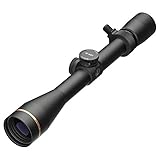 Leupold VX-3HD 3.5-10×40 Leupold VX-3HD 3.5-10×40 |
|
Check Latest Price |
1. Vortex Strike Eagle 1-6×24 — Best Overall Rifle Scope Under $500
Vortex Strike Eagle 1-6×24 Second Focal Plane Riflescope – BDC3 Reticle (MOA)
1-6x24 second focal plane
BDC3 illuminated reticle
116.5 ft FOV at 1x
Throw lever
Pros
- 1x to 6x range covering close quarters through 400 yards
- Illuminated BDC3 reticle for dawn and dusk
- Throw lever included in the box
- Fast focus eyepiece dial
- Vortex unlimited lifetime warranty
Cons
- Very wide field of view makes targets look small at 1x
- BDC drop marks are generic and need your own load
- Second focal plane means holds are estimated not dialed
The Strike Eagle is the scope I hand to people who ask me to just pick one. It runs from 1x to 6x, which covers a walking shot in timber and a 400 yard hog with the same optic and no swapping.
Owners consistently describe clear glass and controls simple enough to adjust in the dark. The magnification ring carries a thread-in throw lever, and the indicators are readable without pulling the scope off the rifle — a small thing you notice every single time.
Technically it is a second focal plane scope with a 3:2 ratio, a 24mm objective and a BDC3 illuminated reticle. Coatings sit on every air-to-glass surface, which is why it holds up in the twenty minutes after sunrise when the deer are moving and the light is ugly.
What you give up is precision at range. Because the reticle is second focal plane, the BDC marks do the work and they are calibrated to a generic trajectory. If you load a lighter bullet than the one the marks assume, the holds will be short.
Is the 1x-6x range wide enough for hunting and defense
For deer, hogs, coyotes and home defense on an AR-style rifle or a lever gun, yes — this range covers the overwhelming majority of shots people take. Our AR-15 scope picks lean on the same 1x-6x logic for the same reason.
It is not wide enough for 700 yard varmint work, where you want 10x at minimum and ideally more. If long-range precision is your primary job, read the Venom or the Argos BTR sections instead.
Who should skip the Strike Eagle
Skip it if you need mil subtensions that stay true at every magnification, or if you need usable holdover markings on your specific load out to 500 yards. Second focal plane BDC is a compromise, and precision shooters outgrow it quickly.
Also skip it if you shoot with glasses in low light and the illuminated reticle matters most to you. The Tango-MSR gives you a brighter reticle at 11 brightness levels with a semi-horseshoe shape that is easier to find in a hurry.
2. Vortex Venom 5-25×56 FFP — Best First Focal Plane Precision Scope Under $500
Vortex Venom 5-25×56 First Focal Plane Riflescope – EBR-7C (MOA) Reticle
5-25x56 first focal plane
34mm tube with 85 MOA travel
9.1 cm eye relief
Pros
- Subtensions hold true across the entire zoom range
- 84 MOA-class dial travel on a 34mm tube
- RevStop zero ring and throw lever included
- Bright XD glass with low chromatic aberration
Cons
- Heavy at about 2.2 pounds for a field rifle
- Hairline reticle strokes are hard to see for aging eyes
- Sized for a bench or heavy precision setup
The Venom is the scope for someone whose shooting has outgrown a hunting glass. It holds subtensions at 5x and at 25x, which means the mil hash marks mean the same thing no matter where you are in the range.
The 34mm tube and 85 MOA of total travel are the real story. That is enough elevation to zero a heavy magnum build high and still come back down, without stacking a 20 MOA ring on a hunting stock.
Owners repeatedly call it one of the best value first focal plane optics available, and they single out the box contents — throw lever, turret tool and a RevStop zero ring that removes the need to count revolutions in the dark.
The XD optical system with fully multi-coated low-dispersion lenses produces a bright image with good color rendition and noticeably less chromatic aberration than scopes a tier below.
What 85 MOA of turret travel actually buys you
Travel is the number people underestimate. A 65 MOA scope zeroed high on a precision build can run out of up-click before you find your zero, and the fix is a taller ring and base — which changes the cheek weld and the balance of the rifle.
With 85 MOA on a 34mm tube, the Venom zeroes where you want it without added height. That is why it pairs cleanly with a chassis or a heavy bolt gun action. Our long range scope guide covers the chassis setup in more depth.
Where the Venom is the wrong choice
At about 2.2 pounds it is a heavy optic for a light hunting rifle. On a mountain gun or a squirrel rifle it will feel like an anchor, and you will notice it on a long walk.
The hairline reticle is also a real consideration past 50. If your eyesight is not what it was, a thicker post or a duplex reticle like the VX-3HD will serve you better than surgical-thin lines at 20x.
3. Vortex Viper HS-T 6-24×50 — Best for 500 to 700 Yard Target Work
Vortex Optics Viper HS-T 6-24×50 SFP Riflescope VMR-1 MOA , black
6-24x50 second focal plane
VMR-1 MOA reticle
Exposed target turrets
17.8 ft field of view
Pros
- Exceptionally clear glass across the whole zoom range
- Fiber optic marker on the 18x subtension
- Holds zero under heavy recoil and handling
- CRS zero stop returns you to zero
Cons
- Only 65 MOA of total elevation travel
- Fine crosshair wires vanish in low light and foliage
- Some edge softness at 24x
The Viper HS-T sits in the sweet spot between a hunting scope and a match rifle optic. Six to twenty-four power covers steel, silhouette and every varmint opportunity in the high desert.
Exposed target turrets are the reason to buy it over a capped hunting scope. Elevation and windage clicks feel positive and repeatable, and the CRS zero stop lets you dial a correction, shoot, and return to zero without counting clicks.
Reviewers praise the glass for gathering light strongly across the entire range, which is what separates a usable 24x from a frustrating one. The image stays crisp where many scopes at this magnification go soft at the edges.
Side focus parallax adjustment and a fast focus eyepiece cover the practical range of a varmint or precision build. In the box you get the scope, a 4 inch sunshade, CRS shims, protective lens caps and a lens cloth.
Does 6-24×50 leave enough elevation travel
Sixty-five MOA is enough for nearly every bolt gun application zeroed at the barrel. It becomes a problem when you want to zero high on a heavy recoil build and still have up-click left, which is why owners often pair it with a 20 MOA ring or base.
If that is your situation, the Venom at 85 MOA on a 34mm tube solves it without extra height. Our long range target scope picks break down the dialing math for both cases.
Where the HS-T frustrates owners
The single most repeated reservation in reviews is the crosshair. Fine wires that look elegant in a photograph become nearly invisible in low light or against foliage at the low end of the range.
There is also some chromatic aberration and edge softness at 24x, which is normal at this price and only becomes obvious if you compare directly against a scope costing twice as much. If low light is your priority, the VX-3HD handles dawn better.
4. SIG SAUER Tango-MSR 1-6×24 — Best Illuminated LPVO for AR Platforms
SIG SAUER Tango-MSR LPVO 1-6x24mm Waterproof Fogproof Hunting Riflescope
1-6x24 second focal plane
Illuminated MSR BDC-6 reticle
11 brightness levels
Cantilever mount
Pros
- Illuminated reticle with 11 brightness levels
- Factory-installed cantilever mount and lens covers
- Holds zero after hundreds of rounds
- Solid sealed construction with low dispersion glass
Cons
- Heavier than competing LPVOs
- Small eye box at 6x
- Lowest BDC hash mark starts at 5 MOA
- Some edge distortion at 1x
The Tango-MSR is the one I recommend when a shooter wants illumination and does not want to buy rings separately. The factory-installed ALPHA-MSR one-piece cantilever mount means the scope is forward-mounted, repeatable, and ready to sit on a flat-top receiver without extra parts.
Owners call it the best value 1-6x illuminated optic in this class, and the semi-horseshoe reticle shape is a genuine advantage. The bottom half of an open reticle gives you a fast aiming reference at 1x and 2x.
The optics use a high performance 6x system with low dispersion glass, and the housing is nitrogen purged and sealed for waterproof and fogproof performance. The reticle runs off a common CR2032-style battery.
Flip-back lens covers come in the box, so there is nothing to buy before the scope goes on the rifle. The semi-horseshoe reticle is also the easiest to find quickly of the illuminated options we tested.
Is a 1-6x LPVO enough magnification for an AR
For home defense, close quarters, three-gun competition and general field use, yes. One power lets you keep both eyes open and maintain a wide field of view, and six power covers most of what you need at 300 yards.
It runs out of reach past about 500 yards for small targets. If your AR is a precision build, the Tango-SPR in the next section covers that end of the range on the same budget.
What owners complain about on the Tango-MSR
Weight is the first complaint, and for a lightweight build it is legitimate. It is heavier than most LPVOs in this class, and on a light receiver it will change how the rifle carries.
Second is the eye box at 6x. Owners report losing the sight picture at the top of the range, which shows up as scope shadow. Third, the BDC hash marks start at 5 MOA, so the lower aiming points do not do much for the close ranges this optic actually gets used at.
5. SIG SAUER Tango-SPR 6-24×52 — Best 30mm Scope for 300 to 500 Yard Work
SIG SAUER Tango-SPR 6-24x52mm 30mm Tube Tactical Riflescope
6-24x52mm second focal plane
30mm main tube
Exposed zero-stop dial
MOA BDC-1 reticle
Pros
- Clean bright image with a 4:1 zoom ratio
- Locking zero stop elevation with capped windage
- Dedicated side focus and included throw lever
- Factory-installed SPR mount plus lens covers
Cons
- Turret adjustments feel slightly mushy
- Isolated reports of turret misalignment on some units
The Tango-SPR fills a gap the rest of this list leaves open: a 6-24 power range on a 30mm tube, on a budget that leaves room for rings and a mount. It is the pick for someone who wants one optic that covers varmints and can still reach across a valley.
Owners praise the clean, bright image and call it ideal for 300 to 500 yard work. The factory-installed SPR mount and flip-back covers mean the box contains most of what you need to mount and shoot it.
Why the exposed zero stop matters
A zero stop means the elevation turret has a hard mechanical stop at zero. You can dial a correction up for a long shot and then return the dial to its stop without reading numbers, which is faster and safer in low light than counting clicks.
The windage side is low profile and capped instead, which keeps it out of the way on a bolt gun. Side focus handles parallax across the magnification range, and the MOA BDC-1 reticle is illuminated for dawn sessions.
Where the SPR falls short
Even though the clicks are accurate, several reviewers describe the feel as slightly mushy compared with exposed target turrets on the Viper HS-T. If you will be dialing a lot of correction, tactile feedback matters.
There are also isolated quality control reports: a stripped ring screw, a scope that arrived not centered, and a replacement with a misaligned elevation turret. These read as individual unit issues rather than a pattern, but they are worth inspecting the scope the day it arrives.
6. Leupold VX-Freedom 3-9×40 — Best Scope for Lightweight Hunting Rifles
Leupold VX-Freedom 3-9×40 (1 inch) Hunt-Plex Reticle Riflescope
3-9x40mm Hunt-Plex reticle
About 12 ounces
33.1 ft FOV at 3x
Lifetime guarantee
Pros
- About 12 ounces on a hunting rifle
- Designed machined and assembled in the USA
- Clear glass that handles low light and harsh sun
- Holds zero after rough field use
- Finger-click capped turrets that are easy to re-zero
Cons
- No adjustable parallax beyond close range
- Reticle is not illuminated
- Lens covers not included in the box
The VX-Freedom is the scope that keeps a mountain rifle a mountain rifle. At roughly 12 ounces it is the lightest optic we tested and it carries a full lifetime guarantee with no proof of ownership needed.
Reviewers frame it as the best value in a genuine Leupold. The glass is clear and crisp in both directions, which is the part budget scopes most often get wrong.
Owners report it holds zero well even after being bounced around in a truck, which is exactly the use case. A scope that walks on a rough forest road is worse than no scope at all.
A 3:1 zoom ratio from 3x to 9x is the traditional hunting curve. The field of view at 3x is 33.1 feet, wide enough to find deer moving in thick cover.
How far can you shoot with no parallax adjustment
This is the most important thing to know about the VX-Freedom. Without an adjustable parallax, it is set for roughly 200 yards or less. Beyond that the shooter has to hold or lean into the scope to bring the target into focus.
That is fine for deer, hogs and general western game inside a few hundred yards. It is not fine for steel, silhouette or any precision work. If your hunting takes you to 400 or 500 yards regularly, the Burris Droptine or the Buckmasters will serve you better.
What you trade for the low weight
No illumination and no lens covers in the box. The Hunt-Plex reticle is a plain duplex with heavy outer posts, which is durable and readable in daylight but disappears in civil twilight.
If you shoot a lot at dawn and do not want to spend on a scope, the Bushnell Banner with its brighter coating or the VX-3HD with the Custom Dial System will serve the same rifle more comfortably.
7. SIG SAUER Buckmasters 3-12×44 — Best Entry-Level 3-12x Scope
SIG SAUER Buckmasters 3-12x44mm Riflescope
3-12x44mm second focal plane
Buckmasters BDC reticle
1-inch tube
34.1 ft FOV at 3x
Pros
- Inexpensive route into a 3-12x hunting range
- Sharp clear image with low dispersion glass
- BDC reticle with holdover dots out to 500 yards
- Flip-back lens covers and throw lever included
Cons
- Non-illuminated reticle in this configuration
- 1-inch tube gathers less light and offers less adjustment travel than 30mm
The Buckmasters is the scope I suggest for someone who has never mounted glass on a hunting rifle and wants to start at 3x without paying for an LPVO. The zoom ratio is the whole selling point: nine times the magnification of the 3x position.
With more than 700 reviews averaging 4.6 stars, it has the kind of installed base that tells you the design is not going anywhere.
Owners value the range, the clear glass and the fact that the caps and throw lever come in the box. Nothing needs to be bought before the scope goes on the rifle.
The single-piece 1-inch main tube is waterproof, shockproof and fogproof, and the reticle carries holdover dots to 500 yards for shooters who want more than a duplex.
Is a 1-inch tube a real limitation
Yes, in two ways. A 1-inch tube gives you less maximum light gathering than a 30mm scope, which matters at dawn and in heavy timber, and it constrains total adjustment travel compared with a 30mm or 34mm body.
Neither matters much for a general hunter putting three or four rounds on a deer. Both matter on a heavy magnum build where windage correction is frequent, which is where the Tango-SPR earns its place.
What to watch on the reticle
The Buckmasters BDC holdovers are only as good as the cartridge they were calibrated for. Shoot a different bullet weight and the dots will not line up, which is the most common complaint pattern for every BDC scope in this price band.
This version is also non-illuminated. There is an illuminated Hellfire variant in the same family, and if you hunt at dawn on a budget, that is the version to look at instead.
8. Bushnell Banner 3-9×40 — Best Budget 3-9×40 Hunting Scope
Bushnell Banner Dusk & Dawn Multi-X Reticle Riflescope with 3.3-Inch Eye Relief, 3-9X 40mm , Black
3-9x40mm Multi-X reticle
6 inches of eye relief
About 12.9 ounces
IPX7 sealed
Pros
- Lowest entry cost in this roundup
- Six inches of eye relief is unusually forgiving
- Dusk and Dawn Brightness multi-coated lenses
- Argon purged with IPX7 waterproof construction
- Most reviewed scope we tested
Cons
- No illumination for very low light
- No adjustable parallax at longer distances
- Plastic construction feels less refined than metal bodies
The Banner is the oldest and most proven design on this list, with several thousand reviews behind it. If you want a proven 3-9×40 for a first hunting rifle and you are careful with it, this is the cheapest sensible place to start.
Its standout spec is eye relief. Six inches is longer than almost every other scope here, and that is not a marketing number. It is the difference between a comfortable cheek weld and scope bite on a heavy bolt gun.
Owners like the brightness and contrast of the Dusk and Dawn Brightness multi-coated lenses. The argon purge keeps the optics fog-free across temperature swings, which matters on a September morning that starts warm and ends cold.
The Multi-X reticle is a traditional hunting reticle with heavy posts. It is not illuminated on this version, so it is a daytime scope despite the series name.
Where a very cheap scope still wins
Eye relief and forgiving ergonomics. At 6 inches you can shoot heavy recoil without a cheek weld fight, and the light body at roughly 12.9 ounces suits a light hunting rifle.
The Multi-X posts are also thick enough to find quickly, which is genuinely useful on a dim morning when you are sitting in a cold tree stand and the reticle is the only thing in your visual field.
What the budget tier gives up
Plastic construction feels less refined in the hand than the aluminum bodies in this list, and there is no illumination for genuine low light and no parallax adjustment for anything past close range.
Frame it as a daytime deer and hog scope, which is exactly what owners say it is. If you want dawn glass and a modern reticle, the Strike Eagle or the Leupold VX-Freedom are the smarter buys.
9. Athlon Argos BTR GEN2 6-24×50 — Best Mil-Dot Precision Scope Under $500
Athlon Optics Argos BTR GEN2 6-24×50 Riflescope – APMR FFP IR MIL, Black
6-24x50 FFP on a 30mm tube
APMR illuminated mil reticle
0.1 MIL clicks
18 MIL travel
Pros
- True first focal plane mil grid at every magnification
- 0.1 MIL click value with 18 MIL of total travel
- Side focus parallax from 10 yards to infinity
- Precision zero stop system
- Fully multicoated for a brighter image
Cons
- Smaller installed base than the major scope makers
- Sunshade and mount are not always in the box depending on variant
The Argos BTR is the sleeper of this list. A real first focal plane mil-dot reticle with 0.1 MIL clicks and 18 MIL of adjustment is a precision configuration normally found well above this budget.
Because the reticle is first focal plane, the mil hash marks hold their spacing at 6x and at 24x. You can move from a holdover to a windage hold without re-learning the reticle.
Owners rate it highly for delivering a genuine FFP mil reticle and a zero stop at a fraction of the cost of premium FFP optics. The side focus covers 10 yards to infinity, which handles everything from close quarters to 700 yards.
The APMR reticle is illuminated, which matters more than it sounds on a precision build where you want the option of dialing light down for a dark timber shot.
MOA versus MRAD — which click value you want
This scope uses mils, and the correct question is what the rest of your kit uses. If you dial in MRAD on an offset scope or use MRAD windage on a chassis, keep mils. If your ammunition data and dope log are all in MOA, an MOA first focal plane scope like the Venom fits better.
Eighteen MIL of total travel is generous for a 6-24x and rarely runs out. The practical limit on most bolt guns is barrel harmonics and the weight of the optic, not the turret.
Where the Argos BTR is the wrong buy
Skip it if you need a pre-computed ballistic ladder, because this is a mil grid rather than a BDC. Skip it if you hunt on a mountain rifle; at about 1.9 pounds it is heavy for that job.
Also check the box before you count on included hardware, because sunshade and mount availability varies by variant. Our longer read on precision rifle scopes covers the chassis and ring height setup.
10. Burris Droptine 4.5-14×42 — Best Scope for Big Game Under 400 Yards
Burris Hunting Durable Waterproof High-Grade Optical Glass Droptine Riflescope with Ballistic Plex Reticle, 4.5-14x 42mm
4.5-14x42mm Ballistic Plex reticle
Adjustable objective
About 8.8 cm eye relief
Pros
- Larger precision-ground lenses for good light collection
- Adjustable objective for parallax control at range
- Generous eye relief for the magnification range
- Hi-Lume multicoating aids low light
- Burris Forever Warranty
Cons
- Capped turrets are not re-zeroable
- Quarter MOA clicks feel mushy and inconsistent
- No sunshade available for this model
- Eye relief gets tight at high magnification
The Droptine is a no-frills hunting scope that does the job without pretending to be a tactical optic. Reviewers describe it as straightforward, capable for medium game inside 400 yards, and backed by the Burris Forever Warranty.
It is the only Droptine model with an adjustable objective, so it is the only one in the line that can correct parallax at real hunting distances rather than being limited to close range.
The high-grade optical glass uses larger precision-ground lenses, and index-matched Hi-Lume multicoating helps with glare and low light. At about 1.1 pounds it stays reasonable on a sporter-weight hunting rifle.
Eye relief of roughly 8.8 centimeters at the low end is forgiving, and the adjustments are positive steel-on-steel for zero retention.
Why the turret feel is the deciding factor
Capped finger turrets cannot be re-zeroed, so once you set your zero you keep counting clicks from there for the life of the scope. That is fine for a deer rifle zeroed once a season.
It is a problem if you change loads, move to a different barrel, or expect to dial correction frequently. Reviewers also report that the quarter MOA clicks feel mushy and vary from click to click, which means zeroing takes a few extra rounds.
Other limits worth knowing
No sunshade is available for this model, which leaves glare unmanaged in bright open country. Eye relief also becomes stingy at the higher magnification settings, so 14x is not where you want to be sitting for a long shot.
If you want a cleaner adjustment experience for a similar role, the Tango-SPR with its exposed zero-stop dial covers the same distance band with more modern controls.
11. Monstrum G3 6-24×50 FFP — Best Complete Boxed Package
Monstrum G3 6-24×50 First Focal Plane FFP Rifle Scope with Illuminated MOA Reticle and Adjustable Objective (Flat Dark Earth)
6-24x50 FFP MOA
Adjustable objective
Illuminated reticle
Rings and sunshade included
Pros
- First focal plane MOA reticle that holds at any magnification
- Adjustable objective for focus and parallax
- Illuminated reticle with multiple brightness levels
- Rings sunshade and flip-up caps included in the box
Cons
- Heavy at about 3.6 pounds
- Glass clarity trails premium scopes from established makers
- Turrets are not as crisply detented
The Monstrum G3 solves a problem most scopes create: it arrives with the hardware you need. Thirty-millimeter high profile rings, a sunshade, spring-loaded flip-up lens covers and a cleaning cloth are all in the box.
That matters for a first precision build because a mount is not optional. A good scope in cheap rings is a well-known way to ruin an otherwise capable optic.
Owners view it as a feature-rich value long range scope. The first focal plane illuminated MOA reticle and the adjustable objective are the two features precision shooters actually care about, and both are present.
The adjustable objective does three things at once: sharpens the target, eliminates parallax, and lets you estimate range by focus. Inline dial illumination with multiple brightness levels handles the low light end.
How heavy is too heavy for a hunting rifle
At about 3.6 pounds this is the heaviest optic we tested. On a bench rest, a chassis, or a heavy bolt gun action it is not a problem at all. Precision rifles are heavy by design.
On a sporter or a mountain rifle it will noticeably change the balance, and it is the single most consistent complaint in the reviews. For a lighter build, the Athlon Argos BTR gives you the same first focal plane configuration at roughly half the weight.
Where the glass falls short
Owners report that edge-to-edge sharpness trails premium glass from established scope makers, and that turrets are less crisply detented. Both are visible when compared directly against a Viper or a Leupold in the same class.
If you are starting out and want a complete long range package to learn on, that is a reasonable trade. If you already know what you want and care about image quality at 20x, spend the difference elsewhere.
12. Leupold VX-3HD 3.5-10×40 — Best Low Light Hunting Scope Under $500
Leupold VX-3HD 3.5-10×40 (1 inch) CDS-ZL Duplex Reticle Riflescope
3.5-10x40mm Duplex reticle
CDS-ZL push-button zero lock
About 1.3 pounds
Pros
- Elite Optical System delivers excellent dawn to dusk brightness
- Custom Dial System accepts a laser-marked bullet drop dial
- CDS-ZL ZeroLock prevents accidental turret movement
- Generous eye relief and eye box
- Withstands heavy magnum recoil
Cons
- Heavier than lighter scopes in its class
- Fixed Duplex reticle carries no holdover marks
The VX-3HD is the scope to buy if low light is the actual problem you are solving. Owners who move up to it report a visible jump in glass clarity and dawn-to-dusk performance, which is what you would expect from Leupold’s Elite Optical System.
The Custom Dial System is the feature hunting shooters notice most. It accepts a laser-marked bullet drop dial made for your specific load, so you turn a ring instead of guessing holdovers.
CDS-ZL ZeroLock is a push-button elevation lock that lets you dial in a correction and then lock the turret so it cannot move when you shoulder the rifle or scramble over a log.
Eye relief and eye box stay consistent across the zoom range, which is what makes target acquisition reliable when the animal is moving and your position is not ideal. The rifle is also designed, machined and assembled in the USA.
Is the Custom Dial System worth the extra cost
If you shoot one or two cartridges and you hate dialing holdovers, yes. A laser-marked dial removes the mental arithmetic from every shot beyond 200 yards, which is a bigger deal in the field than in the shop.
If you already run a dope log or a ballistic solver, it is a convenience rather than a necessity. That is the main argument for spending the same money on the Venom, which gives you a full first focal plane mil grid instead.
The reticle is the weak point
The Duplex reticle carries no holdover information, which looks dated next to a BDC or mil grid. It is durable and easy to see in daylight, and it tells you nothing about holdover.
Weight is around 1.3 pounds, heavier than the VX-Freedom in the same family. This model sits at the top of this price band rather than comfortably inside it, so confirm the current price before you commit to it.
Rifle Scope Buying Guide: Getting More From a Scope Under $500
Most disappointing purchases in this category are not caused by the scope. They are caused by a mismatched magnification range, the wrong focal plane for the reticle you want to use, or a mounting mistake. Here is what actually matters.
Magnification by use case
Match the low end to your shortest shot and the high end to your longest. Everything else follows from that.
- Timber, deer, home defense, AR work: 1x to 6x. You want one power for close shooting and both eyes open.
- General big game hunting: 3x to 9x or 3x to 12x. The 3:1 ratio is the traditional hunting curve and handles a close encounter plus a 400 yard shot.
- Open country and varmints: 4x to 14x or higher. You need the top end for small targets at distance.
- Precision and steel: 6x to 24x or 5x to 25x. A 4:1 or 5:1 zoom ratio gives you usable flexibility at both ends.
Running out of zoom at the low end is a more common regret than adding too much magnification on this budget.
First focal plane versus second focal plane
This is the decision buyers get wrong most often, and it usually matters more than the glass.
First focal plane puts the reticle in front of the erector, so it scales with magnification and mil subtensions stay true at every power. You can range, dial windage, and hold the same spacing at 6x or 24x. The cost is a thinner, more delicate reticle that can look anemic at low power and can strain aging eyes.
Second focal plane keeps the reticle size fixed and thick, which is easier to see and more rugged. The trade-off is that subtensions only work at maximum magnification, so holdovers and mil markings require mental math at every other setting.
If you want mil holds and windage dialing, buy first focal plane. If you hunt with holdovers and want a bold reticle in timber, second focal plane is the better tool. A BDC reticle is second focal plane by definition, so treat any BDC holdover as accurate only for the load it was calibrated for.
Reticle types and the BDC warning
A duplex or Multi-X reticle is heavy posts with simple lines. It is durable, readable, and carries no information beyond a holdover estimate.
A BDC reticle adds hash marks that predict bullet drop for a specific cartridge and bullet. Shoot anything different and the marks lie to you. This is the most common source of missed shots with budget scopes, and it is entirely avoidable.
A mil-dot or Christmas tree reticle in first focal plane gives you ranging marks that hold at any magnification. That is the precision configuration, and it is what makes the Venom and the Argos BTR stand out in this price band.
Objective lens diameter and low light performance
A bigger objective lens gathers more light, which is why scopes intended for dawn and dusk work use 40mm to 56mm objectives. The 56mm objective on the Venom and the 50mm on the Viper HS-T exist for that reason.
A 24mm LPVO objective cannot compete at dawn with a 50mm scope, but you rarely need it to. LPVOs are for close range in daylight, where a 24mm image is more than bright enough and the wide field of view matters far more.
Tube diameter and adjustment travel
Tube diameter determines how much internal adjustment a scope can offer.
- 1-inch tube: Lightest, cheapest rings, limited travel. Fine for a deer rifle.
- 30mm tube: The standard for good reason. More travel than 1-inch, wide ring selection, moderate weight.
- 34mm tube: Maximum travel, up to 85 MOA on the Venom, for heavy recoil builds that zero high.
Travel matters most on a magnum bolt gun zeroed high, where you need up-click left for windage. That is the entire reason the Venom exists in this price range.
Turrets, click values and zero stops
Capped finger turrets are quiet and snag-free but cannot be re-zeroed, so you count clicks from your zero forever after. Exposed target turrets click positively, stand proud for gloved use, and are what you want for dialing.
A zero stop is a hard mechanical stop at the zero position, so you can return to zero by feel. A zero reset lets you push a button and dial back to zero instead. Both are worth having on a precision scope.
Click values are either MOA or mils. Quarter MOA is standard for hunting; tenth MOA and 0.1 MIL are precision values. Stay consistent with whatever your ammunition data already uses.
Eye relief and scope bite
Eye relief is the distance from your eye to the ocular lens. Too little and the scope hits your cheek and blurs the view, which is scope bite. Too much and you lose the aiming picture because the eye box shrinks.
The sweet spot is roughly 3.5 to 4.5 inches, and the scopes here run from about 3.5 inches on the 40mm hunting models to a full 6 inches on the Bushnell Banner. If you shoot a heavy magnum with an aggressive cheek weld, prefer the long end of that range.
Matching the scope to your caliber
Your caliber determines how much elevation travel you need and how fast the bullet drops at distance, which is what a BDC reticle is trying to solve for you.
- .22LR rimfire: Minimal drop. A 3-9×40 or 3-12×44 is plenty for plinking and small game.
- 5.56 and .308 Winchester: The bread and butter. A 3-12x or 4-14x with a duplex or simple BDC covers nearly everything.
- .270 Winchester: Flatter than .308, so less drop. A 3-9×40 with a duplex reticle is a genuine long-range hunting answer.
- 6.5 Creedmoor: Similar ballistics to .308 with a lighter projectile. A 4-14×42 or 6-24x with exposed turrets handles the wind.
- .300 Win Mag and 6.5 Rem Mag: Heavy recoil and real drop. Choose a 30mm or 34mm tube, an exposed turret and a zero stop, which is where the Venom earns its place.
If you reload or change bullet weights regularly, a first focal plane mil grid beats a BDC every time, because the mil marks do not care what you loaded. Our reloading press roundup is a natural companion if you build your own loads.
Vortex versus Leupold under $500
This question comes up constantly, and the honest answer is that both brands build scopes well above this price tier.
Vortex pairs a wider catalog with an unlimited unconditional lifetime warranty that covers the scope and the rifle it is mounted on. Glass choices like the XD system on the Venom put it ahead in brightness, and the catalog means more configurations to match your rifle.
Leupold designs, machines and assembles in Beaverton, Oregon, and the full lifetime guarantee requires no proof of ownership. The Custom Dial System on the VX-3HD and the light weight of the VX-Freedom are the standout features. Leupold tends to sit at the higher end of this price band, which sometimes pushes it over the ceiling.
Choose Vortex for configuration choice and warranty breadth, Leupold for US manufacturing and the Custom Dial System. Both beat most of the rest of this list on glass.
Rings, mount height and torque
Do not put a scope worth this much into the cheapest rings you can find. Ring quality affects zero retention and light sealing more than most buyers expect.
Use a torque wrench and tighten the ring screws in small, even increments in a star pattern. Over-tightening crushes the scope tube, and under-tightening lets it walk under recoil. If the manufacturer specifies a torque value, follow it.
Ring height determines whether you get a clean sight picture or scope bite. Set the ocular lens about half an inch above the top of the receiver with the scope at its lowest magnification. If you cannot get the bells below your iron sight line, you need taller rings or a riser, and on an AR platform a proper cantilever.
Finish by bore-sighting rather than zeroing immediately, then confirm zero with live fire and re-check it after the first session.
What You Give Up Staying Under $500, and When to Move Up
Budget glass shows its age in two places: edge-to-edge sharpness away from the center of the field, and chromatic aberration, which is the colored fringing you see on high contrast edges near the rim of the image at high magnification.
A sub-500 dollar scope can look excellent in the center of the group and noticeably soft at the edges at 20x. A scope costing several hundred dollars more is sharper across the whole field, holds contrast better in fog and heavy timber, and typically has better flare control in hard sun.
What you usually do not give up: turret quality, zero retention, sealing, and warranty coverage. Those are already at the level buyers care about most.
Move up when you start competing at long range, when you need mil subtensions that hold at every power, when you are dialing 30 MOA of correction on a magnum build, or when image quality starts limiting you at 20x and beyond. When you are hunting whitetail in timber, a sub-500 dollar scope is genuinely enough.
Frequently Asked Questions
What is the best rifle scope for the money under $500?
For most people the Vortex Strike Eagle 1-6×24 is the best rifle scope for the money under $500. It covers 1x to 6x, has an illuminated BDC3 reticle, includes a thread-in throw lever, and carries an unlimited lifetime warranty. If you need mil subtensions for precision instead, the Vortex Venom 5-25×56 is the alternative.
What is the best budget rifle scope?
The Bushnell Banner 3-9×40 is the cheapest proven option, with several thousand reviews behind it, argon-purged optics, IPX7 waterproofing and an unusually forgiving 6 inches of eye relief. It is a daytime hunting scope with no illumination and no parallax adjustment.
What is the best hunting rifle scope for the money?
The Leupold VX-Freedom 3-9×40 is the pick for most hunters. It weighs about 12 ounces, holds zero after rough field use, has clear glass that handles both low light and harsh sun, and comes with Leupold’s full lifetime guarantee. It has no parallax adjustment, so keep it inside roughly 200 yards.
What’s better, Vortex or Leupold?
Vortex wins on configuration choice and on warranty breadth, since the unlimited unconditional lifetime warranty covers the scope and the rifle it is mounted on, and models like the Venom use XD low-dispersion glass for brightness. Leupold wins on US manufacturing in Beaverton, Oregon, and on the Custom Dial System that lets you dial holds for your exact load in the VX-3HD. Both exceed the quality of most scopes in this price band.
What is the best night vision or low light scope under $500?
No electronic night vision fits under this ceiling. For optical low light, the Leupold VX-3HD 3.5-10×40 is the strongest pick because the Elite Optical System delivers high brightness and low glare at dawn. The SIG SAUER Tango-MSR 1-6×24 adds an illuminated reticle with 11 brightness levels, which is more useful in civil twilight.
Should I buy FFP or SFP for hunting?
Buy second focal plane if you hunt with holdovers and want a bold, visible reticle in timber, which is what a BDC scope offers. Buy first focal plane if you want mil subtensions that stay true at every magnification for ranging and windage holds. BDC holdovers are only accurate for the specific cartridge and bullet they were calibrated for.
How much eye relief do I need on a rifle scope?
Aim for roughly 3.5 to 4.5 inches of eye relief. Too little causes scope bite, where the ocular lens hits your cheek and blurs the view. Heavy magnum rifles with a high cheek weld want the long end of that range, which is why the Bushnell Banner lists 6 inches.
What rings or mounts do I need for my scope?
Match the ring diameter to your tube: 1-inch, 30mm or 34mm. Use quality rings, a torque wrench, and tighten the screws in small even increments. For an AR-style rifle use a cantilever mount so the scope sits forward and returns to the same zero after removal. Set the ocular lens about half an inch above the receiver so the bells sit below your iron sight line.
Final Recommendations
The best rifle scopes under 500 dollars in 2026 come down to which job you are doing. General hunting, AR platforms, precision work and low light each have a clear answer.
- Best overall, and our editor’s choice: Vortex Strike Eagle 1-6×24 — the most useful zoom range for general shooting, illumination, and the most owner history behind it.
- Best precision value: Vortex Venom 5-25×56 — first focal plane subtensions, 85 MOA of travel, zero ring included.
- Best for 500 to 700 yards: Vortex Viper HS-T 6-24×50 — exposed target turrets and a CRS zero stop.
- Best lightweight hunting scope: Leupold VX-Freedom 3-9×40 — about 12 ounces and a full lifetime guarantee.
- Best low light hunting: Leupold VX-3HD 3.5-10×40 — Elite Optical System glass and a Custom Dial System.
- Best on a strict budget: Bushnell Banner 3-9×40 — proven, sealed, and the most forgiving eye relief we found.
Whichever one you choose, buy quality rings, torque them properly, bore-sight first, and re-check zero after the first session. Those five minutes protect the scope far better than any spec sheet.
Last updated: September 2026. Street prices for optics change frequently, so confirm current pricing before you buy. We may earn a commission from qualifying purchases.