
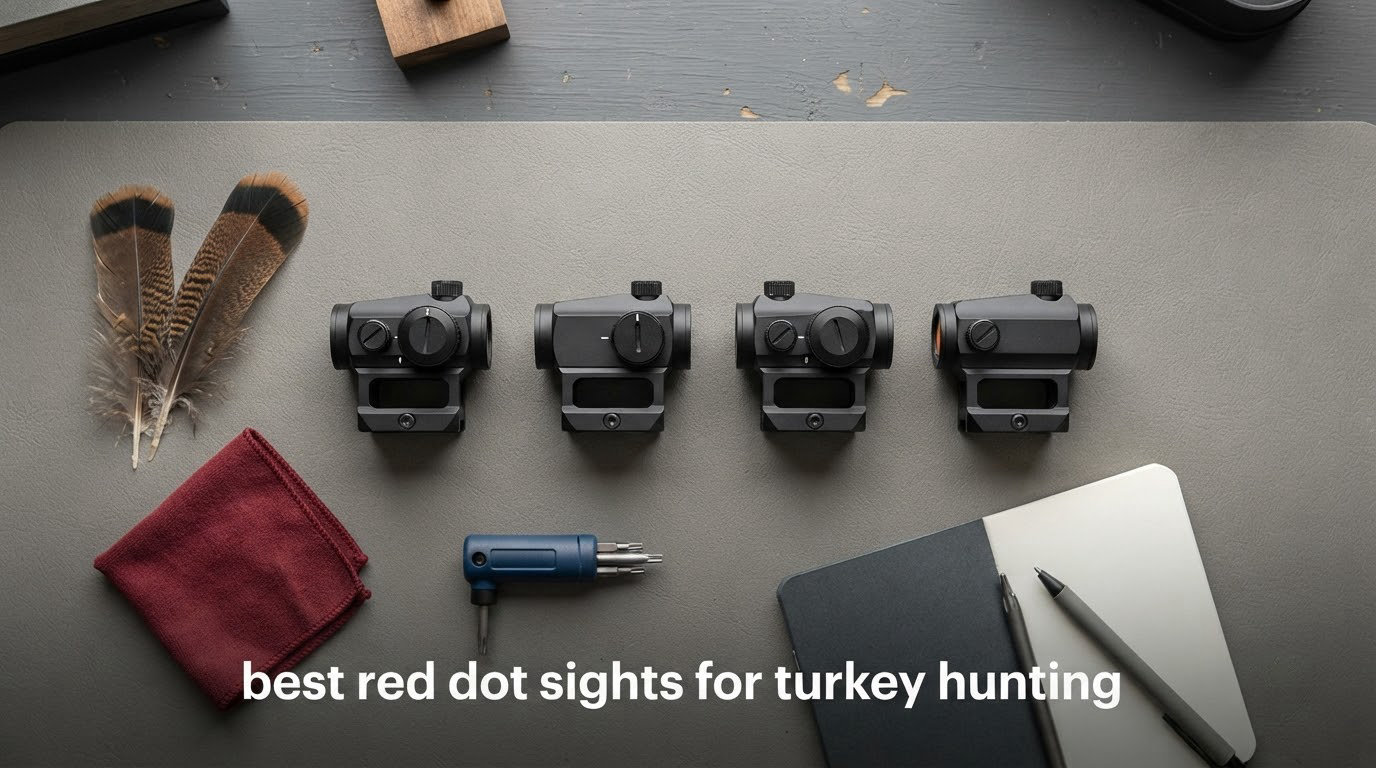
Most turkey hunters buy a red dot sight for one reason: the gobbler will not wait while you find the bead. Modern loads like TSS put a tight, dense pattern in a small circle, which means the shot is won or lost by putting that circle on a head and neck at 30 yards. A red dot gives you one glowing point to hold instead of a bead that disappears in shadow, and it keeps your cheek welded to the comb so your head stays down and both eyes stay open. That is the whole argument, and it is why experienced hunters treat a red dot as close to required equipment rather than an upgrade.
We spent the last few weeks reading owner reports, comparing spec sheets and cross-checking the failure modes that show up in hunting forums. This guide covers the best red dot sights for turkey hunting across the full price range, from a three-ounce budget optic to a solar multi-reticle unit that never needs a battery. Every pick below is a rail-mounted reflex sight that works on a shotgun receiver ring, a Picatinny rail or a barrel rib clamp, and we tell you plainly which one is wrong for you.
If your shotgun is still on plain bead sights, start with our shotgun red dot guide for mounting basics, and if you also carry a sidearm, our pistol optic picks cover the smaller-footprint options.
Table of Contents
- Why Use a Red Dot for Turkeys?
- Our Top 3 Picks for Turkey Hunting
- All 10 Red Dot Sights Compared in 2026
- How We Evaluated These Optics
- 1. Holosun 510C Multi-Reticle Solar Reflex Sight
- 2. Sig Sauer ROMEO5 Gen I and Gen II
- 3. Vortex Strikefire II
- 4. Holosun 507C X2
- 5. Vortex Crossfire Gen II
- 6. Vortex SPARC Gen II
- 7. Bushnell TRS-25
- 8. Sightmark Ultra Shot R-Spec
- 9. Burris FastFire 3
- 10. Bushnell Trophy 1×28
- How to Mount a Red Dot on a Turkey Gun
- Red Dot vs Fiber Optic vs Ghost Ring for Turkeys
- Red Dot vs Green Dot: Which Works Better at Dawn
- Buying Guide: Key Features to Look For in a Turkey Optic
- Frequently Asked Questions
- Final Thoughts
Why Use a Red Dot for Turkeys?
Three reasons come up constantly, and they are the same three reasons that show up in every hunter forum thread on the subject.
Tight patterns demand precise placement. A dense, tight-spreading turkey load leaves no margin. A red dot is a precision aiming reference rather than a crude holdover, so you can put the center of the pattern on the neck instead of guessing where the front bead is sitting relative to the comb.
Your head stays on the comb. With a reflex sight, the aiming point and the target are the same visual event. You do not lift your head, look down, find the bead, and come back up while a strutting gobbler is deciding whether you are a threat.
Both eyes stay open. You keep the bird’s body language in your peripheral vision. You can see the hen drifting in behind him, the second gobbler stepping into the open, and the way a tom changes his strut right before he drums. That peripheral awareness is how you avoid shooting a hen and how you know when to wait.
There is a fourth, quieter benefit: confidence on the first shot. A hunter who can see the dot find the bird on a cold morning in a dark timber edge is a hunter who takes the shot instead of waiting for another gobbler to walk into a better setup.
Our Top 3 Picks for Turkey Hunting
These three cover the most common situations. The Holosun 510C is the one we put on our own gun. The Sig Sauer ROMEO5 is the best value for a first setup. The Vortex Crossfire Gen II is the pick if you want the lowest cost of entry with a lifetime warranty attached.

Holosun 510C Multi-Reticle
- 2 MOA dot with 65 MOA circle
- Solar Failsafe with shake wake
- Limited lifetime warranty


All 10 Red Dot Sights Compared in 2026
Every sight below is a 1x non-magnified reflex or holographic unit, which is the only class that makes sense on a turkey gun. Dot size, emitter style and mount height are the three columns that decide the outcome, and the table below gives you all three at a glance before you read the individual write-ups.
| Product | Specifications | Action |
|---|---|---|
| Holosun 510C Multi-Reticle |
|
Check Latest Price |
| Sig Sauer ROMEO5 Gen II |
|
Check Latest Price |
 Vortex Strikefire II Vortex Strikefire II |
|
Check Latest Price |
 Holosun 507C X2 Holosun 507C X2 |
|
Check Latest Price |
| Vortex Crossfire Gen II |
|
Check Latest Price |
 Vortex SPARC Gen II Vortex SPARC Gen II |
|
Check Latest Price |
 Bushnell TRS-25 Bushnell TRS-25 |
|
Check Latest Price |
 Sightmark Ultra Shot R-Spec Sightmark Ultra Shot R-Spec |
|
Check Latest Price |
 Burris FastFire 3 Burris FastFire 3 |
|
Check Latest Price |
 Bushnell Trophy 1×28 Bushnell Trophy 1×28 |
|
Check Latest Price |
Every one of these is sold in the budget-to-mid price range, so the tier question is mostly about weight, window size and battery behaviour rather than sticker cost. If you want to know how a reflex sight measures up against a magnified optic, our red dot and magnifier guide covers the setup where you shoot longer than 40 yards.
How We Evaluated These Optics
We did not bench-test these sights on a range. Instead we synthesised manufacturer specifications with a large body of owner feedback and long-running hunter forum discussions, which is the signal experienced turkey hunters themselves rely on. When the same failure mode shows up across hundreds of reviews, it is real, and we treat it as real.
Four things decided the ranking. First, durability under 12 gauge recoil, which is a harder duty cycle than most carbine optics ever see. Second, mount security, because forum consensus is blunt that a solid mount matters more than glass quality. Third, whether the battery can die in the field during a three-day hunt in November. Fourth, whether the sight sits high enough to break your cheek weld, which produces the inconsistent point of impact that costs birds.
We also weighted the negative reviews heavily. Buyers ask for honest cons before they buy a red dot, and the failure modes reported in that feedback are what separate a good turkey optic from a bad one.
1. Holosun 510C Multi-Reticle Solar Reflex Sight
HOLOSUN 510C Multi-Reticle 2 MOA Dot & 65 MOA Circle Open Reflex Sight – Solar FailSafe Shake-Awake, 12 Settings – Red/Green Dot (Red)
2 MOA dot, 65 MOA circle
Solar Failsafe with shake wake
Limited lifetime warranty
Pros
- Multi-reticle gives a 2 MOA dot or 65 MOA circle
- Solar Failsafe runs on ambient light
- Shake Awake wakes the optic on motion
- Zero retention reported through heavy recoil
Cons
- Windage may need a large side-to-side correction at installation
- Quick detach mount can fit loosely on first fit
This is the sight we would put on our own turkey gun, and it is the first unit we reach for when a hunting partner asks for one recommendation. The 65 MOA circle surrounding a 2 MOA dot solves the single biggest aiming problem on a shotgun, which is finding a tiny dot quickly against a dark background of timber and a strutting bird. The dot is small enough to place precisely and the circle gives your eye something to land on while the gobbler is still moving.
Solar Failsafe is the feature that changes how you pack. Because the emitter keeps working on ambient light, a dead battery stops being a reason to bail out of a setup at dawn. Shake Awake handles the other end of the problem, waking the optic the moment you move it instead of making you cycle a button with cold gloves on.
Owner feedback is unusually consistent on durability. The most common theme across thousands of reviews is zero retention through hundreds of rounds, rough handling, water exposure and recoil, with the circle singled out as the reason the dot is easy to find in low light. That matters in a ground blind at first light more than any optical specification.
The honest weakness is the installation. A number of owners report that windage needed a significant side-to-side correction out of the box before the sight would zero, and that the quick detach mount can feel loose on the first installation until it is tightened with the included tool. Neither is a defect, but both are things to plan for on the bench rather than in the field.
Why it works so well on a turkey shotgun
The multi-reticle system means you can change aiming references without changing sights. Circle-dot for walking birds when speed matters, plain 2 MOA dot for a stationary tom at 35 yards when precision is everything.
At 8.32 ounces the weight is noticeable on a shotgun but not punishing, and the rail mount means you can slide it between a shotgun, a rifle and a pistol setup using the same rings.
Where it falls short
It is an open-emitter design, so the front lens is exposed to rain, snow and the grit that comes off a road-side setup. In a ground blind in bad weather you will want a lens cover or a lens cloth in your pocket.
If you have astigmatism, the small 2 MOA dot can look like a comet rather than a clean point. Owners with astigmatism report clearer results with a larger dot, so read the section on dot size before you settle on this one.
2. Sig Sauer ROMEO5 Gen I and Gen II
SIG SAUER ROMEO5 GEN I 1x20mm Waterproof Shooting Gun Sight
2 MOA red dot, 145 grams
MOTAC motion activation
IPX-7 waterproof
Pros
- Largest review base in this roundup
- Unlimited eye relief
- Includes low Picatinny mount and riser
- Zero retention reported over 1000 rounds
Cons
- Reflective front lens darkens the view at dusk
- Long button press powers the optic fully off
- Turret cap screws are fiddly to remove
The ROMEO5 is the most thoroughly owner-tested optic in this group, with well over thirteen thousand reviews. That volume matters for a hunting gun because it means the long-term failure rate is well documented rather than a mystery. Zero retention over a thousand or more rounds is the most common report, along with quick zeroing and strong battery life thanks to motion activation.
For a turkey gun the practical selling point is the mount package. It ships with both a low Picatinny mount and a 1.41 inch riser, so you can set the dot up for co-witness alignment with the shotgun’s bead and still get a comfortable cheek weld. At 145 grams it barely changes the balance of a 12 gauge.
Motion activation wakes the dot when the gun moves and shuts it down when you go still, which removes the dead-battery anxiety that matters most on a multi-day spring hunt. Ten illumination settings including two night-vision levels cover the full range from a dark timber roost to full morning sun on an open field.
The one optical weakness owners report is a reflective front lens, which adds a slight tint and makes the view darker at dusk than some competing glass. In a pre-dawn setup that is a real consideration, though for a spring gobbler at 7am in April it rarely matters.
Read this before the first hunt
The single most repeated theme in the reviews is confusion around the power controls. The brightness buttons are momentary clicks rather than press-and-hold, and holding a button longer than about a second powers the optic fully off. Owners who do not read the manual sometimes return a perfectly good sight.
Rubber turret cap screws are also reported as fiddly to remove, so keep a small tool in your range bag rather than fighting them with gloved fingers in a blind.
Who should skip it
If you shoot very early in heavy overcast light, the tinted lens bothers some owners and you may prefer a brighter, clearer window. The rest of the package is hard to argue with at this level of field testing.
If you already own a red dot and want magnification instead, the same platform pairs with a 1x or 2x tube for those open-country birds past 50 yards.
3. Vortex Strikefire II
Vortex Strikefire II Red Dot Sight – 4 MOA Red/Green Dot
4 MOA dot with red or green options
Fully multi-coated glass
Offset cantilever mount
7.2 ounces
Pros
- Single-piece shockproof aluminum chassis
- Zero shift reported across thousands of rounds
- Unlimited lifetime warranty
- Green dot option suits shooters with astigmatism
Cons
- 4 MOA dot looks oversized behind a magnifier
- Brightness buttons are stiff to press
- Shallow battery life in cold weather
The Strikefire II is the one on this list that hunters name when they talk about recoil survival. The single-piece aluminum chassis is shockproof against both recoil and impact, and owners report thousands of rounds with no zero shift and a clear window in full sun. A long-running discussion on a turkey hunting forum has one poster reporting three years of problem-free use on a Vortex and praising the sight picture over the alternatives available at the time.
The 4 MOA dot is the defining characteristic. It is a big, obvious dot that you can find instantly, which works well on a bird strutting in dim light at 25 yards. It is less precise than a 2 MOA dot at longer range, and it grows visually larger if you pair it with a magnifier.
Nitrogen purging and o-ring seals make it fogproof and waterproof in any weather, and the multi-coated glass gives unlimited eye relief so the aiming point is easy to find no matter where your head sits. Elevation and windage adjust up to 100 MOA each, which is more than enough to compensate for a change in zero between buckshot and slug loads.
Red and green dot options are both available, and shooters with astigmatism repeatedly single out the green as far easier to see. That single choice matters more than any other spec if you have astigmatism and a 4 MOA red dot looks like a smear to you.
What survives a shotgun
Recoil is the reason the chassis is one piece rather than bolted together. Owners running heavy 12 gauge loads report no point of impact shift and no loosening adjustment turrets after thousands of rounds, which is the durability signal that matters most when you cannot afford to re-zero on opening morning.
Shockproof construction and o-ring sealing mean a muddy tailgate or a rain-driven setup is survivable, which is not something you can say about every optic in this price band.
Where it falls short
Cold weather battery life is the reported weak point, and April turkey mornings in the north are exactly when cold weather battery life decides whether you zero at dawn or not. Carry a spare cell.
Several reviewers also wish for more brightness settings for direct sunlight, and the rubber cover over the buttons makes them stiff to press with gloves on. If you hunt in open country with a rising sun behind the bird, test the brightness range before season.
4. Holosun 507C X2
HOLOSUN HS507C-X2 Red 2 MOA Dot & 32 MOA Circle Open Reflex Pistol Sight – Durable Shake-Awake Solar Failsafe Parallax-Free Aluminum Sight for Full-Sized Handguns – Multi-Reticle Red Dot
2 MOA dot, 32 MOA circle
1.44 ounce aluminum body
Solar with shake wake
Pros
- Extremely light at 1.44 ounces
- Lock mode stops accidental setting changes
- Side battery tray keeps zero
- Clear glass even with astigmatism
Cons
- CR1632 battery life reported shorter than expected
- Plus and minus buttons are awkward to press together
The 507C X2 is frequently described in owner reviews as one of the best value optics available, and for a turkey gun its main draw is weight. At 1.44 ounces it is the lightest sight we cover, which matters on a barrel-heavy shotgun where every ounce forward of your trigger hand changes how the gun carries through a strutting bird.
It also handles astigmatism better than most of its size. Owners running it on 12 gauge shotguns report tight sub-groups at 25 yards with slugs, and the glass is repeatedly described as clear. The 32 MOA circle around a 2 MOA dot gives you a faster aiming reference than the plain dot on the 510C while keeping the centre precise.
The side-mounted CR1632 battery tray is a design we would like to see on every optic. You can swap cells without removing the sight and without losing your zero, which on a three-day spring hunt is the difference between shooting the first bird and walking back to the truck.
Solar Failsafe and shake wake handle the rest of the battery problem, and lock mode stops a stray bump in a pack from changing your brightness setting. The RMR-style footprint is the most common base pattern in the class, so mounts and rings are cheap and easy to move between guns.
Best use case
This is the sight for a shooter with astigmatism, or for anyone who wants a small, light optic that never gets in the way of a shotgun’s balance point. The circle-dot reticle handles both fast walking shots and precise stationary ones.
It is also the easiest of the ten to move between a shotgun and a pistol, which is handy if you use one optic across several guns.
Where it falls short
The recurring complaint is CR1632 longevity. Some owners report the cell dying sooner than expected, around seven months with light use, so a spare cell in the pack is not optional.
Shutting the optic down requires a simultaneous two-finger press, and the plus and minus buttons are positioned awkwardly enough that owners describe the action as finicky. Read the manual once at the bench and it never comes up again.
5. Vortex Crossfire Gen II
Vortex Crossfire Red Dot Sight Gen II – 2 MOA Red Dot, Tan
2 MOA red dot, 5.2 ounces
Helicoil thread inserts
11 illumination settings
Pros
- Helicoil threads resist stripping
- Low profile keeps the cheek weld intact
- Zero retention reported with buckshot and slugs
- Unlimited lifetime warranty
Cons
- Brightness wheel only turns one direction
- On off switch sits close to the windage turret
- Dot shows a corona effect at high brightness
The Crossfire Gen II is the budget pick here, and the reason is the helicoil thread upgrade. The mounting threads on a cheap optic are the first thing to strip when a hunter tightens it for the tenth time on a muddy tailgate, and the steel inserts in this one are designed specifically to prevent that.
Owners running it on shotguns report no recoil issues and solid zero retention with both buckshot and slugs. That is the exact duty cycle you care about, and it is the thing budget optics usually get wrong.
At 5.2 ounces it is light enough to disappear on a shotgun, and the mount height sits close to a T2 base so red dot mounts, rings and magnifiers all line up true if you decide to add magnification later. Eleven illumination settings give you nine daylight levels and two night-vision levels, which is more than most of the field requires.
Multiple anti-reflective coatings on every air-to-glass surface push more light through the window, and o-ring seals keep moisture and debris out. The Vortex lifetime warranty and the customer service behind it are the most frequently mentioned reasons owners buy the brand a second time.
Why it works for a first turkey setup
The 2 MOA dot is fine enough for accuracy at extended range and quick enough to acquire on a moving bird. That balance is what you want on a turkey gun, where most shots happen between 20 and 40 yards.
Skeletonized low and lower co-witness mounts are included, so you can set the dot height for your particular comb and cheek weld rather than accepting whatever the factory default is.
Where it falls short
The brightness wheel only turns in one direction, from zero to eleven, and cannot be reversed with a single click. You will get used to it, but adjusting down in the field takes several clicks.
The on and off control sits close to the windage turret, so a finger can rub the knurled adjustment knob while you reach for it, and at the very highest brightness settings the dot shows a corona or star-burst effect. Keep the brightness a notch or two below maximum in daylight.
6. Vortex SPARC Gen II
Vortex SPARC Red Dot Sight Gen II – 2 MOA Dot
2 MOA dot, 7.5 ounces
Standard AAA battery
12 illumination settings
Pros
- AAA battery is easy to find anywhere
- Up to 700 hours on the highest setting
- Integrated multi-height mount system
- Zeroes easily and holds zero
Cons
- Lens covers flap around and some owners remove them
- Rear buttons need a lot of force to operate
- Limited riser and colour options
The SPARC’s argument is the battery. It runs a standard AAA cell, which you can buy in any grocery store on the way to the hunt, and rated life runs up to 700 hours on the highest setting and 50,000 hours on the lowest. For a three-day spring hunt in a state with no hardware store in the county, that is a meaningful advantage over a coin cell.
Owners describe it as a solid, affordable sight that zeroes easily and holds that zero, with a brightness range that does not wash out in direct sun. The 2 MOA dot acquires fast at close range and is fine enough to place a shot at distance, which covers the whole range most gobblers are taken at.
The integrated multi-height base supports both absolute co-witness and lower co-witness mounting, so you can change the height rather than buying a different mount. The single-piece chassis is compact and light at 7.5 ounces, and the o-ring seals keep water and debris out.
Twelve illumination settings give you real control in a dark timber roost tree, and a few users notice slight dot flickering that they describe as not annoying and not preventing aim. Multiple anti-reflective coatings increase light transmission across every air-to-glass surface.
Where the extra battery life pays off
Any hunt longer than one day, and especially any hunt in November or February where the optic sits in a cold truck between setups. You are not relying on a coin cell surviving a freeze overnight.
The snap-together flip lens covers are a small touch that matters in a ground blind where the sight is inside a shelter and in the field where it is not.
Where it falls short
The included lens covers flap around, and a number of owners remove them and carry a soft cloth instead. Rear buttons need a fair amount of force to operate, which is awkward with gloves on.
Colour and riser options are limited compared with competitors, so if you need a specific riser height or a specific dot colour you may have fewer choices than the market offers.
7. Bushnell TRS-25
Bushnell Trophy TRS-25 Red Dot Sight Riflescope, 1x20mm, Black
3 MOA dot, 3.68 ounces
70+ MOA adjustment
Nitrogen purged and sealed
Pros
- Lightest optic in the roundup
- Zero held through thousands of rounds on 12 gauge
- Works on shotguns rifles pistols and muzzleloaders
- Tight adjustment knobs
Cons
- Dot star-bursts at higher brightness settings
- Battery compartment cap is very tight to remove
- Co-witness needs a riser that is not included
With more than fifteen thousand reviews, the TRS-25 has the most owner history of anything on this list. The consistent description is the best low-cost red dot available, with solid construction, a crisp dot, tight adjustment knobs and zero retention through thousands of rounds on 22, 9mm, 5.56, 12 gauge and muzzleloader platforms.
At 3.68 ounces it is the lightest optic here, so it genuinely disappears on a shotgun. The manufacturer lists it as compatible with shotguns, rifles, pistols and muzzleloaders, which means one cheap sight can cover a whole gun safe for a hunter who is not fussy about matching brands.
Seventy plus MOA of windage and elevation correction is more range than you will ever use, and it means the sight can absorb a barrel change or a switch between buckshot and slug without a fight. Eleven brightness settings cover daylight through low light, and battery life runs past 5000 hours on the mid setting with a CR2032 included in the box.
Nitrogen-purged, o-ring sealed optics stay dry and fog-free, and the shockproof construction is rated for bumps, drops and general field abuse. For a hunter learning to shoot a turkey gun with a sighted rifle, it is the least intimidating place to start.
The first-timer case
Nothing about this sight is confusing. Buttons do what they look like, the turrets click cleanly, and the dot is a straightforward 3 MOA that a new shooter can find without instruction. That simplicity has real value on a bird you only get three or four chances at.
Owners consistently praise the machining relative to generic sights at similar price points, and the CR2032 cell, lens covers and lens cloth all come in the box.
Where it falls short
There is no automatic shutoff or shake wake, so the battery can drain if you leave the switch on between setups. That is the one habit you have to build, and it matters on a multi-day hunt.
Co-witness with standard iron sights requires adding a riser, which is not included, and the battery compartment cap can arrive very tight and hard to remove. The dot also shows a star-burst pattern at the higher brightness settings, so keep it a couple of clicks down in daylight.
8. Sightmark Ultra Shot R-Spec
Sightmark Ultra Shot R-Spec Reflex Sight , Black
5 MOA dot, 33mm glass
6061-T6 aluminum body
Quick detach mount
Pros
- Integrated shield protects the housing
- Large window aids pickup on a moving bird
- Coated scratch resistant lens holds up in rough conditions
- Quick detach mount
Cons
- Heaviest optic here at 15.2 ounces
- 5 MOA dot is large for precision at distance
- Rubber turret caps are hard to remove
The R-Spec is the fastest-acquiring sight in this roundup, and that is not an accident. The 33mm objective lens and the 5 MOA dot give you the biggest, most obvious aiming point available, which is exactly what you want when a strutting gobbler is 25 yards out in brush and you need to put the dot on him in the first second.
Owners commonly recommend it for shotguns specifically because the larger dot aids fast acquisition on moving birds. The 6061-T6 aluminum body and the integrated protective shield are the reasons it holds up, and the coated scratch-resistant lens system does real work in a rough setup.
Four reticle options across red and green give you a genuine choice for the light you are hunting in, spread across ten brightness settings. The quick detach mount makes putting the sight on and taking it off simple if you run different optics for different setups.
This is a solid mid-priced optic that most owners describe as delivering more than they expected. The trade-offs are physical rather than optical, and both are ones you can decide about with your hand on the gun.
When the biggest dot wins
Walking and stalking gobblers in thick cover, or any situation where the bird appears at close range with little warning. At those ranges a 5 MOA dot removes the aiming question entirely.
The integrated shield is also worth something on a shotgun, because a 12 gauge receiver does not care what you bang it against while you are climbing over a fence.
Where it falls short
At 15.2 ounces it is the heaviest optic in this roundup, and on a barrel-heavy shotgun that weight is noticeable over a long sit in a blind. Nothing breaks, it just feels heavy after a few hours.
The 5 MOA dot is large for precise shooting at distance, and the rubber turret caps are difficult to remove when you need fine adjustment. If your birds average above 40 yards, a 2 or 3 MOA dot is the better starting point.
9. Burris FastFire 3
Burris Optics Hunting Lightweight Versatile FastFire 3 Red Dot Sight 3MOA with Picatinny Mount, Black
3 MOA dot in a 4 ounce housing
Automatic brightness sensor
Top mounted battery access
Burris Forever warranty
Pros
- Top battery access keeps your zero
- Automatic brightness sensor adapts to light
- Compact build does not upset shotgun balance
- Holds zero after hundreds of rounds
Cons
- Battery cap is easy to cross-thread and can strip
- Real battery life is well below the claim in auto mode
- Sits very low and needs a riser on a long gun
The FastFire 3 is the one that keeps coming up in shotgun hunting conversations, and the reason is top-mounted battery access. You can change cells from the top of the housing without removing the optic and without re-zeroing, which is the single most requested feature among owners of other brands.
Owners report it holding zero after hundreds of rounds on shotguns and pistols, and turkey hunters in particular describe a large improvement in daytime target pickup. At 4 ounces and with a 30mm objective it stays compact and does not upset the balance of the gun.
The automatic brightness sensor adapts to changing ambient light, with three manual settings as backup, so you do not need to reach for buttons every time the sun comes out from behind a cloud. The 3 MOA dot gives a reasonable balance between fast acquisition and precision.
The hardened aluminum body is shockproof and waterproof, and the Burris Forever warranty means a damaged housing is replaced rather than argued about. It is available with a 3 MOA or an 8 MOA dot depending on how much precision or how much speed you want.
The battery cap problem, stated plainly
This is the dominant complaint and it accounts for most of the negative reviews. The battery compartment cap is easy to cross-thread, and several owners report stripping the cap or the retaining screw. Force it and you will turn a good optic into a paperweight.
Actual battery life in automatic mode is also well below the advertised figure, with one owner reporting around 350 operating hours. That is still plenty for a season of spring gobblers, but do not believe the headline number.
Where it fits
The optic sits very low and needs a riser for a comfortable cheek weld on a long gun. On a shotgun with a comb that already rises to meet a bead, a low mount works fine, but on a flat-comb gun you will want the riser.
Only three manual brightness levels are available, and auto mode can come up brighter than some shooters prefer at dawn. A manual setting is worth finding before season.
10. Bushnell Trophy 1×28
Bushnell TRS-26 Red Dot Sight – 1x26mm
3 MOA dot in a sealed housing
Four interchangeable red and green reticles
Nitrogen purged optics
Rated up to 50000 hours of battery
Pros
- Fully enclosed o-ring sealed housing
- Large objective for an open sight picture
- Four interchangeable reticles
- Zero retention reported on heavy recoil platforms
Cons
- No shake wake so the dot needs a button press after shutoff
- Included split ring mount gets loose over time
- Blue tinted glass indoors
This is the only fully enclosed optic in the group, and that single fact decides where it belongs. In a ground blind in a cold rain, on a layout blind with the sides open, or on a public-land setup where the wind is driving water at you, an enclosed housing is the difference between a working optic and a dead one.
The o-ring sealed optical housing stays dry even when fully immersed, and nitrogen purging prevents fogging from humidity or rapid temperature change. That means putting the gun in a cold truck at 4am does not cost you the first hour of the morning.
Owners find more performance than the price suggests, praising the field of view, optical clarity, bright daylight dot and zero retention on recoil-heavy platforms, with several reviewers comparing it favourably to a generic open-emitter sight. The large objective lens gives an unobstructed picture for both-eyes-open shooting.
Four interchangeable reticles in red and green let you pick an aiming reference for the light, night vision settings are included, and the auto shutoff remembers your last brightness setting so you only set it once.
Why the sealed housing matters
An open emitter is a window for water, snow, mud and dust. Most of the time that is a non-event. On a March turkey hunt in a ground blind in the rain it is how you spend the morning wiping glass instead of watching the timbers.
Enclosed glass also tends to fog less because the internal surfaces are purged, and the sealed body is easier on the electronics in a cold truck.
Where it falls short
There is no shake wake, so the dot needs a button press after the auto shutoff, and the button is not where you expect it. The included split ring mount is serviceable but goes loose over time, and it is the most common upgrade point owners mention.
The mounting pattern does not match common pistol footprints such as RMR or Docter, which makes it awkward if you also want to run it on a sidearm. Glass has a noticeable blue tint indoors, the body around the lenses is thick, and the battery can occasionally lose contact under the compartment cap and power down mid-shoot.
How to Mount a Red Dot on a Turkey Gun
Mounting is where most turkey optic regret starts. An optic mounted too high lifts your head off the comb, your cheek weld changes, and your point of impact moves in a direction you did not plan for. Choose the route that fits your gun and your willingness to modify it, and set the height before season, not on opening morning.
Route one, drilled and tapped receiver. Most tactical shotguns and a lot of pump guns have a pattern of threaded holes on top of the receiver for a Picatinny rail or a ring set. This is the cleanest option because the ring height is set by the receiver rather than by the optic. If your shotgun is drilled and tapped, an RMR or similar footprint with a low ring set is the most stable arrangement available.
Route two, Picatinny rail. A short rail mounted to the receiver or to a side rail gives you full height control, and you can slide the optic fore and aft until the eye is behind the glass. This is the most flexible route and the easiest to undo if you sell the gun or change your mind.
Route three, clamp to the barrel rib. For side-by-sides, older over-and-unders and any gun with no rail and no drilling, a rib clamp is the only option. It requires no modification to the gun at all, which matters if the gun is a family heirloom or you do not want to touch the barrel. The trade-off is that the optic sits higher than a receiver-mounted setup, so check your cheek weld carefully before you tighten the clamp screws.
On a side-by-side, mount position matters more than anywhere else because the barrels run side by side under the rib. Set the optic far enough forward or far enough back that it does not sit over the top of the rear sight or the front bead in a way that blocks your view.
How to zero it with the load you actually shoot
Zero your red dot with the exact turkey load you will hunt with, not with birdshot or a slug. Tight patterning loads throw a very different point of impact than the buckshot you were zeroing with, and a sight zeroed on the wrong shell is a sight you cannot trust in April.
- Mount the optic and tighten every screw with the included tool, then snug the rings with a dab of thread locker if you have any.
- Set the brightness to a level where the dot is clearly visible against the sky and not washed out at the back of the scope.
- Rest the shotgun on a solid support with the butt against your shoulder in the same position you will hunt in.
- Fire three to five rounds at a large backstop at 25 yards.
- Adjust windage first, then elevation, in small clicks, and fire three more.
- Repeat until the group is where you want it, then confirm the zero with the same load you will shoot in the field.
- If you will switch between two loads, note the second zero with a strip of tape on the receiver.
For a 3 MOA dot, one click on a standard adjustment is roughly a quarter inch at 25 yards. Work in small clicks and check often rather than cranking a turret and firing one round.
Red Dot vs Fiber Optic vs Ghost Ring for Turkeys
This is the question shoppers ask most often, and the answer depends on what you are shooting at and what you are comfortable with. A red dot is not automatically the best choice for every hunter, and buying one because it is the popular answer is how people end up unhappy with a perfectly good optic.
Red dot. Best when light is low, when the range is 20 to 40 yards, and when you want one aiming point that is genuinely precise. Red dots also work on muzzleloaders, crossbows and air rifles, which makes them the most versatile option on this list. The weakness is that a small dot can be hard to find quickly in very low light, and a bright gobbler against a dark background is easier to acquire with a bright fiber optic bead.
Fiber optic. Best in bright conditions and at very close range, because the illuminated bead is visible without any electronics. A fiber optic requires no battery, cannot fail because a cell died, and is the traditional choice among turkey hunters who shoot in open fields at 8am with the sun behind them. The weakness is that a thin fiber optic bead is nearly invisible before sunrise and provides no precision reference for a tight pattern at range.
Ghost ring. Best for new shooters and for anyone who wants a sight picture that looks like a shotgun rather than a rifle. The ring gives a defined target with a dot inside it, which is easier to learn on and pairs with a traditional shotgun look. The weakness is that the ring eats into your field of view, and the aperture is a physical obstruction that some experienced shooters find distracting.
Our practical answer: if you shoot before sunrise or in thick timber, buy the red dot. If you shoot open country after sunrise with a goose over the decoys, a fiber optic is proven and cheaper. If you are new to shotguns, a ghost ring teaches the same fundamentals without electronics.
Red Dot vs Green Dot: Which Works Better at Dawn
Most of the sights on this list offer both colours, and the choice matters more than most buyers expect.
Red is the default and it is the more visible option. Human vision is most sensitive to green, which means a green dot looks brighter to the eye at a given emitter output, and it holds up better at low light. That is why several of the sights here let you switch to green, and why shooters with astigmatism repeatedly report the green dot as far easier to see.
Green also does not bloom as badly against a bright morning sky, and a 2 MOA green dot is generally easier to keep as a clean point for someone with mild astigmatism.
Red wins in one situation, which is unusual and worth knowing: in heavy fog, rain or snow, a red dot cuts through atmospheric haze better than green because the longer wavelength scatters less. In those conditions, a red dot stays visible at distances where a green one starts to look like a smear.
If you can only pick one, red for daylight and distance, green for pre-dawn timber and astigmatism. Most of the sights here let you have both from the same battery.
Buying Guide: Key Features to Look For in a Turkey Optic
Most of the decision-making happens in five specifications. Once you have those, brand loyalty and warranty length decide the rest.
Dot size in MOA. A MOA is roughly one inch at 100 yards. For head and neck work at 25 to 40 yards with a tight pattern load, 2 MOA is the sweet spot because it is fine enough to aim with and large enough to find. A 3 MOA dot is a fine compromise and forgives a shaky mount more than 2 MOA. A 4 or 5 MOA dot is a speed choice, and it is a reasonable pick for walking birds in thick cover. Above 5 MOA you are choosing visibility over precision.
Window size. The sight window is the area of glass you look through. A larger window means a bigger visual target and faster pickup, and a narrow window with thick frame borders produces more glare and star-bursting around the dot. This is the single most important spec for shooting a bird that is moving in low light, and it is the reason to prefer a large-window reflex over a tiny micro dot for a turkey gun.
Emitter type, open or enclosed. An open emitter exposes the front lens to rain, snow, mud and dust, and it is cheaper and lighter. An enclosed emitter seals the housing, survives weather and temperature swings better, and costs more. If you hunt out of a ground blind in cold rain, spend the extra. If you hunt open country in April sunshine, an open emitter costs you nothing.
Mount footprint and height. RMR and Deltapoint Pro are the two most common footprints. A shared footprint means you can buy cheap mounts and rings once and move the same glass between a shotgun, a rifle and a pistol. Mount height is the more important half of this decision. Too low and you cannot see the dot with a proper cheek weld. Too high and you break your weld, and a broken weld means a different point of impact every time you shoulder the gun. If your shotgun has a raised comb, a low mount usually works. If it has a flat comb, plan on a riser.
Battery type and service. A CR2032 or CR1632 coin cell is small and cheap but easy to leave in a truck overnight. An AAA cell is larger and easier to find in a store when you are two hours from anywhere. A shake wake or motion activation feature extends coin cell life substantially by shutting the emitter down when the gun is still. A top-mounted battery tray lets you change cells without removing the optic or losing your zero, and owners consistently call this out as the feature they wish every brand had.
Warranty length. Vortex and Sightmark offer unlimited lifetime warranties, Burris offers its Forever warranty, Holosun lists a limited lifetime warranty on its multi-reticle models, and the others in this group are on two-year or limited terms. On a gun you will carry for a decade, the warranty is a real part of the purchase decision.
Cold weather behaviour. April in the southern timber is warm. April in Maine and February in Iowa are not. Cold reduces coin cell output, and a red dot that dims noticeably on a frozen morning is a problem. If you hunt in cold conditions, a solar or extended battery model is worth the extra money.
Astigmatism. If a dot looks like a comma or a starburst rather than a clean point, you have astigmatism and a small red dot is the worst possible choice. Move up to a larger dot, or switch to green, or pick a larger window reflex that draws the dot with a circle. This single factor changes the recommendation more often than any other, so test before you commit.
Price tiers. Under the entry tier you are buying one job: a visible dot that survives recoil. A 3 or 5 MOA dot with eleven brightness settings, a sealed or o-ringed body and a lifetime warranty is everything a turkey hunter needs, and there is no reason to spend more than the entry tier allows. In the mid tier you are buying battery features, astigmatism-friendly windows, larger glass and better mounts. In the premium tier you are buying lighter construction, better coatings, enclosed emitters and longer warranties, which matter most if you also use the optic on a rifle or pistol.
One honest note on this category. A red dot will not fix a bad cheek weld, a canted gun, a scope mounted too high, or a load that patterns wider than you think. If your bird is missing, check the pattern on paper first, because no optic makes a 6 inch pattern into a 3 inch one.
Frequently Asked Questions
What is the best red dot sight for a turkey shotgun?
For most hunters the Holosun 510C is the best overall choice because the 65 MOA circle around a 2 MOA dot makes the aiming point easy to find fast, and solar power plus shake wake remove the dead battery problem on long hunts. The Sig Sauer ROMEO5 is the best value option and the Vortex Crossfire Gen II is the best budget option, with a lifetime warranty and threads that resist stripping.
What size dot should I use for turkey hunting?
A 2 MOA dot is the most versatile choice for head and neck work at 25 to 40 yards with a tight pattern load. A 3 MOA dot forgives a shaky mount and gives a brighter, more visible point in low light, which suits a walking gobbler in thick cover. A 4 or 5 MOA dot is a speed choice for close range birds. If you have astigmatism, go larger rather than smaller, or switch to a green dot.
Can turkeys see a red dot sight and get spooked?
A gobbler reacts to movement, shape and the behaviour of the hunter, not to a faint red aiming point inside a lens. When you shoulder the gun you change your posture, your movement and your scent all at once, and the dot is a very small part of that. Hunters on a long-running forum thread about this have generally concluded it is not worth worrying about. The bigger spook risk comes from standing up too soon or presenting a silhouette, and no optic fixes either of those.
Is it illegal to hunt turkeys with a red dot sight?
Electronic sights are legal for hunting on public land under federal law, but state rules vary and some states restrict illuminated sights, some restrict scopes, and some define a minimum sight radius for hunting firearms. Before you buy, check your state wildlife agency regulations and your federal refuge rules, and confirm the specific gun you are hunting with. If in doubt, a fibre optic or ghost ring has no legal question attached to it at all.
Do red dots actually help accuracy with a shotgun?
A red dot does not tighten your pattern. What it does is let you place that pattern on a small target while keeping your cheek welded to the comb, your head down and both eyes open. With a tight, high density turkey load the pattern is small enough that placement decides the outcome, and that is the whole accuracy argument. A red dot also cuts down on wasted shots at birds you never had a bead on, which matters when you only get three or four chances a morning.
Which is better for a shotgun, Holosun or Vortex?
Holosun models tend to lead on battery features such as solar failsafe and shake wake, and on reticle options that let you pick a dot, a circle or both. Vortex models tend to lead on build simplicity and the unlimited lifetime warranty, and the Crossfire Gen II uses helicoil thread inserts that resist stripping in the field. If you want the safest power management, choose Holosun. If you want a warranty that lasts as long as you own the gun, choose Vortex.
Final Thoughts
The best red dot sights for turkey hunting are the ones that solve a specific problem rather than the ones with the longest spec sheet. The Holosun 510C is our pick because the circle-and-dot reticle finds the bird fast and the solar power means the battery is never the reason you miss a setup. The Sig Sauer ROMEO5 is the one to buy if you want the most proven option for the money. The Vortex Crossfire Gen II covers the budget end with a lifetime warranty and threads that will not strip.
Set the mount height so your cheek weld never changes, zero with the load you will actually shoot, and carry a spare battery regardless of what the packaging claims. Get out in the timber before the first weekend of the season and confirm the dot works in the light you will hunt in, because a sight that looks great on a bench can be disappointing in a ground blind at 5:40 in the morning.
Whatever you choose, check your state rules on illuminated sights, and pack a warm layer and a hunting backpack rated for a long sit for the day ahead. Our shotgun optic guide covers the mounting details in more depth if you are still working out the hardware.