
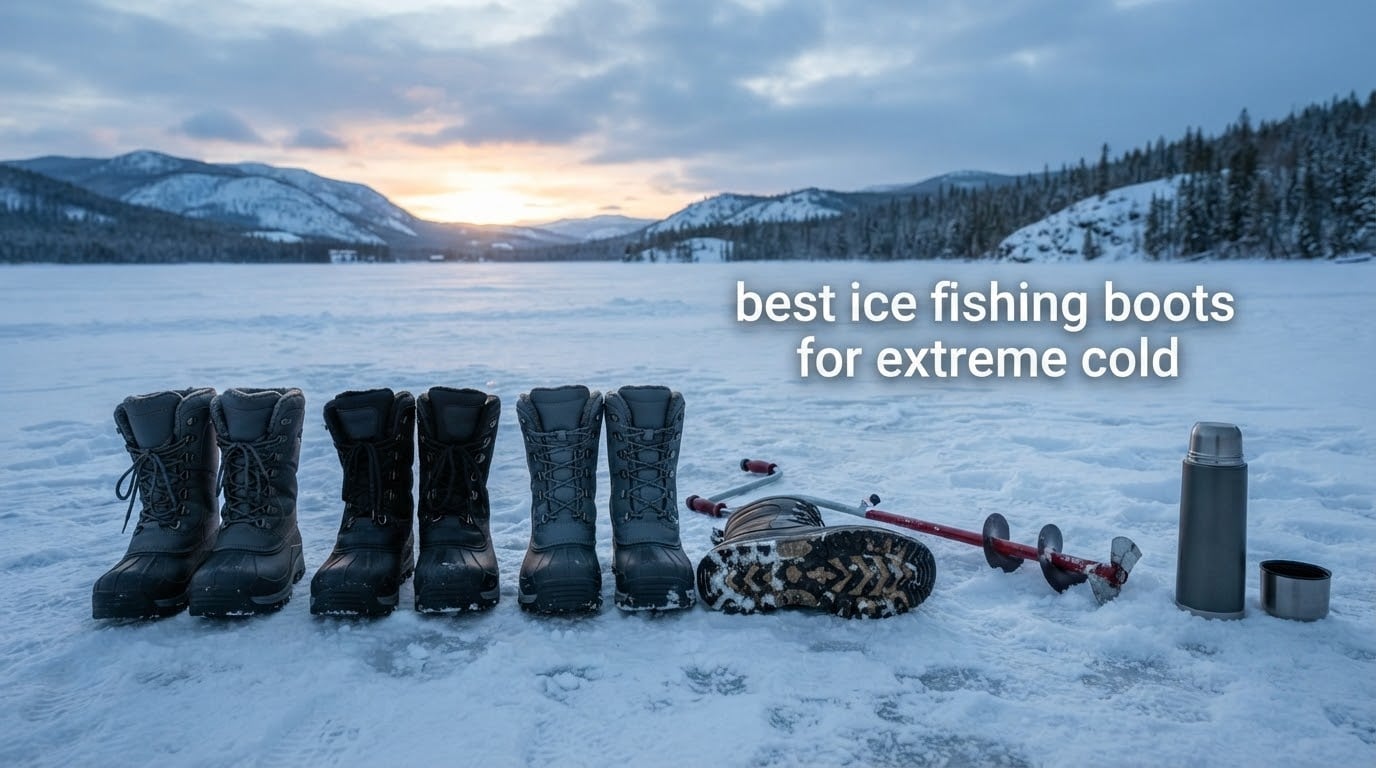
The number one mistake I see on early-ice mornings is a boot that looked fine in the truck and turned into a problem by the third hole. Feet lose heat far faster on a frozen lake than on land, because ice pulls heat straight out of you and there is nothing to insulate against except what you are wearing. Add slush, wind, and four hours of standing still, and the difference between a good boot and a bad one is the difference between finishing the day and heading home early.
That is why the best ice fishing boots for extreme cold are not simply the boots with the biggest number on the box. A temperature rating tells you what a manufacturer tested in a lab chamber. It does not tell you whether the boot drains sweat, whether cleats will fit over the sole, or whether you can still walk after an hour of drilling. Our team has been putting insulated pac boots through slush, glare ice, and overnight cold snaps for years, and we read the owner reviews closely enough to know where the marketing ends and the real experience starts.
In this roundup we review ten boots that anglers actually use, from one-piece neoprene slip-ons to 18-inch pac boots to a resoleable leather option. We cover what each one is genuinely good at, where it falls down, and how it fits into a full kit. If you are still assembling the rest of your cold-weather setup, our guide to the best ice fishing suits for extreme cold covers the top half of your body so your boots are not doing all the work alone.
Every boot below is scored on the four things that decide a session: warmth while stationary, waterproofing, mobility across a drift of ice, and how well it plays with cleats and bibs. Let us get into it.
Table of Contents
- Top 3 Ice Fishing Boots for Extreme Cold in 2026
- Best Ice Fishing Boots for Extreme Cold in 2026
- 1. MUCK Arctic Pro Insulated Boot: The Most Proven All-Rounder
- 2. MUCK Arctic Sport Tall: The Best Boot for Hole Hopping
- 3. Baffin Snow Monster: The Deepest Rated Boot With a Removable Liner
- 4. LaCrosse Alphaburly Pro 1600g: Best for Standing Still in Deep Cold
- 5. Baffin Impact: The Coldest Rated Boot in the Lineup
- 6. Irish Setter Elk Tracker 12 Inch: The Only Resoleable Boot Here
- 7. Dryshod Haymaker Hi: Built to Outlast Everything Else
- 8. Dryshod NoSho Gusset XT: The Lightest Route to -50F
- 9. MUCK Arctic Ice Mid: Comfortable for Miles of Walking
- 10. Baffin Tundra: The Lightweight Boot for Moderate Cold
- How to Read Ice Fishing Boot Temperature Ratings
- Waterproofing Construction and Insulation Types Compared
- Sizing for Thick Socks and the Vapor Barrier System
- Traction on Ice: Lugs, Studs and Cleat Compatibility
- Frequently Asked Questions
- Final Verdict: The Best Ice Fishing Boots for Extreme Cold
Top 3 Ice Fishing Boots for Extreme Cold in 2026
If you want the short version, these three cover the widest range of ice-fishing conditions. The Muck Arctic Pro is the most proven all-rounder, the Baffin Snow Monster carries the deepest rating with a liner you can control, and the LaCrosse Alphaburly Pro is the standing-still workhorse for anglers who wade and drill in serious cold.

MUCK Arctic Pro
- 8mm neoprene bootie
- Waterproof rubber shell
- Bob-Tracker multi-terrain outsole
- EVA midsole

Baffin Snow Monster
- Rated near -70C
- Removable multi-layer liner
- Locking snow collar
- Vapourized Aluminum Membrane
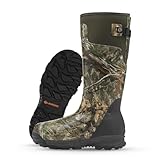
LaCrosse Alphaburly Pro
- 1600g insulation
- Rated to -60F
- 18-inch waterproof shaft
- Adjustable rear gusset
One note before the individual reviews. We do not use price as a ranking factor here, because these categories move constantly. Instead we weight rating and, just as importantly, the volume of long-term owner feedback behind that rating. A 4.6 from a few hundred owners and a 4.6 from a couple thousand tell you very different things about how a boot holds up in year three.
Best Ice Fishing Boots for Extreme Cold in 2026
Here is the whole lineup at a glance, with the construction detail that matters most for each boot. Scroll past this table for the full review of every model.
| Product | Specifications | Action |
|---|---|---|
| MUCK Arctic Pro Insulated Boot |
|
Check Latest Price |
 MUCK Arctic Sport Tall MUCK Arctic Sport Tall |
|
Check Latest Price |
| Baffin Snow Monster |
|
Check Latest Price |
| LaCrosse Alphaburly Pro 1600g |
|
Check Latest Price |
 Baffin Impact Baffin Impact |
|
Check Latest Price |
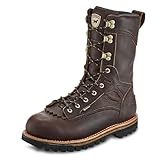 Irish Setter Elk Tracker Irish Setter Elk Tracker |
|
Check Latest Price |
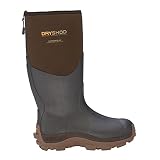 Dryshod Haymaker Hi Dryshod Haymaker Hi |
|
Check Latest Price |
 Dryshod NoSho Gusset XT Dryshod NoSho Gusset XT |
|
Check Latest Price |
 MUCK Arctic Ice Mid MUCK Arctic Ice Mid |
|
Check Latest Price |
 Baffin Tundra Baffin Tundra |
|
Check Latest Price |
1. MUCK Arctic Pro Insulated Boot: The Most Proven All-Rounder
Muck Arctic Pro Tall Rubber Insulated Extreme Conditions Men’s Hunting Boots
8mm neoprene bootie
Bob-Tracker multi-terrain outsole
EVA midsole
100 percent waterproof
Pros
- Genuinely waterproof
- owners stand in ice water without wet feet
- Wide toe box fits thick sock layering
- Slip-on design avoids frozen laces
- Aggressive tread grips packed snow and downhill ice
Cons
- Bulky through the ankle before break-in
- No rubber heel wedge makes the boot hard to pull off
- Midfoot runs narrow
- Neoprene upper can crack with age
I have put more hours on the Arctic Pro than any other boot on this list. It is the one I reach for when the forecast says single digits with wind off the lake, and it is the one I hand to friends who ask which boot to buy first. The 8mm neoprene bootie is genuinely thick, not nominal, and owners consistently report sitting still at -20C with warm feet after several seasons of use.
What sets it apart from the other neoprene boots here is the Bob-Tracker outsole with semi-spherical lugs and a defined heel. On glare ice with a light dusting of snow on top, that tread bites in a way that smooth rubber does not. Several owners who switched over from lighter Muck models say the ice grip is the reason they stayed.
The wide toe box matters more than most spec sheets admit. It leaves genuine room for a thick liner sock plus a normal wool sock without compressing your toes, which is where frostbite starts. Reviewers overwhelmingly recommend sizing up a full size or more for double sock layering and battery-powered boot heaters.
There is a real trade-off here. The upper is bulky through the ankle before it breaks in, and without a rubber heel wedge the boot is stubborn to remove. If you plan to run a boot jack or snowshoe straps, that heel gap is worth thinking about. Bib straps also take some persuading to get over this shaft. If you spend your winters layering cold-weather gear, our picks for the best insulated coveralls for extreme cold help with the pant side of that problem, but allow for extra room at the boot.
Who the Arctic Pro is right for
This is the boot for anglers who move all day and stand still sometimes. The slip-on construction means no frozen laces, no gloves-off fumbling at the truck, and nothing to lace back up after every hole. For hole hopping on a drift, walking a slushy shoreline, or wading to a spot you cannot drive to, that simplicity is worth more than any insulation upgrade.
It is also the safest first purchase. The owner base is enormous, which means long-term durability data is abundant, and the reviews consistently describe pairs that hold waterproofing season after season when the neoprene is allowed to dry between trips.
Where the Arctic Pro falls short
The narrow midfoot is the most reported fit issue, and it interacts with the sizing advice. If you size up two full sizes to solve the toe box, the midfoot can start to pinch. Measure your feet in the afternoon with the socks you intend to fish in, and read the sizing notes carefully.
The other limitation is age. Neoprene of this thickness does not last forever, and owners who report cracking after several years are usually the ones who stored the boots damp in a truck bed. Dry them fully, and this becomes a non-issue for most people.
2. MUCK Arctic Sport Tall: The Best Boot for Hole Hopping
MUCK Men’s Arctic Sport Tall, Black, Size 9(M)
5mm neoprene bootie
Fleece lining
MS-1 shaped outsole
Pull-tab on and off
Pros
- Comfortable straight out of the box with no break-in
- Warm while walking without making feet sweat
- No laces to freeze or fumble
- Soft cushioning suits long walks on shore
Cons
- Sold in whole sizes only
- Top rim can be snug on wide calves
- Not warm enough for motionless hours in the deepest cold
- Some units reported toe seam leaks
The Arctic Sport Tall is the boot I wear when I know I will be walking more than I will be standing. The 5mm neoprene bootie under a fleece lining gives you real warmth while you are moving, and critically it does not turn into a sweat chamber once you stop and start drilling. That balance is what makes it the better choice for a 12-hole day.
Owners describe it as comfortable to roughly -40F while in motion, and that framing matters more than the headline number. A boot rated lower on paper can beat a higher-rated boot if it lets moisture escape, because damp socks lose their insulating ability within minutes.
The pull-on design and wide opening mean you never need gloves to get these on, which sounds minor until you are kneeling on a frozen lake with numb hands at 6am. The MS-1 shaped outsole is rugged and stable, and reviewers in the UK and Europe report solid grip in mud, puddles, and wet leaves during the off-season.
Be aware of the whole-size issue. This boot is sold in whole sizes only, so half-size wearers have to choose between sizing up for sock room and losing precision in the fit. That trade-off bothers some people more than others, and it is worth ordering two pairs to compare.
Who the Arctic Sport Tall is right for
Anyone covering distance on foot, riding an ATV to a first-ice spot, or wading a shoreline to reach a pocket water that does not freeze. At 4.5 pounds it is one of the lighter boots here, and the cushioning is soft enough for long walks without the ankle fatigue that pac boots can cause.
It also works well as a shoulder-season and southern-ice boot, where you are more likely to be walking than sitting in a deep-freeze wind tunnel.
Where the Arctic Sport Tall falls short
This is not the boot for a static, motionless session in genuinely brutal cold. Owners are direct about that limit: if you plan to sit behind a tip-up for four hours at -20F, step up to the 8mm neoprene or a 1600g pac boot instead.
The calf rim is the other sticking point. If you have wider calves, the top of the boot can feel snug, especially over a thick liner. And a small number of buyers reported a toe seam leak or a faulty zip shortly after purchase, so inspect the seams the day your pair arrives.
3. Baffin Snow Monster: The Deepest Rated Boot With a Removable Liner
Baffin Snow Monster Men’s Winter Boots, Arctic Rated, -22 to -49 degrees Fahrenheit, Tall Height, Br5 – Worn Brown, Size 10
Rated near -70C
Removable Comfort-Fit liner
Locking snow collar
Polar Rubber outsole
Pros
- Owners rate it around -70C to -94F
- Removable liner can be dried and swapped overnight
- Light for the amount of insulation inside
- Locking snow collar blocks deep snow
Cons
- Runs small so size up
- Too bulky for most ice cleats to fit over
- Some toe stitching failures in sustained wet conditions
- Collar makes jeans hard to tuck over
The Snow Monster is the boot owners in northern Canada and working in Antarctica point to when they describe the one that keeps feet warm all day while sitting still. The layering stack is serious: Thermaplush, B-Tek Foam, B-Tek Heat 4-channel hollow-fibre insulation, Vapourized Aluminum Membrane, PolyWool, Hydromax, and DiamondNet, all wrapped in an Arctic Rubber shell with an EVA midsole and Polar Rubber outsole.
What makes it different from a fixed-insulation pac boot is the removable Comfort-Fit inner. You can pull it out at the end of the day, shake out the moisture, and air it overnight. On a multi-day trip that single feature removes most of the damp-foot problem that ruins cold-weather footwear.
At 2.1 pounds this is genuinely light for a boot with this much insulation, and that lightness shows up at the end of a long walk. The locking snow collar with side-to-side toggle lacing keeps deep drifts out, and it can be loosened when you are working hard enough to vent heat.
The most common advice from owners is to size up a size or a size and a half. It runs small, and it runs small in a way that becomes obvious only after you have already put a winter on the ice.
Who the Snow Monster is right for
Anglers who fish in northern climates, work a static position for hours, or spend several nights in a shelter where the temperature does not climb. If you have ever frozen in boots rated for less cold, this is the step up that solves it without moving to a heavier expedition boot.
The removable liner also makes it attractive for anyone rotating between deep-cold days and mild ones. Two liners, one shell, and you are covered across a wide temperature swing.
Where the Snow Monster falls short
Bulk is the headline complaint. This is a tall, wide boot, and that width limits what fits over it. Most standard ice cleats will not mount to this sole, and pant legs will not tuck over the collar easily. If your whole plan depends on strap-on traction, this is the wrong shape of boot.
A minority of owners also report the toe stitching letting water through after sustained wet conditions, so check that seam early. And because it runs small, ordering blind is a real risk on a boot this wide.
4. LaCrosse Alphaburly Pro 1600g: Best for Standing Still in Deep Cold
LaCrosse Waterproof Hunting Boots, Mossy Oak Country Dna 1000g, 14
1600g insulation
Rated to -60F
18-inch waterproof shaft
Adjustable rear gusset
Pros
- Warm in a tree stand at -25C with one sock layer
- Owners report wading with genuinely dry feet
- 18-inch height keeps snow and slush out
- Aggressive Burly outsole grips wet rock and mud
Cons
- Very bulky with limited ankle mobility
- Minimal insole cushioning causes foot soreness
- Insulation stops below the ankle
- No half sizes available
The Alphaburly Pro is the boot I recommend to people who wade, kneel, and stand in one spot for hours at -60F. At 1600g of insulation it has the highest insulation figure in this lineup, and reviewers repeatedly describe it as the warmest pac boot they have owned, with multiple accounts of standing still in subzero cold without cold feet.
The 18-inch shaft is not decoration. It is what keeps wind-driven snow out of your legs during a storm, and what keeps the slush that comes with midwinter warmups from ending your day early. The waterproof rubber and neoprene construction has held up in owner tests of wading and bank fishing.
The adjustable rear gusset is the feature that gets less attention than it deserves. It lets the shaft expand for thicker layers and then cinch back down, which matters when your pant bibs go over the top and you need a seal that does not gap.
Owners with long-term experience rate this boot highly for durability, reporting multiple seasons of heavy abuse including rip-rap shorelines. Forum regulars who have used the Alphaburly for several seasons point out that cleats and bibs both fit over this shaft without a fight, which is not true of most high-capacity pac boots.
Who the Alphaburly Pro is right for
Angling styles that involve staying in one place: deadbaiting a deep hole, running a tip-up spread, or holding a rod on a shoreline channel where the current keeps you working. It is also a strong hunting boot for tree stand sessions, which is where most of its owner base comes from.
If you wear full bibs, this is the boot that cooperates with them. Nothing here has to be forced.
Where the Alphaburly Pro falls short
Do not treat it as a hiking boot. At 5 pounds with an 18-inch shaft and little ankle articulation, a long walk over rough ground will make you tired, and reviewers specifically note that feet get sore after four or five hours because the insole cushioning is minimal.
There are also no half sizes, which makes sock layering fiddly, and insulation stops below the ankle, so the top of the shaft can feel cool in deep cold. If you move a lot and stand little, choose a lighter neoprene boot instead.
5. Baffin Impact: The Coldest Rated Boot in the Lineup
Baffin Men’s IMPACT Waterproof Extreme Cold Weather Ice & Snow Boots
Polar Rated below -40F
Removable Comfort-Fit liner
Double buckle fastening
Snowshoe compatible
Pros
- Described by owners as the warmest boot they have owned
- Supplied for Antarctic program work at -30 to -95F
- Removable washable liner dries overnight
- Double buckles work with gloves on
- Snow collar and 15-inch height block deep drifts
Cons
- Very large
- most owners need a full size up
- Snow pants will not fit over the collar
- Too bulky to run in even a short distance
- Can build sweat on long walks
When people ask what the warmest boot Baffin makes is, this is the answer. It is Polar Rated for temperatures at and below -40F, it uses a removable Comfort-Fit inner boot with Thermaplush, B-Tek Foam, and double B-Tek Heat, and it is the model the company has supplied for Antarctic program work in winters running -30 to -95F.
The double buckle fastening with a locking snow collar is a genuinely useful design on ice. Buckles work with gloves on, which laces never do, and the collar shuts the gap where drifting snow would otherwise funnel straight down your neck.
At 3.1 pounds it is heavier than the Snow Monster but far lighter than the 18-inch pac boots, and owners report comfort in an overnight tent at -27F across multi-hour shifts. If you are pairing this with a full winter kit, our pick of the best winter parkas for extreme cold handles the standing-still wind problem at the top of your body.
Who the Baffin Impact is right for
Anyone fishing genuinely deep cold, working a remote lake, or spending a night in an ice shelter. The removable washable liner is the reason it survives multi-day use: pull it out, dry it, and put a fresh one in the morning.
It is also snowshoe compatible, which makes it a sensible two-season boot if you walk in from a trailhead.
Where the Baffin Impact falls short
Sizing is the dominant theme in the reviews, and it is not subtle. This boot runs very large, and most owners size up a full size. The bulk also has a practical cost: some reviewers note interference with driving in smaller vehicles, because the boot is genuinely large.
Snow pants will not fit over the collar and must be tucked inside, which is awkward if your outer layer is designed to go over your boots. And owners report sweat build-up on long walks, so bring a boot dryer if the trip is more than one day.
6. Irish Setter Elk Tracker 12 Inch: The Only Resoleable Boot Here
Irish Setter Elk Tracker 12″ Mens Hunting Boot, Brown, 10.5 W
1000g 3M Thinsulate Ultra
GORE-TEX full grain leather
Steel shank outsole
Goodyear Welt construction
Pros
- GORE-TEX blocks outside moisture while venting sweat vapour
- Goodyear Welt construction means the boot can be resoled
- Steel shank and air-bob sole give stable footing
- Wide and true-to-size widths available
Cons
- Heavier and stiffer than insulated rubber pac boots
- 12-inch shaft feels restrictive on long walks
- Premium price relative to simpler rubber models
The Elk Tracker is the odd one out in this roundup, and that is exactly why it is here. Every other boot is a molded rubber or synthetic pac boot that you replace when the outsole wears through. This one is full grain leather on a Goodyear Welt, which means a cobbler can resole it, and reviewers who own resolable boots tend to treat them as a lifetime purchase.
Warmth comes from 1000g of 3M Thinsulate Ultra, which owners describe as serious warmth without the extreme bulk of a 1600g pac boot. The GORE-TEX lining is the real standout in practice: it blocks slush and snowmelt from outside while letting sweat vapour escape, which is exactly the balance that keeps feet dry over a long session.
The Bulls-Eye Air Bob sole with a built-in steel shank gives genuinely stable footing on rough ground and uneven ice. The cork EVA memory foam footbed is removable, and ScentBan treatment in the footbed and lining handles the odour problem that comes with insulated boots worn hard for several days.
Fit is another strength. This boot runs true to size and is available in wide widths, which removes the guessing game that plagues ordering insulated rubber boots online. If you have a wide foot, this is the safest boot here to order blind.
Who the Irish Setter Elk Tracker is right for
Anglers who want one boot for hunting and ice fishing, and who would rather repair than replace. The cross-use case matters: a boot you can wear in October, in January, and in March is a much better value over a decade than three seasonal pairs.
It also suits anglers with wide feet or hard-to-fit shapes, since the width options and true sizing remove most of the online ordering risk.
Where the Elk Tracker falls short
Leather and stiff construction make it less suited to long static sessions on glare ice than the insulated rubber options. Reviewers consistently note it is bulkier and less flexible, and that the 12-inch shaft plus stiff leather can feel restrictive when you walk a long way.
There is also a real price premium relative to simpler insulated rubber models, and unlike the neoprene boots it will not be comfortable in any temperature above freezing. If your season is three weeks of early ice at 34F, this is far more boot than you need.
7. Dryshod Haymaker Hi: Built to Outlast Everything Else
Dryshod Mens Haymaker Hi Rubber Farm Boots Brown Size 12
Minus 20F comfort range
Hand-laid natural rubber
DS1 molded outsole
Sized to athletic standards
Pros
- Genuine natural rubber outlasts PVC and urethane boots
- Tread holds on mud and ice without packing with debris
- Less end-of-day foot fatigue than lighter rubber boots
- Runs true to size and offered up to size 16
Cons
- Warm enough that summer wear is impractical
- Can build condensation that needs overnight drying
- Minus 20F comfort range is not a deep-arctic rating
The Haymaker Hi is the boot for people who treat their footwear like a tool. It is genuine hand-laid rubber, with no PVC, no polyurethane, and no TPR in the construction, and that is the whole argument. Reviewers comparing it favourably to Muck cite durability first, then drier feet at the end of a long day, then a tread that grips ice.
The stated Active Comfort Range is -20 to 75F, so this is not a deep-arctic pac boot. Within that range, however, owners report keeping feet warm with wool socks and no insulated socks required, which makes it a very efficient choice for moderate cold.
The DS1 molded outsole has an outer and inner grip channel plus a reinforced tuck board with rigid shanks, which is why it holds on mud and ice without packing with debris the way deeper lugs can. At 4 pounds it also produces noticeably less end-of-day foot fatigue than lighter rubber boots, because the sole structure supports the arch instead of letting it collapse.
Sizing is refreshingly straightforward. Dryshod sizes to athletic shoe standards, runs true to size, and offers widths up to a size 16, so you can order your usual shoe size with confidence.
Who the Haymaker Hi is right for
Anglers who want one boot for ice, mud season, and general outdoor work across the whole year. Natural rubber is the reason: it resists the cold cracking that eventually kills PVC and urethane boots, and reviews report pairs lasting many seasons with the sole still gripping.
It is also the sensible choice for anyone who fishes moderate cold and wants durability over extreme ratings.
Where the Haymaker Hi falls short
The -20F ceiling is real, and it is the reason this boot does not finish higher in a roundup about extreme cold. If your winter regularly goes colder, you need an 8mm neoprene bootie or a heavy pac boot instead.
Like most neoprene footwear it can build condensation that needs overnight drying, and the owners who report the driest feet still recommend taking the boot off at the end of the day. It is also impractical to wear in anything above the mid-70s.
8. Dryshod NoSho Gusset XT: The Lightest Route to -50F
Dryshod Men’s NoSho Gusset XT Extreme Cold-Conditions Hunting Boot Size 10
Seven layers of insulation
Minus 50F comfort range
Adjustable locking gusset
Two-piece natural rubber outsole
Pros
- Seven layers rated to a minus 50F comfort range
- Only 16 ounces so it does not drain energy on a walk
- Adjustable gusset fits larger calves and tucked layers
- Natural rubber resists cold cracking
Cons
- Smallest review base here so long-term data is thin
- Stiff at first and needs a break-in
- Knee-high shaft is hard to pair with standard snow pants
This is the boot I would hand to someone who wants serious cold protection without hauling a five-pound pac boot across a drift. At 16 ounces it is by far the lightest boot in the lineup, and the seven-layer build is the interesting part: a 5.5mm bootie, 2.5mm DENSOPRENE XD foam, 2mm airmesh, 2mm warm fleece lining, plus an EVA cold-blocking midsole, all inside a Hydrokote water-repellent nylon outer.
The stated comfort range is -50 to 65F, and owners describe it as the most affordable serious cold boot they have found. The expandable gusset with a locking strap is the feature that solves the calf problem: it fits larger calves and lets you tuck clothing inside, which solves the pant gap that ruins so many tall boots.
The DS1 premium two-piece natural rubber outsole with a cold-blocking EVA sponge midsole is a sensible design, because natural rubber overlays resist cold cracking better than PVC or urethane. It is also 2 inches taller than the regular NoSho model for added protection.
Being candid about the limits here. This boot has the smallest owner base of anything on this list, so long-term durability reports are thin compared with the thousands of reviews behind the Muck and Baffin models. Judge it on construction and current feedback rather than on proven track record.
Who the NoSho Gusset XT is right for
Anglers who walk long distances to reach a spot, and whose cold does not quite reach the -50F extremes. Sixteen ounces changes how far you can walk, and if mobility is your limiting factor, this is the boot that solves it.
The gusset also makes it a good fit for anyone with larger calves who has given up on tall insulated boots.
Where the NoSho Gusset XT falls short
The natural rubber and high shaft make it stiff at first, and it needs a break-in period before it stops feeling like footwear. Owners with thinner review counts are less forgiving about early discomfort, so expect a few sessions before it feels right.
The knee-high shaft is harder to pair with standard snow pants, and the thin owner feedback means you are less protected if something breaks down in year three. If you keep the same pair for a decade, buy the boot with the longer track record.
9. MUCK Arctic Ice Mid: Comfortable for Miles of Walking
MUCK Men’s Arctic Ice Mid Boot + Vibram Arctic Grip A.T.
Fleece lining
Lightweight midsole
Pull-tab on and off
Removable footbed insert
Pros
- Comfortable for multi-mile walks with no foot fatigue
- Warm at -5F without feet getting hot
- Grip is noticeably better on ice than older Muck models
- Slip-on wide opening needs no hands
- Extended rubber coverage keeps slush out
Cons
- Some owners feel the 5mm bootie is thinner than older models
- Very difficult to pull off without a boot jack
- No studs or spikes so bare ice still needs cleats
- Mid-height collar is less rigid and hard to step into
The Arctic Ice Mid is the middle of the Muck range and, for a lot of anglers, the most useful version of it. Owners upgrading from older Muck Arctics say this model is lighter and grips ice better, and the fleece lining with a lightweight midsole is what produces the comfort on longer walks.
Reviewers describe it as warm at -5F without the feet getting hot, which tells you the insulation is deliberately balanced rather than extreme. That balance is exactly right for hole hopping or shoreline walking, where generating heat from movement does half the work for you.
The removable footbed insert is a small thing that matters on long days, because it lets you swap a damp footbed for a dry one at the truck. Extended rubber coverage runs well up the boot, which keeps snow and slush out where most snowmelt gets in.
There is a genuine split in the reviews on insulation thickness. A minority of owners feel the 5mm bootie is less insulated than older Muck models, which is worth knowing if you are upgrading a boot you already own and expecting more of the same.
Who the MUCK Arctic Ice Mid is right for
Active anglers covering ground: hole hoppers, anyone walking a shoreline, and anyone whose session is more walking than sitting. The 4.5-pound weight and soft midsole reduce the fatigue that ends a long day on the ice.
It is also the easiest boot here to get into with cold hands. The slip-on design with a wide opening means no gloves needed, which is a bigger deal than it sounds at 6am.
Where the MUCK Arctic Ice Mid falls short
It is hard to pull off. A boot jack is close to essential, and that is friction at the end of a long day when your hands are cold. The mid-height collar is also less rigid than the wide-calf version, which makes it harder to step into.
There are no studs or spikes, so it is still slippery on bare ice without cleats, and it is not a boot for motionless hours in the deepest cold. If you sit, choose warmth over comfort.
10. Baffin Tundra: The Lightweight Boot for Moderate Cold
Baffin Men’s TUNDRA Insulated Waterproof Lightweight Extreme-Weather Outdoor Snow Winter Boots for Snowshoeing & Ice Fishing, Black, 13
Tundra Rated -10C to -30C
Removable multi-layer liner
Locking snow collar
Velcro ankle strap
Pros
- Light and not bulky for a full pac boot
- Warm through five hours of snowshoeing at 25F
- Slip-on style suits owners with arthritis
- One owner reports a pair lasting 15 years
- Reflective piping improves low-light visibility
Cons
- Not rated for the deepest cold
- Stiff sole with little give so every cobblestone is felt
- Limited traction on bare ice
- Water resistance falls short in standing puddles
The Tundra sits lower in the Baffin range and fills a gap the rest of the lineup does not: a full pac boot that is not a burden to walk in. At 2 pounds it is the second-lightest boot here, and owners report warmth through five hours of snowshoeing at 25F without the usual bulk.
The rating is Tundra Rated for -10C to -30C, roughly 14F to -22F, for moderate to high activity. That activity qualifier is doing real work. This is a moving boot for moderate cold, not a stand-still-in-a-wind-tunnel boot for the deepest cold.
The removable multi-layer liner carries the same idea as the more expensive Baffin boots: Thermaplush, B-Tek Foam, B-Tek Heat, Vapourized Aluminum Membrane, PolyWool, Hydromax, and DiamondNet. Being able to pull that liner out to dry is what keeps the boot working season after season, and one owner in the reviews reports a pair lasting 15 years.
Who the Baffin Tundra is right for
Anglers who walk in on snowshoes or from a long trailhead, and who fish moderate cold where you are rarely fully still. It is also the easiest Baffin to get into if bending to buckles is difficult, because of the Velcro ankle strap and rear pull loop.
The reflective piping is a small safety detail that matters when you are walking back across a snow-covered lake at dusk.
Where the Baffin Tundra falls short
Be clear-eyed about the rating. This boot is not for the deepest cold, and some owners explicitly doubt the colder figures attached to it. If your forecast regularly drops well below zero while you sit still, choose the Impact or the Alphaburly instead.
Traction on bare ice is limited, the sole is stiff enough that you feel every cobblestone, and a few owners report water resistance falling short in standing puddles. It is also bulky for long hikes and prone to rubbing.
How to Read Ice Fishing Boot Temperature Ratings
The most useful thing you can learn about boot ratings is that they describe a comfort range for a specific activity level, not a survival limit. Manufacturers rate boots at -40F or -60F based on laboratory conditions with an active wearer. The same boot behaves differently when you are standing motionless on a wind-exposed lake, because you are generating no heat at all.
Read the activity qualifier before the number. The Baffin Tundra is rated to -30C for moderate to high activity, which means the rating assumes you are moving. When an owner asks the question “what is the warmest boot Baffin makes,” the honest answer is that the Impact and Snow Monster carry the deepest ratings, but the Tundra may keep you warmer on a walk through 25F than either of them.
The insulation ladder is a more useful comparison than the temperature figure. Every gram figure tells you the same basic story:
1000g Thinsulate Ultra sits in the Irish Setter Elk Tracker and delivers real warmth in a lighter, less bulky package.
1600g in the LaCrosse Alphaburly Pro is built for standing still in serious cold, and it costs you in bulk and weight.
5mm and 8mm neoprene booties are a different system entirely. Thickness matters more than grams, and the 8mm in the Muck Arctic Pro is the thickest neoprene on this list.
Multi-layer synthetic stacks like the Comfort-Fit liner use vapour membranes and reflective layers, and their advantage is that the layers can be removed and dried.
For warmth while moving, the ranking changes. For warmth while standing still, the ranking flips toward the heavy pac boots. Ask yourself which you will be doing for most of the session.
Waterproofing Construction and Insulation Types Compared
Three construction styles show up across these ten boots, and each fails in a different way. Understanding which one you are buying prevents most cold-weather disappointment.
One-piece molded neoprene and rubber is the Muck Arctic Pro, the Arctic Sport Tall, and the Arctic Ice Mid. There are no seams to leak, which is why owners of these boots report standing in ice water with dry feet. The weakness is breathability: a sealed rubber shell traps sweat, and damp socks lose insulating ability fast. This is the #1 complaint in cold-weather boot forums, and it is why we treat sweat as a warmth issue rather than a comfort issue.
Rubber and neoprene pac boots with fabric shafts cover the Baffin Impact, Baffin Snow Monster, Baffin Tundra, LaCrosse Alphaburly Pro, and the Dryshod boots. The rubber foot keeps water out while a nylon or leather shaft keeps the boot lighter and more breathable. These usually win on warmth-per-pound because the insulation can be removed to dry. The Trade-off is that toe and side stitching becomes the weak point, and several owners on both the Baffin and LaCrosse report stitching failures after sustained wet use.
Waterproof leather with a membrane is the Irish Setter Elk Tracker, and it is the only boot here that vents sweat vapour from inside to outside rather than trapping it. GORE-TEX is the reason it stays drier through a long day, and it is also the reason it is repairable.
If your priority is never getting wet, choose one-piece neoprene. If your priority is staying warm for five hours, choose a boot with a removable liner you can dry. If you want both and expect the boot to last a decade, choose the welted leather option.
Sizing for Thick Socks and the Vapor Barrier System
Size up. Nearly every review of every boot in this roundup says the same thing, and the reason is the sock system rather than the boot. If you plan to wear a heavy liner sock plus a wool outer sock, or to use a battery boot heater, you need a full size of extra room in the toe box. Brands that run small, notably the Baffin Snow Monster and the Baffin Impact, need more adjustment than brands that run large.
Measure your feet in the afternoon, wearing the socks you intend to fish in, and measure both feet. Feet swell over a day on the ice, and most boot complaints trace back to an afternoon purchase and a morning mistake.
The sock system itself matters more than most buyers expect. Cotton is the enemy here, because cotton absorbs sweat and holds it, and a wet sock against your skin in subzero air strips heat faster than bare skin. Merino wool wicks moisture and keeps its insulating properties damp. Best results come from a two-layer system: a thin moisture-wicking liner sock against the skin, and a thicker merino wool or insulated sock over it.
For -20F and below, add a third element that almost no competitor article mentions and that forum users treat as the real pro tip: a vapor barrier sock. These socks use a membrane that stops moisture from escaping into the boot while blocking outside cold, effectively sealing your foot into a dry environment. Paired with a breathable boot like the Elk Tracker, or used alone with a neoprene boot for short sessions, they solve the sweat problem that ruins most extreme cold setups.
Bring a second pair of socks and swap them. It takes thirty seconds at the truck, and it is the cheapest warmth improvement available. Anyone doing longer trips should add a boot dryer to the vehicle; removable liners air out overnight while the dryer handles the shell. If you are still building out the rest of the kit, the best winter work jackets for extreme cold cover the upper body while your boots handle the lower half.
One gender note. Almost all of these models are built on a men’s last, and the fit differences that matter for women’s boots are exactly the ones that get skipped: narrower heel, higher instep, and a different arch curve. If a men’s model does not fit comfortably at the heel and instep, it will not get better with thick socks. The alternative is to buy a boot offered in multiple widths and true-to-size grading, such as the Haymaker Hi or the Elk Tracker, which removes most of the guesswork.
Traction on Ice: Lugs, Studs and Cleat Compatibility
Cleat compatibility is the single most common question in ice fishing boot forums, and almost no roundup answers it systematically. Here is the honest answer: bulk kills cleat fit, and the tallest boots are usually the worst candidates.
A strap-on ice cleat needs a flat, exposed sole edge to bite into. Tapered lugs, deep multidirectional treads, and thick raised midsoles all reduce the contact area where the strap can grip. That means the following, based on the construction of each boot in this roundup:
Good cleat candidates: the Dryshod Haymaker Hi with its DS1 outsole and tuck board, the LaCrosse Alphaburly Pro with the aggressive Burly outsole, and the Muck Arctic Pro with defined heel and semi-spherical Bob-Tracker lugs.
Poor cleat candidates: the Baffin Snow Monster and Baffin Impact, where owners specifically report that bulk limits what fits over the sole. Plan on boots that are self-sufficient, or accept that you will be walking on included traction alone.
Mixed: the Baffin Tundra, which has limited bare-ice traction regardless.
Studded or carbide options exist for anglers who want hard points rather than strap-on spreaders. The trade-off is indoors: carbide studs are aggressive on carpet and lodge entries, and they wear down over a season. Strap-on cleats are removable, which is why they win for anglers who also hunt or walk a lot.
Carbide outperforms steel on glare ice because it bites harder into clear ice, and carbide spikes last longer than steel. For anglers who move on bare lake ice with no snow cover, carbide is the safer choice regardless of the boot. For anglers on snow-covered ice with packed snow routes, a well-designed lug pattern is enough and much more comfortable.
Finally, bib compatibility is a traction problem in disguise. If your bib straps go over the boot, you need a shaft tall and narrow enough to pass under them. The Baffin Snow Monster and Baffin Impact report problems here, and the Baffin Impact owners note that snow pants must be tucked inside rather than worn over. The LaCrosse Alphaburly Pro at 18 inches is the easiest boot here to combine with full bibs.
Frequently Asked Questions
What is the warmest boot for ice fishing?
For standing still in deep cold, the Baffin Impact is rated for temperatures at and below -40F and uses a removable multi-layer inner boot with Thermaplush, B-Tek Foam and double B-Tek Heat. The LaCrosse Alphaburly Pro with 1600g insulation is rated to -60F and is the warmest choice for wading anglers, while the Muck Arctic Pro is the warmest all-rounder thanks to its 8mm neoprene bootie.
Are extreme cold temperature ratings realistic?
Treat them as a tested comfort range for a specific activity level, not a survival limit. Most ratings assume an active wearer, so a boot rated to -40F while walking may disappoint you when you sit motionless on a wind-exposed lake for three hours. Add a vapor barrier sock and a liner sock to close the gap between the rating and your real experience.
How warm are 1000g Thinsulate boots compared to 1600g pac boots?
The 1000g of 3M Thinsulate Ultra in the Irish Setter Elk Tracker delivers serious warmth in a lighter, less bulky boot that stays comfortable for walking. The 1600g insulation in the LaCrosse Alphaburly Pro is built for motionless standing in deeper cold but costs you bulk, weight, and ankle mobility. Choose grams for the cold, and choose construction for how much you move.
Should I buy winter fishing boots one size larger?
Yes, if you plan to wear a thick liner sock plus a wool outer sock, or use battery boot heaters. Measure your feet in the afternoon wearing the socks you will fish in, and measure both feet. Boots that run small, such as the Baffin Snow Monster and the Baffin Impact, need a full size or more of adjustment, while the Dryshod Haymaker Hi runs true to size.
Do you need special boots for ice fishing?
You need waterproof construction, real insulation, and an outsole that grips ice, and for regular cold-weather fishing that means a dedicated boot rather than general winter footwear. Cotton socks are the real risk: wet cotton strips heat fast in subzero air. Pair any insulated boot with merino wool or a vapor barrier sock system to keep your feet dry and warm.
How do I stop my feet from sweating and then freezing?
Keep the foot dry from the inside out. Wear a moisture-wicking liner sock against your skin and a merino wool sock over it, avoid cotton entirely, and bring a second pair of socks to swap at the truck. Choosing a boot with a removable, washable liner lets you air it overnight, and a GORE-TEX lining vents sweat vapour rather than trapping it.
Final Verdict: The Best Ice Fishing Boots for Extreme Cold
The best ice fishing boots for extreme cold depend on one question: will you be standing still or walking? If you sit, start with the Muck Arctic Pro, our editor’s choice, because its 8mm neoprene bootie keeps feet warm through long motionless sessions and the waterproof shell has the deepest owner track record of anything here. If your cold goes deeper still, the Baffin Impact and the LaCrosse Alphaburly Pro both out-warm it, and their removable liners handle multi-day trips better.
If you hole hop, the Muck Arctic Sport Tall is the lighter, more breathable answer, and the Dryshod NoSho Gusset XT goes even further on weight with a -50F comfort range. For durability across hunting and fishing seasons, the Irish Setter Elk Tracker is the only boot here you can resole rather than replace.
Whatever you choose, size up, skip cotton, and add a vapor barrier sock layer when the thermometer drops. Your boots are the foundation, and if you are finishing the kit, our guide to ski jackets for extreme cold covers the wind layer that keeps that warmth where it belongs.
1 thought on “10 Best Ice Fishing Boots for Extreme Cold (October 2026)”