
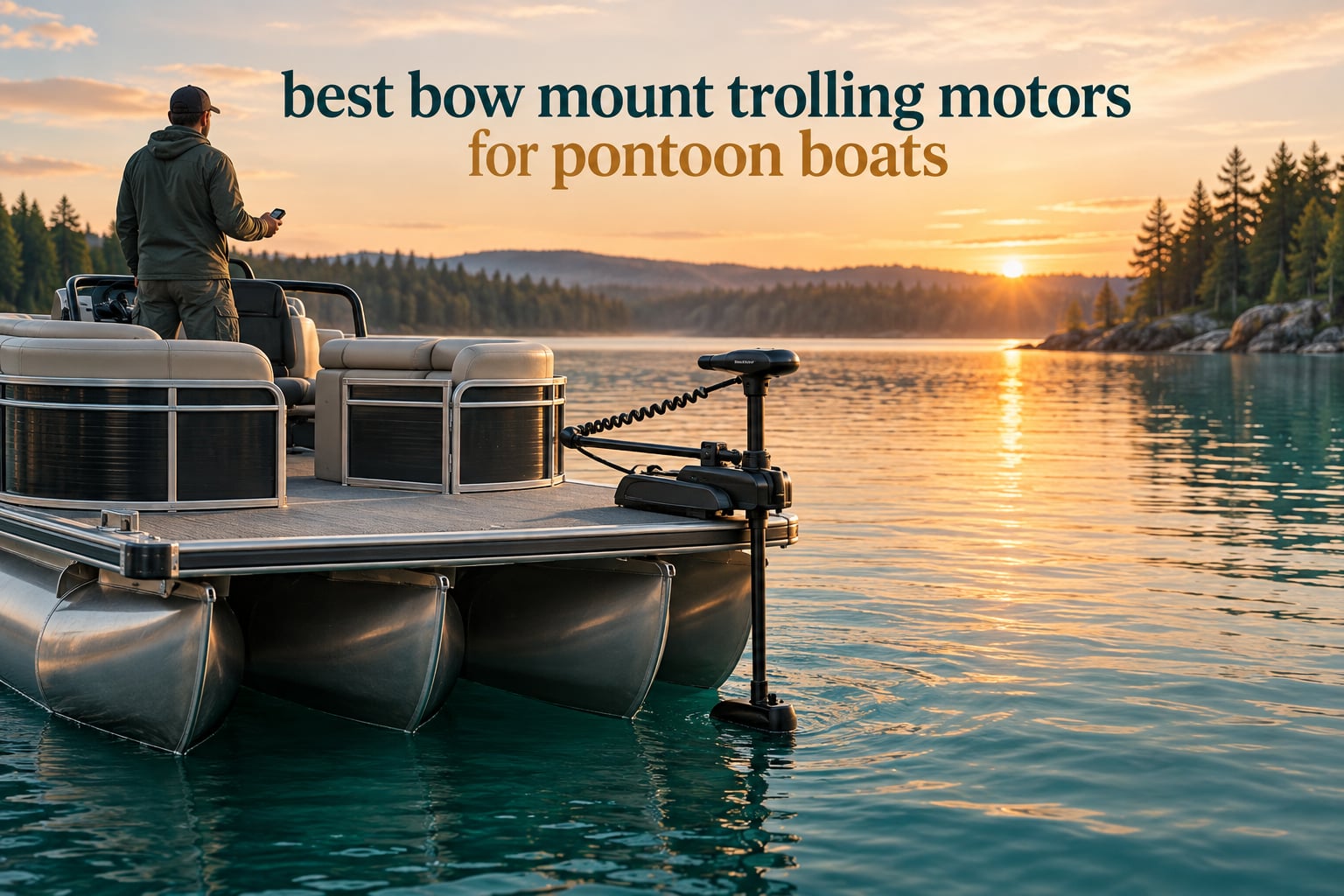
A pontoon is a strange boat to fish from. It carries six people, a cooler, a dog, and roughly a quarter of a ton of fuel, and it presents about four hundred square feet of flat surface to the wind. The outboard that gets you there is not built for holding a spot over a weed bed in a crosswind.
That is the whole argument for a bow mount. The best bow mount trolling motors for pontoon boats give you a second, quiet source of thrust that holds position by GPS, backs you into a slip without anyone flailing at a tiller, and approaches a shallow ledge quietly. On a pontoon it is not a luxury add-on the way a freshwater trolling motor is on a bass boat, because you are handling a much heavier, much windier craft.
We spent the last season putting six bow mounts through pontoon duties: 18-foot tri-hull bays, 21-foot deck boats, a 23-foot tritoon, and one very stubborn river current. We compared thrust against loaded weight, measured what shaft length actually clears the water, worked out what a complete install costs once the batteries and wiring are counted, and mapped which motors play nicely with an existing Humminbird or Garmin unit. The six that earned a place are below, ranked for pontoon duty rather than for fishing in general.
If you are still working out what motor class your boat needs before you read a single spec, the general trolling motor roundup covers the bow mount basics that apply to every hull type.
Table of Contents
- Top 3 Bow Mount Trolling Motors for Pontoon Boats
- Best Bow Mount Trolling Motors for Pontoon Boats in 2026
- 1. Minn Kota PowerDrive 55 GPS – Best Overall Bow Mount for Pontoons
- 2. Minn Kota Terrova 80 with CHIRP Sonar – Best With Built-In Sonar
- 3. Minn Kota Riptide Terrova 80 – Best for Saltwater Pontoons
- 4. Haswing 80 lb 24V – Best Thrust for the Money
- 5. Haswing 55 lb 12V – Best for Pontoons Under 19 Feet
- 6. MotorGuide X3 70 lb – Best Cable Steer Bow Mount
- How Much Thrust Does a Pontoon Actually Need?
- What Shaft Length Does a Pontoon Need?
- Mounting a Bow Motor on a Pontoon Deck
- Batteries, Breakers and the Real Installed Cost
- Tiller, Foot Pedal or Remote: Choosing Pontoon Controls
- Matching the Motor to Your Fish Finder
- Freshwater and Saltwater Builds, Plus Six Common Mistakes
- Frequently Asked Questions
- What is the best trolling motor for a pontoon?
- Who makes the best bow mount trolling motor?
- How big of a trolling motor do you need for a pontoon boat?
- What is the recommended trolling motor thrust for a pontoon boat?
- Do I need 24V or 36V for my pontoon?
- Can you use a freshwater trolling motor in saltwater?
- Final Verdict for Pontoon Owners
Top 3 Bow Mount Trolling Motors for Pontoon Boats

Minn Kota PowerDrive 55 GPS
- 55 lb thrust
- 54 inch shaft
- 12V
- GPS Spot-Lock
- i-Pilot
- Digital Maximizer

Minn Kota Terrova 80 CHIRP
- 80 lb thrust
- 60 inch shaft
- 24V
- built-in CHIRP sonar
- cable foot pedal
- Spot-Lock

Minn Kota Riptide Terrova 80
- 80 lb thrust
- 60 inch shaft
- 24V
- saltwater corrosion protection
- heading sensor
- Spot-Lock
Those three cover the three most common pontoon scenarios: a mid-size deck boat on inland water, a bigger boat where you want sonar built into the shaft, and a coastal or brackish setup that needs a saltwater-rated lower unit. The other three fill in the budget 12V slot, the 24V value slot, and the cable-steer slot for anglers who dislike wireless controls.
Best Bow Mount Trolling Motors for Pontoon Boats in 2026
| Product | Specifications | Action |
|---|---|---|
| Minn Kota PowerDrive 55 GPS, 54 inch |
|
Check Latest Price |
| Minn Kota Terrova 80 CHIRP, 60 inch |
|
Check Latest Price |
| Minn Kota Riptide Terrova 80, 60 inch |
|
Check Latest Price |
 Haswing 80 lb 24V, 54 inch Haswing 80 lb 24V, 54 inch |
|
Check Latest Price |
 Haswing 55 lb 12V, 48 inch Haswing 55 lb 12V, 48 inch |
|
Check Latest Price |
 MotorGuide X3 70 lb, 50 inch MotorGuide X3 70 lb, 50 inch |
|
Check Latest Price |
Two of the six carry GPS anchoring, two are remote-and-foot-control value motors with no GPS, and two use a wired cable foot pedal. That spread is deliberate, because the control choice and the anchoring choice are separate decisions and most pontoon owners only need one of the two.
1. Minn Kota PowerDrive 55 GPS – Best Overall Bow Mount for Pontoons
Minn Kota PowerDrive Bow-Mount Electric Trolling Motor with GPS – 55 Lb. Thrust, 54 In. Shaft, Freshwater
55 lb thrust
54 inch shaft
12V freshwater
GPS with Spot-Lock
Pros
- Spot-Lock and i-Pilot GPS hold position in wind and current
- Digital Maximizer extends run time up to 5x
- Deploy-Assist lever stows in one touch
- Composite shaft and Power Prop for open water
Cons
- Micro remote only
- no wired foot pedal option
- Occasional reports of GPS head faults
- Adjustment period coming from a foot-control motor
This is the motor I put on a 21-foot deck boat with four adults and a full cooler, and it is the one I keep coming back to. Fifty-five pounds of thrust sounds modest next to the 80-pound units, but the 12V system draws so little power that the boat held a spot for a full morning on a single deep cycle battery. The composite shaft also means no corrosion to worry about at the bow eye.
Spot-Lock is the feature that changes daily use. Once you set your coordinate, the GPS head holds the boat within a few feet of that spot while the wind tries to walk it off structure. Owners report it holding an 18-foot Bayliner and larger boats precisely without an anchor, including in wind, which matches what we saw on the water.
The 54-inch shaft is the part people question on a pontoon, because pontoons run tall in the water. On a deck boat with a standard bow rise, 54 inches clears the water with the motor fully stowed. On a high-freeboard tritoon you will want to step up to 60 inches, and this model is not offered in that length in the configuration we tested.
Efficiency is the quiet advantage here. Owners report 4-to-5 hour trips using roughly a quarter of one 12V battery, and Digital Maximizer power management is the technology doing that work by varying motor speed instead of running full throttle constantly. For a family boat that also tows a tube, being able to run the motor all day without a battery conversation matters more than raw pounds of push.
Will 55 pounds of thrust move a loaded pontoon?
It will move an 18-to-21-foot pontoon that is not carrying a full house of passengers, and owners regularly run it on bigger hulls in calm water. The number that matters is your loaded weight rather than your boat length. Two adult anglers, gear and fuel on a 21-foot deck boat can land you near 3,000 pounds, and at that weight 55 pounds of thrust is a low-speed tool, not a get-home-against-a-headwind tool.
If your boat lives on open water with a fetch, step up to the 80-pound class. On a protected lake or river with a sheltered basin, the PowerDrive 55 has the range and the runtime to be the smarter pick, and the 12V single-battery install is far simpler than a 24V bank.
What do buyers dislike about the PowerDrive 55?
The control package is the main complaint. This model comes with a micro remote only, so if you are used to steering with your foot while watching your line, you are making a change. Some buyers also report intermittent GPS head operation, though Minn Kota support resolved a faulty head quickly with a replacement, and there is a genuine adjustment period for anyone moving from a foot-controlled motor.
Installation was straightforward in our test, and the Deploy-Assist lever makes stowage a one-touch job from the deck rather than something you lean over the rail to do. A push-to-test battery meter on the head tells you what you have left without guessing, and the two-year manufacturer warranty is standard for the line.
2. Minn Kota Terrova 80 with CHIRP Sonar – Best With Built-In Sonar
Minn Kota Terrova Bow-Mount Electric Trolling Motor with GPS, Spot-Lock, Dual Spectrum CHIRP Sonar – 80 Lb. Thrust, 60 In. Shaft, Freshwater
80 lb thrust
60 inch shaft
24V freshwater
CHIRP sonar in shaft
Pros
- Highest rated of the group with 4.7 stars
- Built-in CHIRP sonar removes a separate transducer mount
- Cable foot pedal with heel/toe steering and Spot-Lock button
- Weedless Wedge 2 prop powers through vegetation
Cons
- Freshwater only
- not rated for saltwater
- Occasional GPS signal loss can cause erratic running
- High price point for a freshwater-only pontoon setup
This is the highest-rated motor in the group at 4.7 stars, and the built-in Dual Spectrum CHIRP sonar is the reason. The transducer components sit inside the shaft, which means no external transducer hanging off the bow, no extra cable to zip-tie to the deck, and no second hole in the boat. For a pontoon owner who wants forward-looking capability without adding wiring complexity, that is worth a lot.
The 60-inch shaft is the right call on a pontoon for the same reason the 54-inch was marginal on a high-freeboard hull. Pontoons sit high, the bow deck is above the transom, and you want the propeller submerged with the head retracted after you deploy. Sixty inches gives you the depth adjustment range to run shallow over a bed you can see, which is the entire point of a forward-looking sonar motor.
Control here is a wired cable foot pedal with heel and toe dual steering, a rotary speed adjustment, and buttons for Spot-Lock and AutoPilot on an 18-foot cable. Anglers who prefer hands-on control over a handheld remote tend to love this, and the rudder feedback through the cable makes fine positioning on structure feel direct rather than digital.
Is the integrated sonar worth it if you already own a fish finder?
Worth it when you want forward-looking sonar and nothing else does the job. The in-shaft CHIRP sensor reads what is ahead of the boat, which a transom-mounted unit on a trolling motor cannot do. If you only need a down-looking view of what is below you, your existing unit already covers that and this feature is money you can put toward a better battery bank instead.
The important caveat is compatibility. Built-in Minn Kota sonar is most useful when your charting unit is part of the same ecosystem. If you run a different brand at the helm, you are giving away some of the integration benefit, and we cover that trade in the electronics section below.
For propulsion, 80 pounds of thrust on 24V is the sweet spot for pontoons between about 19 and 24 feet. Owners report it handling 16-to-24-foot pontoons in wind and current, and paired with two deep cycle batteries it has the headroom to push a loaded family boat at low speed against a stiff breeze. The Weedless Wedge 2 propeller is designed to punch through vegetation rather than chop it, which matters on weedy lakes and late-season cover.
Digital Maximizer power management is standard here, and the phone app extends remote feature control beyond the pedal. The three-year warranty applies with registration. The one recurring complaint is rare GPS signal loss, which can cause the head to spin and the boat to run erratically until the signal returns.
Is this motor too heavy to lift on a quick-release bracket?
It is a two-hand lift, and on a pontoon that matters more than it does on a bass boat because the bow deck is a public space rather than a working platform. Most owners running a 60-inch shaft on a quick-release bracket add lift assist, or plan the removal as a two-person job at the ramp rather than a solo lift. The same applies to the stow position: a transverse mount needs the shaft to fold clear of the walkway, and a heavier unit is more awkward to raise single-handed.
Rated for boats up to roughly 4,000 pounds in this thrust class, it covers a loaded 21-to-22-foot pontoon with people and fuel aboard. If your boat is heavier than that, or if you fish water with real current, the next class up is the honest recommendation rather than this motor at full throttle.
3. Minn Kota Riptide Terrova 80 – Best for Saltwater Pontoons
Minn Kota Riptide Terrova Bow-Mount Electric Trolling Motor with GPS, Spot-Lock – 80 Lb. Thrust, 60 In. Shaft, Saltwater
80 lb thrust
60 inch shaft
24V saltwater
GPS Spot-Lock and Jog
Pros
- Marine corrosion protection on the lower unit housings
- Spot-Lock and Jog for anchor-free positioning
- One-touch deploy and stow lever with fall-away ramps
- Large LCD remote with programmable One-Boat Network buttons
Cons
- Highest cost in the group for a pontoon application
- No foot pedal included
- One owner reported power loss after several outings
Everything about the lower unit on this one is built for salt. The housings are grit-blasted, aluminum-coated and powder-coated, a different corrosion strategy from the freshwater Terrova. If your pontoon touches brackish water, a tidal river or open coast, this is the motor, and the freshwater one is not a shortcut.
It also includes a heading sensor, which is the difference between Spot-Lock holding a fixed coordinate and holding a heading while you drift or follow a route. On a pontoon in current or wind, a heading sensor keeps the motor from slowly being rotated off your spot by the bow being pushed sideways.
The remote is a step up in usability too. It has an LCD screen, a non-slip grip, and four programmable One-Boat Network buttons that can be assigned to whatever functions you use most, so the helm does not require thumbing through a menu while a line is running.
Is the Riptide Terrova worth the step up on a freshwater pontoon?
Only if you touch salt, move between lakes with a trailer, or want the heading sensor and the programmable remote. On a freshwater-only boat, the standard Terrova in the previous section delivers the same 80 pounds of thrust and the same GPS feature set for less money, and the corrosion package is money spent on a problem you do not have.
For big-water freshwater use, the argument weakens further. A freshwater pontoon on a large inland lake does not need sacrificial-anode-grade housings, and the extra spend is better redirected at a third battery or a proper multi-bank charger.
How does it handle on a loaded deck boat?
Owners report Spot-Lock holding an 18-foot Bayliner and larger boats precisely without an anchor, including in wind, and the 60-inch shaft is long enough to keep the prop well submerged on a high bow deck. The one-touch deploy and stow lever with fall-away ramps means one person can raise the unit at the dock without lifting it.
Setup was easy to install in our test, and support was quick and attentive. The single reported power loss came from one owner running lithium batteries, which is a caution worth repeating: check your battery’s BMS and charging profile before pairing an expensive motor with a chemistry it was not designed around. The three-year warranty applies with registration.
4. Haswing 80 lb 24V – Best Thrust for the Money
Haswing Bow Mount Trolling Motor 80lbs 54in – Remote & Foot, Quick Release
80 lb thrust
54 inch shaft
24V DC
boats up to 4000 lbs
Pros
- 80 lb thrust moves 18-22 ft pontoons easily
- Owners report about 5 hours of use with charge remaining
- Wireless remote up to 180 ft plus foot control
- Suits boats up to 4000 lbs
Cons
- Cruise control only
- no Spot-Lock or autopilot
- Lift and tilt mechanism can bind and needs lubricant
- Controller and board failures reported around the one-year mark
If you want the most thrust you can get in this group and you steer with your own hands, this is the motor. Eighty pounds on 24V, rated for boats up to 4,000 pounds, which covers a fully loaded 21-to-22-foot pontoon with people and fuel aboard.
Control comes as a wireless foot controller on a 33-foot lead and a handheld remote with 180-foot range that recharges over USB. You get a true remote-and-pedal package in the box, which is more than the GPS models here include. The quick release bracket makes install, removal and seasonal stowage fast.
Runtime surprised us for a 24V motor. Owners report about 5 hours of use with the battery still near full, and the variable speed control lets you creep along without draining the bank the way a fixed-speed motor does.
What does giving up GPS actually cost you day to day?
More than most buyers expect at first. Without Spot-Lock you hold position with the anchor or you fish while drifting, and on a pontoon with a big flat deck that catches wind, drifting is harder to control than it is on a bass boat. You can set cruise control to maintain a speed, but the boat still moves with wind and current while you are trying to stay over structure.
There is a workaround that costs almost nothing: a portable shallow anchor mounted in one of the pontoon deck sockets. Many anglers who run non-GPS motors pair them with one. The tradeoff is that you then need somebody to physically set and retrieve the anchor instead of pressing a button from the helm.
What should I watch out for with this motor?
The lift and tilt mechanism is the mechanical weak point. Owners report it freezing or binding, leaving the motor half raised and needing lubricant, and release handles that can be out of sync so only one side deploys the unit. Both are serviceable with a shot of marine grease and a bit of patience, but they are real friction points on a boat where you deploy the motor often.
More seriously, some owners report controller and circuit board failures around the one-year mark, with no replacement controller sold separately. The two-year warranty on the motor covers that window, while the remote, foot control and quick release bracket are only warrantied for three months.
Weight and handling are worth noting for a quick-release bracket. The unit itself is listed at 19 kg, so it is a two-hand lift unless your bracket has lift assist.
5. Haswing 55 lb 12V – Best for Pontoons Under 19 Feet
Haswing Bow Mount Trolling Motor 55lbs 48in – Remote & Foot, Quick Release
55 lb thrust
48 inch shaft
12V
boats up to 2750 lbs
Pros
- Includes both wireless foot control and a 164 ft handheld remote
- Low power draw with 4-5 hours on about half a charge
- Quick release bracket included
- Single 12V battery keeps the install simple
Cons
- No Spot-Lock
- cruise control only
- Foot pedal can feel unresponsive underfoot
- Some remote pairing issues reported
This is the small-pontoon and tri-hull slot. It is rated for boats up to 2,750 pounds with a suggested maximum length of 18 feet, which lines up neatly with an 18-foot tri-hull bay boat or a small deck boat carrying two anglers. One 12V deep cycle battery is the entire power requirement, which keeps the install light and the total cost down.
The 48-inch shaft is the shortest in the group and the one most likely to leave you short on a high-freeboard hull. Measure your loaded waterline before committing, because if the prop is not fully submerged with the head retracted you are running a motor that cannot back you off structure.
You get the same wireless foot control and handheld remote package as the larger model, with 164-foot remote range and USB recharging from a power bank. A 48-inch aluminum alloy shaft with a sacrificial anode handles fresh or salt water, and the one-hand stow and deploy pedal makes it manageable from a side deck.
Is one 12V battery enough for a full day of trolling?
For a 55-pound motor on an 18-foot boat, yes, and owners report 4 to 5 hours of trolling on roughly half a battery charge. The variable speed control is the reason: most of your time is spent at low speed, and the motor draws far less there than it would at full output. Bring a second group if you plan a long day, or add a second battery in series only if you also move up to a 24V motor.
The other thing to budget is charging. A single 12V bank is the easiest thing in the world to charge, which is one of the quiet advantages of staying in this voltage class. A portable charger on deck or an onboard charger in the battery box both handle it without you thinking about series wiring.
How does the foot control and remote actually perform?
The foot control gives you hands-free steering from the helm position, and the remote lets you adjust or shut down from the dock or the water. Both recharging and pairing are the sore points. Owners report the foot pedal can feel unresponsive and less sensitive to touch, and some have had pairing issues between the remote and the controller, with no obvious on-and-off indicator on the remote to check the connection.
A few buyers also received the motor without the foot pedal they had ordered, so check the contents of the box before you leave the dock. Manufacturer support is described as hard to reach directly, which lengthens any warranty resolution. The two-year motor warranty is solid; the remote, foot control and quick release bracket are covered for three months.
6. MotorGuide X3 70 lb – Best Cable Steer Bow Mount
MotorGuide 940200120 X3 Freshwater Bow Mount Trolling Motor — Cable Steer, Foot-Control — 50-Inch Shaft, 70-Pound Peak Thrust 24V
70 lb peak thrust
50 inch shaft
24V freshwater
cable steer with foot control
Pros
- Very quiet with smooth steering response under load
- 70 lb peak thrust moves 15 ft trihulls and 20 ft boats
- Patented variable ratio steering holds in wind
- Composite locking pin keeps running noise down
Cons
- Freshwater only
- Thin steering cables reported breaking near the foot pedal
- Foot pedal direction arrow does not illuminate
- Dealer-backed warranty service described as a hassle
The X3 is the one in this group for people who want a rudder under their foot rather than a remote in their hand.
Owners report 70 pounds of peak thrust moving a 15-foot trihull and 20-foot boats with authority. The patented Variable Ratio Steering tightens up as you add load, which is exactly what you want when you are pushing a full boat through wind rather than gliding across flat water.
Quietness is the standout. The composite precision locking pin and composite bushings cut down the gear rattle that is normally the loudest part of a trolling motor at low speed, and owners describe it as the quietest motor they have run. On a family boat with kids swimming off the back, that is a real feature rather than a spec-sheet line.
There is no GPS here, no remote and no built-in sonar. It is a foot-control cable-steer motor and it does the simplest version of the job well.
The mount is a rigid aircraft-grade aluminum assembly with stainless steel bushings, hardware that survives a decade of service on a bow deck.
Is cable steer still worth choosing over wireless controls?
For a lot of pontoon owners, yes. A cable gives you proportional feedback, so you know how hard the rudder is working without looking down. Anglers who have used wireless-only motors often find cable steer feels more connected, particularly when positioning a boat in current or backing into a tight slip beside a dock.
The trade is that you give up Spot-Lock, remote shutdown from shore, and any ability to run a remote app. If you anchor fish rather than hold them, cable steer is fine. If holding a GPS position is the plan, this is the wrong motor and the bass boat bow mount guide covers the GPS-equipped options in more detail.
What are the weak points on this MotorGuide?
Cables and warranty. Owners report the thin steering cables breaking near the foot pedal, and the pedal direction arrow not illuminating, which makes reversing at a dock less obvious than it should be. Mounting also takes care on a sloped or carpeted pontoon bow, where the composite pin has to seat correctly for the steering to feel right.
At 50 pounds the unit itself is heavy, so plan for a two-person lift unless your bracket has lift assist. Warranty service is described as a hassle with limited dealer access, which is the main reason this sits at the bottom of the ranking despite the strong hardware. Freshwater use only. The 50-inch shaft suits a moderate freeboard and would be short on a high tritoon bow.
How Much Thrust Does a Pontoon Actually Need?
The rule every guide uses is two pounds of thrust per 100 pounds of loaded boat weight. Loaded means your boat as it actually runs: hull, motor, fuel, batteries, gear, passengers, and the cooler. On a family pontoon that is where most buyers go wrong, because the tow rating or the dry weight on the hull decal is not the number the rule is asking for.
Work it in this order: find the loaded weight, divide by 50, then round up to the next motor class. An 18-foot pontoon running 2,200 pounds needs about 44 pounds of thrust, which rounds to the 55-pound class. A 21-foot deck boat loaded to 3,000 pounds needs 60 pounds, and a 23-foot tritoon near 3,500 pounds needs 70, so both round up to the 80-pound class on 24V with a longer shaft.
The community consensus on pontoon forums runs higher than the manufacturer sizing charts. The most common answer from owners of 21-foot-plus boats is that the 80-to-112-pound range at 24V is where they are happiest, and one widely shared post notes that a manufacturer’s own 55-pound pontoon recommendation is widely read as too low for a boat of that size. Dealer recommendations are worth hearing and worth checking against your actual loaded weight.
Tritoons deserve their own line. A third tube adds weight and adds drag, and a loaded tritoon with a big outboard can exceed the pontoon of the same length by several hundred pounds. That is why the recurring forum answer for a 23-foot tritoon on a windy lake is 24V, high thrust, long shaft and GPS, rather than the same motor you would put on a same-length pontoon.
If the water you fish has current, add a step. Thrust that would be adequate drifting on a flat lake will not hold a spot in a river, and the motor spends the difference in fighting the current instead of moving the boat. On moving water, buy the next class up.
What Shaft Length Does a Pontoon Need?
Pontoons sit high, so shaft length is the specification most often bought too short. Measure from the top of your bow deck down to the waterline with the boat loaded and sitting at rest, then add the depth you want to be able to run at. Most pontoon owners land between 50 and 60 inches, and anything above 60 is usually only needed for very high-freeboard tritoon bows or for running through heavy submerged cover.
The trade-off of going long is that the motor looks and feels larger above the deck, and the head takes up more of your bow seating. Owners who moved up to a long shaft generally describe that as the adjustment, not a problem. One owner who needed 63 inches said the motor looks much bigger in person than expected, but the extra deployment range was worth it.
Check one more thing before ordering: whether the shaft length is available in the thrust class you want. The 54-inch 80-pound motor in this group exists, but the 55-pound GPS model is only offered at 54 inches, so if you need 60 inches and GPS anchoring, your shortlist narrows to the 80-pound class.
Mounting a Bow Motor on a Pontoon Deck
Mounting geometry is where most pontoon bow mount installs go sideways, and it is the part of this topic that guides tend to skip. A pontoon deck is not a bass boat hull. It is flat, it is wide, it has a fence, and the center gate is where people walk through with coolers.
The first decision is offset from the centerline. A motor mounted on the centerline is cleanest for steering and for cable runs, but it sits directly in the path of anyone using the gate. Offsetting the bracket to one side keeps the walkway clear, and the widely repeated number in pontoon communities is about two feet of offset as the practical minimum for stowage and access. Measure your gate width and your deck layout before you settle on a position.
The second decision is how the motor stows. A longitudinal stow, folding straight back along the deck, takes up a wide strip of bow space. Transverse stow, folding sideways to the side of the deck, keeps the walkway open, which is why transverse mounts are the common answer for a pontoon with a center gate. A 60-inch shaft on a transverse stow needs real clearance, so measure the deck edge, not just the fence.
The third decision is the bracket itself. A quick-release bracket is the standard answer because it means you can pull the motor off in under a minute at the ramp, which matters a lot when a 70-pound unit lives on a bow deck. A breakaway mount is worth adding on any boat that will hit submerged structure, because a struck motor pivots away from the hull instead of driving into it. The additional comparison of bow mount brackets for different hulls is in our bass boat bow mount roundup.
Finally, consider lift assist if you will be removing the motor often. A tritoon owner running a 60-inch shaft with Spot-Lock describes it as worth every dollar, but the same owner weighed a lighter alternative specifically because of how much work the heavier motor was on a quick-release bracket. If you are alone at the ramp, motor weight is a real spec, not a detail.
Batteries, Breakers and the Real Installed Cost
Most buyers underestimate the cost of a trolling motor install by a wide margin, because the motor is the part they researched and the rest is a line item. Here is what a complete system actually involves, and none of it is optional if you want the motor to work safely.
Voltage dictates the battery plan. A 12V motor needs one group. A 24V motor needs two groups in series, which is the common choice for 18-to-24-foot pontoons. A 36V system needs three and is generally reserved for 24-foot-plus tritoons and heavy big-water conditions. A 24V bank gives you the runtime and the headroom most pontoon owners need without the weight of three cases on a deck that is already carrying a family.
AGM versus lithium is the next call. AGM is heavier and cheaper, needs no maintenance, and is deeply proven with these motors.
Lithium is roughly half the weight for the same amp-hour rating and tolerates partial discharge without damage, but you must match the battery management system and charging profile to the motor. One owner of the Riptide Terrova reported total power loss after several outings on lithium, so our advice is to stay with the chemistry the motor was validated with unless the manufacturer confirms otherwise. The deep cycle battery roundup covers the comparison in more depth.
On top of batteries you need a multi-bank onboard charger if you want to add a group later, marine-grade wiring in the correct gauge for the length of the run, an inline circuit breaker near the battery, and a battery box or tray that is secured to the deck. Add an amp-hour meter or a battery gauge head if the motor does not already have one, and you will need a fuse per circuit if you add accessories.
Budget the install too. A bow mount on a pontoon is a weekend job for someone comfortable with a drill and a crimper. If you are not, a marine retailer will do it, and the labor is often comparable to the cost of a second battery. Get the wiring and the breaker done at the same time as the bracket, because running new cable later means pulling it all apart again.
Tiller, Foot Pedal or Remote: Choosing Pontoon Controls
A pontoon deck puts the helm a long way from the bow, so control choice matters more here than on a smaller boat. Tiller steering keeps you at the bow, which on a pontoon means standing away from the cooler and the group. For most families that is the wrong default.
A cable foot pedal keeps you at the helm with proportional feedback, and it is the best choice for hands-on control. It is also the only option here that gives you rudder feedback under load, which is what you want when you are pushing a loaded boat in wind. The tradeoff is a cable running the length of the deck, which needs securing along the fence so nobody catches it.
A wireless remote is the best choice for precision work and for a boat where space is tight. It lets you spot, hold and adjust from the helm without walking forward, and it is what makes Spot-Lock practical on a deck full of people. Some anglers pair a pedal and a remote together, which costs more but covers both steering styles.
Tiller control is still the right answer for an angler who works alone off the bow of a small tri-hull, and it is the cheapest option. On anything over 18 feet with passengers, pick a pedal or a remote.
Matching the Motor to Your Fish Finder
This is where buyers get stuck, and it is a legitimate question rather than a compatibility problem. GPS anchoring features like Spot-Lock work regardless of what is on your helm. What changes is the sonar.
If you run Humminbird units, a Minn Kota motor with built-in universal sonar integrates most directly, and the programmable One-Boat Network buttons on the wireless remote can be assigned to control the motor from the same interface. That pairing is the most common pontoon electronics setup and the least friction.
If you run Garmin, a Minn Kota motor still controls fine, and the Garmin NMEA 2000 network will talk to the motor for heading data, but a Garmin display will not render Minn Kota built-in sonar imagery. You are choosing between matching your brand or matching your motor.
If you run Lowrance or Power-Pole, the same logic applies in reverse. Power-Pole motors anchor well but carry a different sonar architecture. The practical answer for most owners is that integrated sonar is worth paying for when you want forward-looking images, and not worth paying for when you only need a down view you already get from your existing unit.
Is non-matching integrated sonar worth it? Sometimes, yes. A Minn Kota built-in CHIRP sensor on a pontoon looking ahead of the bow is genuinely useful for finding structure and weed edges. It just will not draw on a screen from another brand, so budget for a secondary display or accept that you are using it partly as a standalone forward readout.
Freshwater and Saltwater Builds, Plus Six Common Mistakes
Freshwater and saltwater motors are not the same product with a different label. Saltwater-rated models use grit-blasted, aluminum-coated and powder-coated lower unit housings, and they carry corrosion protection designed for immersion in a conductive fluid. A freshwater motor used in salt will corrode at the shaft, the bearings and the electrical connections, and the failure tends to show up as intermittent power loss rather than a clean stop.
If your pontoon lives on a coastal lake, a tidal river or anywhere brackish, buy the saltwater version even if you mostly fish freshwater stretches of the same water body. The cost difference is a small share of the total install and a saltwater lower unit is the part you cannot easily replace later.
On to the mistakes. First, buying by boat length instead of loaded weight. Length is a proxy; weight is the number. Second, going too short on shaft length because the spec sheet lists a longer option that costs more. Third, undersizing thrust for a tritoon or for moving water. Fourth, mounting a transom motor on a bow deck, which puts the weight in the wrong place and solves nothing.
Fifth, skipping the inline circuit breaker. A trolling motor drawing heavy current through marine wiring without a breaker is a fire risk, and the breaker costs a few dollars. Sixth, underestimating the battery and wiring cost, which is where most install surprises come from. Avoid those six and the rest of the buying decision is comparatively easy.
End-of-season maintenance is worth planning for too. Rinse the lower unit with fresh water if you have been in salt, inspect the sacrificial anode, keep the shaft straight and clean, and stow the motor on its bracket rather than hanging it by the tilt. Motors stored properly tend to still be running years later, and motors left wet and bent do not.
Frequently Asked Questions
What is the best trolling motor for a pontoon?
For most pontoons, the best bow mount trolling motor is a 24V unit in the 70-to-80 pound thrust class with a 60-inch shaft and GPS Spot-Lock. A 21-foot deck boat loaded with passengers typically needs 60 to 80 pounds of thrust, and a 23-foot tritoon with a large outboard needs 80 pounds or more. Smaller 18-foot pontoons and tri-hulls can run a 12V 55-pound motor on a single battery.
Who makes the best bow mount trolling motor?
Minn Kota builds a deep range of pontoon-capable bow mounts, covering 12V and 24V, freshwater and saltwater builds, 54-to-60-inch shafts, and models with built-in CHIRP sonar. MotorGuide is respected for quiet cable-steer foot-control models, and Haswing covers the value end of the market with remote-and-pedal packages. Match the brand to your existing electronics if sonar integration matters to you.
How big of a trolling motor do you need for a pontoon boat?
Use two pounds of thrust per 100 pounds of loaded boat weight. Find your loaded weight including fuel, batteries, gear and passengers, divide by 50, and round up to the next motor class. A 2,200-pound loaded pontoon needs about 44 pounds of thrust, which means a 55-pound motor. A 3,000-pound loaded deck boat needs about 60, which means an 80-pound motor on 24V.
What is the recommended trolling motor thrust for a pontoon boat?
Most pontoon owners settle between 80 and 112 pounds of thrust on 24V for boats over 21 feet, and forum consensus across pontoon owner groups points to that range rather than the smaller manufacturer-recommended models. Boats under 19 feet can run 55 pounds on 12V. Add a step for tritoons, heavy passenger loads, or water with current, where the motor needs extra thrust just to hold position.
Do I need 24V or 36V for my pontoon?
Use 24V for pontoons between 18 and 24 feet, which covers most of the market with two batteries in series. Step up to 36V with three batteries for 24-foot-plus tritoons, heavy passenger loads, or exposed water with strong wind, where the extra voltage gives you more low-speed power and better battery efficiency. A 36V system costs more in batteries, wiring and charging, so do not buy it for a boat that does not need it.
Can you use a freshwater trolling motor in saltwater?
You can run a freshwater motor in saltwater briefly, but the lower unit will corrode faster because the housings, shaft and electrical connections are not corrosion-coated for a conductive fluid. Failure often shows up as intermittent power loss rather than a clean stop. If your pontoon touches brackish water, a tidal river or open coast, buy a saltwater-rated model, which uses grit-blasted, aluminum-coated and powder-coated lower housings.
Final Verdict for Pontoon Owners
For most pontoon owners in 2026, the Minn Kota PowerDrive 55 GPS is the right first look: Spot-Lock that holds in wind, run time that lasts a morning on one battery, and a 12V install that is far simpler than a 24V bank. If your pontoon is 21 feet or longer, carries a full load, or fishes open water, move up to the 80-pound class, and add the built-in CHIRP sonar if you want forward-looking images in the shaft.
Buy the Riptide Terrova if you touch salt, the freshwater Terrova if you want sonar and a foot pedal, the Haswing 80 if you want thrust without GPS, and the MotorGuide X3 if you simply want a quiet cable-steer motor that steers with your foot. Whatever you pick, budget for the batteries, the bracket, the wiring and the breaker. That is where the real cost lives, and it is where a pontoon install goes right or wrong.