
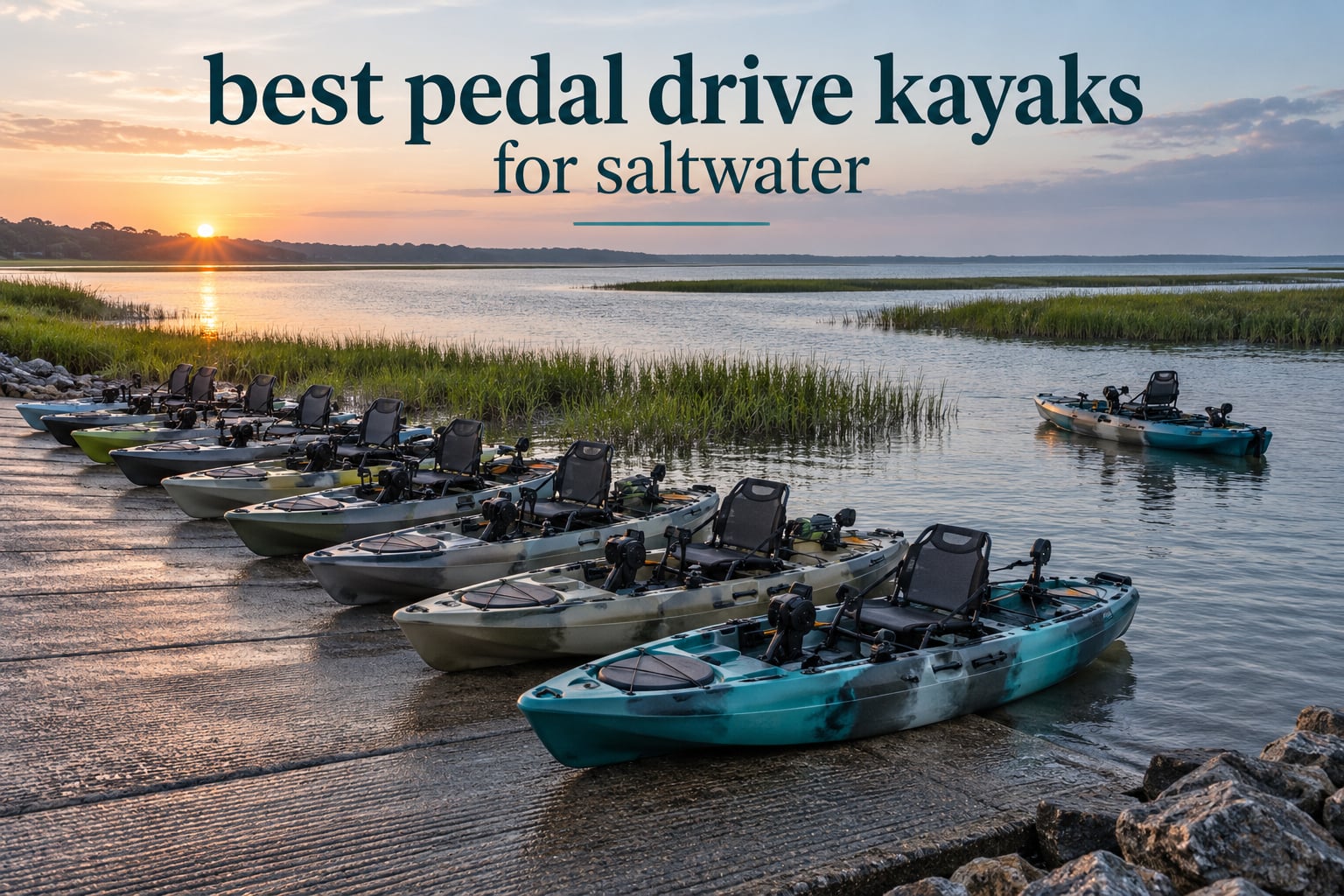
Salt water is where a pedal drive kayak either earns its place or becomes a very expensive beach toy. On a lake you can tolerate a drive that steers lazily, reverses badly and collects rust you never see. In tidal current the same boat fights you the whole tide, and every ferrous part you did not rinse becomes a repair bill by autumn. We compared ten pedal drive kayaks built for fishing, and the differences that matter here are beam, rudder authority, whether the drive reverses instantly, and how much stainless sits below the waterline. This is our guide to the best pedal drive kayaks for saltwater in 2026, sorted by the water you actually fish.
Two words you will see constantly. A prop drive spins a propeller with a circular pedaling stroke and gives you instant reverse the moment you pedal backward. A fin drive pushes flexible blades fore and aft, which is quieter and safer around rocks and weeds but offers no reverse. Both add secondary stability, meaning the drive hanging under the hull resists roll before you even shift your weight. A self-righting hull is one with enough beam and buoyancy to float you back to the surface after a capsize instead of leaving you swimming.
There is no single best pedal drive kayak for saltwater. The right answer depends on whether you fish an estuary, the open ocean or the flats, and on how far you can carry a boat. We are not going to pretend otherwise, so each pick below is labelled with the water type it suits best and the compromises you accept to get it. If you are still deciding between a paddle boat and a pedal boat, our pedal boat guide covers the freshwater case, and the saltwater-specific differences are laid out below.
Table of Contents
- Top 3 Pedal Drive Kayaks for Saltwater in 2026
- All Ten Picks at a Glance in 2026
- 1. Reel Yaks Raptor 9.5 ft Modular: Best Pedal Drive Kayak for Saltwater Overall
- 2. BKC Brooklyn 12.5 Pro: Best for Open Water and Long Runs
- 3. Reel Yaks Raider 9.5 ft Modular: Best Value for Flats and Inshore Water
- 4. Reel Yaks Radar 10 ft Modular: Best for Heavy Gear and Rough Inshore Water
- 5. Pelican Catch Kicker 110 HDII: Best for Solo Launches and Shallow Water
- 6. Old Town Sportsman PDL 106: Best for Standing Casts and Skinny Water
- 7. BKC Brooklyn 10.0 Single: Best for Narrow Water and Light Loads
- 8. Old Town Malibu PDL 12 ft: Best for Open Water Rigging
- 9. Lifetime Renegade 116: Best for Tackle Storage and a Paddle Backup
- 10. Wilderness Systems Recon 120 HD: Best for Rod Storage on a Big Hull
- Prop Drive vs Fin Drive: What Actually Changes in Salt Water
- Hull, Chop and Rudder Authority on Open Water
- Saltwater Care: The Freshwater Rinse Checklist
- Buying Guide: Length, Beam, Capacity and Rigging
- Who Should Skip a Pedal Kayak
- Frequently Asked Questions
- The Verdict for 2026
Top 3 Pedal Drive Kayaks for Saltwater in 2026


All Ten Picks at a Glance in 2026
| Product | Specifications | Action |
|---|---|---|
 Reel Yaks Raptor 9.5 Modular Reel Yaks Raptor 9.5 Modular |
|
Check Latest Price |
 BKC Brooklyn 12.5 Pro BKC Brooklyn 12.5 Pro |
|
Check Latest Price |
| Reel Yaks Raider 9.5 Modular |
|
Check Latest Price |
 Reel Yaks Radar 10ft Modular Reel Yaks Radar 10ft Modular |
|
Check Latest Price |
| Pelican Catch Kicker 110 HDII |
|
Check Latest Price |
 Old Town Sportsman PDL 106 Old Town Sportsman PDL 106 |
|
Check Latest Price |
 BKC Brooklyn 10.0 Single BKC Brooklyn 10.0 Single |
|
Check Latest Price |
 Old Town Malibu PDL 12ft Old Town Malibu PDL 12ft |
|
Check Latest Price |
 Lifetime Renegade 116 Lifetime Renegade 116 |
|
Check Latest Price |
 Wilderness Systems Recon 120 HD Wilderness Systems Recon 120 HD |
|
Check Latest Price |
1. Reel Yaks Raptor 9.5 ft Modular: Best Pedal Drive Kayak for Saltwater Overall
Reel Yaks Raptor Modular Fishing Kayak, Fin Drive 9.5ft, 380 lbs Capacity
9.5 ft modular hull
380 lb capacity
62 lb weight
Fin pedal drive
Pros
- Two-piece body fits in an SUV or closet
- Smooth fin drive that works in wind and current
- Wide W-hull feels roomier than 9.5 ft suggests
- Arrives rigged with rod holder tracks hatch and seat
- Fast replacement parts support
Cons
- Rudder control wires and ferrules break for some owners
- Rudder quick-release hardware has snapped early
- Low seat leaves no usable storage underneath
Saltwater verdict: the Raptor is the pick we would launch from a beach, estuary or protected inlet, because the modular format removes the single biggest obstacle to pedal boating in salt water, which is getting 60-plus pounds of hull to a shoreline and back again.
The two-piece body splits into sections you can carry one at a time, and owners confirm it assembles without tools. That matters at a tidal launch where you are fighting a clock rather than parking a cart. The fin drive is smooth and efficient, and it pushes well into wind and current with far less effort than a paddle would demand from a loaded boat.
The W-hull is wide relative to its 9.5 ft length, and anglers describe it as roomier than the length suggests, with 380 lb of listed capacity. It ships rigged with a rod holder, track rails, a storage hatch and a stadium seat, so an electronics decision is the main thing remaining to make.
The weak point is the rudder. Multiple owners report control wires and ferrules breaking, and rudder screw hardware snapping within the first season. In salt water that failure mode is worse, because the cable is a corrosion trap and chafes against its own housing. Treat the rudder as a maintenance item, not a permanent install.
How it holds up in tidal current and chop
At 9.5 ft with a wide W-hull, this is an estuary and inlet boat rather than an offshore one. It handles light chop and a working current well. The fin drive is quiet, which helps you approach reds and snook without pushing them off the flat, and it will not stall out on submerged grass the way a propeller does.
What you give up for the modular format
You give up reverse. The fin blades move fore and aft, so backing down on a fish is a paddle-and-swerve exercise, and the low seat leaves no usable storage underneath for a wet dock bag. Owners also note that track-rail end caps must be loosened and refitted to slide accessories on, which is fussy in the parking lot.
2. BKC Brooklyn 12.5 Pro: Best for Open Water and Long Runs
BKC Brooklyn 12.5 Pro Pedal Fishing Kayak, Propeller Drive
12.5 ft HDPE hull
550 lb capacity
80 lb weight
Propeller pedal drive
Pros
- Prop drive cruises 3-4 mph on its own
- 550 lb capacity and stable enough to stand and cast
- Saltwater anglers report successful open-water trips
- Rod holders dry-bag hatches bungees and accessory plates
- Lighter than most 12 ft pedal boats
Cons
- Rudder does not self-center so a hand stays on it
- Drive cover must come off before raising the unit
- Weak reverse makes backing out of current hard
Saltwater verdict: the Brooklyn 12.5 Pro is the longest and highest-capacity boat in this group, which makes it the one to look at if you intend to troll line for striped bass well past the breakwater rather than work the marsh edge.
Owners put the propeller drive at roughly 3-4 mph on its own and around 5 mph when they add paddle power, and one reviewer logged more than 75 pedal miles. That is real range for a solo boat. The 550 lb capacity is the highest here, which absorbs a heavy saltwater rig, a cooler and a battery without the boat riding low.
Rigging is thorough out of the box: three flush-mounted rod holders, two watertight hatches with dry bag inserts, bow and stern bungees, accessory plates and scupper plugs. The tracking is good and saltwater anglers report successful trips on open water, which is the reason this boat lands on the list.
Two things cost you. The hand-controlled rudder does not self-center, so in a cross-current you are always holding something. And the drive cover has to come off before you can raise the unit out of the water, which is exactly the wrong sequence when you are easing through shallow grass on a falling tide.
Why length and capacity help in open salt water
At 150 inches long and 35 inches wide, this hull holds a line in a chop that unsettles a 9.5 ft boat, and the extra length converts pedaling effort into distance instead of bobbing. The width is what lets you stand to cast, which is how most of these fish are caught. Owners also note it is lighter than comparable 12 ft pedal boats, which softens the transport hit.
Where it will frustrate you
At 80 lb it is heavy and awkward to carry single-handed, and the propeller needs a working clear path underwater. If you are moving through shallow tidal flats where you would have to raise and lower the unit constantly, the sequence gets old fast. Owners also flag limited access to the inner hull, which restricts aftermarket rod-holder back plates.
3. Reel Yaks Raider 9.5 ft Modular: Best Value for Flats and Inshore Water
Reel Yaks Raider Modular Fishing Kayak – 9.5ft, 380 lbs Capacity, Red White Black – Pedal Fishing Kayaks for Adults & Youth, Sit on Top, Compact Storage, Lightweight, Easy Transport
9.5 ft modular hull
380 lb capacity
66 lb weight
Propeller pedal drive
Pros
- Very stable W-hull lets you stand and cast
- Prop drive moves through current with little effort
- Two sections assemble in seconds
- Comfortable adjustable stadium seat
- Responsive pre and post sale support
Cons
- Each section is heavier than the marketing suggests
- Sections do not align perfectly even when new
- Prop picks up weeds and needs frequent clearing
Saltwater verdict: the Raider is the boat we would put on a flats boat for sight casting reds and snook, because instant reverse plus a wide W-hull is the combination you want when a fish runs underneath you in two feet of water.
Owners consistently describe it as stable, quick and well built, and specifically say it handles current and chop well for a solo paddler. The propeller drive reverses the instant you stop pedaling backward, which is the single most useful trait for inshore fishing because you spend half the trip repositioning rather than traveling.
The four-step modular assembly means the boat lives in a closet between trips, and the tandem center section is a popular add-on for anyone bringing a second angler. Rated capacity is 380 lb, and the HDPE body with a 35 inch cockpit suits an angler in a full PFD.
Two durability notes matter for salt water. Owners report stripped gearbox internals and loosening pedals inside the first season on some boats, so factor in a service kit. And the propeller gathers weeds, which in a tidal marsh means clearing it by hand more than once a season.
Why reverse matters on the flats
On a flat, the fish you are casting to is often closer than you planned. With a prop drive you back up and re-approach while keeping the rod loaded, which keeps the fish pinned. With a fin drive you would be doing that maneuver with a paddle, and a paddle in a strong current is a lot of work for very little steering control.
Honest drawbacks
Each half is heavier and more awkward to lift than the marketing weight implies, and the two sections do not align perfectly even when new, so plan on a kayak cart for anything beyond a soft beach ramp. The front storage compartment is also not reachable while seated.
4. Reel Yaks Radar 10 ft Modular: Best for Heavy Gear and Rough Inshore Water
Reel Yaks Radar Modular Fishing Kayak, 10ft, 430 lbs Capacity
10 ft modular hull
430 lb capacity
88 lb weight
Propeller pedal drive
Pros
- Instant forward and reverse for tight maneuvering
- Two-piece format makes transport and storage simple
- Wide W-hull feels planted in rough water
- Rigs with rod holders track rails and hatch
- Fits in a vehicle trunk
Cons
- 88 lb total weight makes the sections demanding to lift
- Rudder tension usually needs adjusting
- Prop and rudder hardware are common repair items
Saltwater verdict: the Radar steps up to 430 lb of capacity in a modular frame, which makes it the fit for an angler running a trolling motor, a fish finder and a full box of tackle out of an inlet into chop.
Buyers single out the responsive propeller drive, particularly the forward and reverse control, and the way the wide W-hull feels planted in rough water. The two-piece format still fits in a vehicle trunk, which is the practical advantage over the fixed 12 ft hulls when you are launching alone.
It rigs out of the box with flush-mount rod holders, track rails and a storage hatch, so an electronics mount and a motor bracket are the first two things to add. Fin and propeller drive variants are both listed, which matters if you move between grass flats and open water.
The recurring friction is on land. At 88 lb total, the two sections are demanding to carry, and owners report that rudder tension usually needs adjusting before the rudder will lift clear of the water. In salt water, plan on re-checking that tension after every few trips rather than once a season.
Capacity versus footprint
Ten feet of length with a 33 inch beam is a rare middle ground. You get enough capacity for a real offshore rig without carrying 115 lb of hull, and the narrower length turns more cleanly around structure and marsh cuts than the 12 ft boats do. For an estuary and nearshore mixed routine, that balance is the selling point.
Where it is the wrong boat
It is not a true offshore boat. The capacity is generous but the hull is short, so it will not lay down the way a 12 ft hull does when a swell stacks up outside the inlet. The pedal drive is also not user-removable, so if your water splits between deep and shallow you are choosing one drive for both.
5. Pelican Catch Kicker 110 HDII: Best for Solo Launches and Shallow Water
Pelican Catch Kicker 110 HDII – Sit on top Fishing Angler Pedal Kayak – Amazonia – HyDryve II Pedal System – Stable – 11 ft
11 ft polyethylene hull
300 lb capacity
59 lb weight
HyDryve II fin drive
Pros
- HyDryve II fin drive is smooth around plants
- Ergoboost seat raises you for better visibility
- Lightest hull here at 59 lb with handle tracks
- Side-handled rudder tracks straight in current
Cons
- Lowest capacity in the lineup at 300 lb
- Pedal position adjustment is limited so fit is not universal
- Accessories mount to handles only leaving little free track space
Saltwater verdict: the Catch Kicker 110 is the lightest boat here at 59 lb, and for a solo angler walking a soft tidal bank with a shoulder full of gear, that single number decides more trips than anything else on the spec sheet.
The HyDryve II fin pedal system is smooth and efficient around plants, which is exactly the environment you find in a tidal marsh and around shallow structure. The Ergoboost seat raises your seating position, and owners point out that you see more water and more fish from it. A side-handled rudder helps the boat track straight in current without a cable running to your hand.
It is a polyethylene sit-on-top hull at 11 ft, and the two mid-side metal handles have built-in accessory track grooves so you can mount gear without separate hardware. The boat carries a lifetime limited warranty against manufacturer defects with one year on parts and accessories.
Now the honest part. At 300 lb it has the lowest capacity in this group, which is a real limit for a tall angler in cold-water gear. Accessory mounting is restricted to the handle tracks, leaving little free rail space, and the fin drive offers no reverse at all. Ratings trend below the other boats we analyzed, and pedal position adjustment is limited, so fit is not universal.
Best fit for estuary and marsh water
Quiet fin propulsion is the right tool when you are 20 feet from a bed in knee-deep water and want the fish to stay under you. The raised seat widens your view of channels and drop-offs, and the light weight means you can carry it from a parking area to a soft launch without a cart. It is a genuinely good boat for protected water.
Where it falls short in salt water
No reverse is a real handicap when a strong ebb pulls you off a flat or you need to back off a snag. The 300 lb rating caps how much electronics and tackle you can carry, and the handle-track mounting means a trolling motor bracket is a custom job. Buy it as an estuary boat, not a coastal one.
6. Old Town Sportsman PDL 106: Best for Standing Casts and Skinny Water
Old Town Sportsman PDL 106 Sit-on-Top Fishing Kayak, Steel Camo
10.5 ft pontoon hull
450 lb capacity
107 lb plus 18 lb console
Forward and reverse drive
Pros
- Pontoon-style hull stands up to casting
- Quiet drive with instant reverse
- Rudder responds faster than competitors
- Universal transducer mount and accessory tracks
- Mesh seat adjusts for leg length
Cons
- Heaviest build here at 107 lb
- Capacity trimmed versus the 12 ft models
- Paddle is sold separately
Saltwater verdict: the Sportsman PDL 106 is the most stable boat in this group by a wide margin, and stability is the feature that keeps you upright when you stand to cast at a redfish in a current.
Owners describe the pontoon-style hull as built like a tank, and several say they upgraded from mid-grade fishing kayaks and felt an immediate difference in speed and control. The pedal drive runs quiet with instant reverse, and the rudder responds fast enough that owners joke about towing a passenger. That rudder authority is what you want in a tidal race.
Electronics rigging is the best in the group. A universal transducer mount makes a fish finder straightforward, and the customizable accessory tracks accept motor brackets and rod holders. The breathable mesh seat adjusts to leg length, and a removable pedal console simplifies launching and landing by letting you take the heaviest part off.
The weight is the story. At 107 lb for the hull plus an 18 lb removable console, this needs a plan for every ramp, and a kayak cart is effectively required to move it on land. The listed capacity is 450 lb with 343 lb usable for angler and gear, and the paddle is a separate purchase.
Who this hull is built for
Anglers with hip or balance issues, and anyone who fishes standing up. A wide pontoon-style hull gives a standing platform that a narrow tunnel hull simply does not, and the drive hanging below the hull adds secondary stability on top of that. If you are moving slowly over shallow structure and need to cast without sitting down, this is the boat.
The transport tax
Owners who regret pedal boats almost always cite weight and resale rather than on-water performance, and this is where that complaint is loudest. The 18 lb removable console helps, but a 10.5 ft pontoon hull at 107 lb is a two-person carry or a cart job every single time. Plan your launch before you commit.
7. BKC Brooklyn 10.0 Single: Best for Narrow Water and Light Loads
BKC Brooklyn 10.0 Single Pedal Fishing Kayak, Sit-on-Top
10 ft rotomolded HDPE
350 lb capacity
75 lb weight
Flipper pedal drive
Pros
- Flipper drive accelerates quickly in a compact hull
- Rotomolded HDPE resists UV and dents
- Hand rudder turns well in chop
- Comes with seat rod holders hatch and rail
Cons
- Paddle is not included in the box
- Lowest capacity among the BKC models here
- Small review base limits wear data
Saltwater verdict: the Brooklyn 10.0 is the most compact boat here, and its 10 ft rotomolded hull turns and threads through narrow creeks and mangroves where a 12 ft pedal boat is simply too much boat.
The flipper-style pedal drive gives quick acceleration in a small hull, which is what you want when you are repositioning around a point in a two-knot flood tide. Owners like the hand-operated rudder for responsive turns in chop, and the rotomolded HDPE body resists UV and dents, which is a fair argument in a sun-heavy salt-water state.
It comes with an aluminum upright seat using dry mesh tech, a front hatch, bungee-secured rear cargo and rod holders. Scupper holes drain the deck quickly after a full wave washes over you, which happens more often than anglers expect in nearshore conditions.
Capacity is 350 lb, the lowest of the BKC models in this roundup, and the listing is inconsistent about whether a paddle comes with the hull, so confirm that before you rely on it as your backup. With only a dozen ratings, there is very little long-term wear data on the flipper drive, which matters if you are buying for multi-season salt-water use.
How it handles a working tide
Short hulls get pushed around more in current, and a 10 ft boat is at the edge of what we would take past a rock jetty. Inside a marsh or a protected bay, though, the trade works in your favor. The boat is nimble, drains fast and is far easier to get onto a soft bank than any 12 ft model here.
What you trade for the footprint
You trade stability while standing and you trade load capacity. There is no room for a large electronics package, and the hand rudder needs constant attention in a cross-current. Anglers who fish structure offshore should look one size up rather than stretch this hull to cover it.
8. Old Town Malibu PDL 12 ft: Best for Open Water Rigging
Old Town Ocean Kayak Malibu Pedal Sit-on-Top Kayak, Lava
12 ft sit-on-top hull
PDL drive
Slide-track beach seat
Large stern tankwell
Pros
- Stable and fast with chop handling for coastal water
- Slide-track seat vents and drains to keep you dry
- Large stern tankwell takes a cooler and gear
- Three flush rod holders and two 18 in accessory tracks
- Owners rig it with a trolling motor and extended tiller
Cons
- Arrives partly rigged so setup takes time
- Small review base means limited long-term data
Saltwater verdict: the Malibu PDL is a 12 ft recreational pedal hull built around rigging, and owners report that it accepts a trolling motor with an extended tiller for push-pull steering, which is the setup most serious nearshore striper anglers end up wanting.
At 12 ft it is long enough to lay down in a chop and fast on the pedal, and reviewers describe the chop handling as well suited to open coastal water. The design is a refined version of the earlier Old Town Salty PDL hull, which is useful context because it means the basic layout has been in coastal use for a while.
Storage is the standout. The redesigned stern tankwell takes a cooler and a full gear load, the Element Beach seat slides on a track and vents and drains so you stay dry, and there are three flush-mount rod holders plus two 18 in accessory tracks flanking the cockpit. That track space is what makes a motor and transducer install straightforward.
Two cautions. The boat arrives partially outfitter-rigged, so budget an afternoon for the first setup rather than launching the day it arrives. And with ten ratings, the review sample is small enough that we would treat the five-star average as encouraging rather than proven. The hull carries a limited hull warranty and a five-year warranty on the PDL drive.
Why 12 feet helps offshore
Length converts pedaling effort into forward motion instead of bobbing, and a 12 ft hull holds a line when a wind-driven chop stacks across an inlet mouth. Paired with a stern tankwell and accessory tracks, it is also the easiest of these boats to load for a full day of trolling or live bait work. If your trips take you past the structure, this is the shape you want.
Setup time and rig planning
Budget real time for the first rigging session, and decide your electronics before launch day. Two 18 in tracks flanking the cockpit give you motor bracket and transducer options, but cable routing and a clean install are on you. Plan your power as well, and our trolling motor battery guide covers the capacity math for a salt-water day.
9. Lifetime Renegade 116: Best for Tackle Storage and a Paddle Backup
Lifetime Renegade 116 Pedal Drive Fishing Kayak
11.5 ft HDPE hull
350 lb capacity
102.5 lb weight
Deployable prop drive
Pros
- Pedal system keeps your hands free for casting and steering
- Integrated rudder steering with good tracking
- Sliding framed seat sets your pedaling position
- Multiple storage areas with rod holders and accessory mounts
- UV and impact resistant HDPE with scupper drains
Cons
- 102.5 lb weight means solo launching takes planning
- Only one customer rating so no long-term feedback
Saltwater verdict: the Renegade 116 pairs a deployable propeller drive with multiple dedicated storage areas, which makes it the pick for an angler whose tackle organization matters as much as their speed.
The single owner review describes comfortable all-day pedaling, integrated rudder steering that feels natural quickly, good tracking and a supportive sliding seat. The framed seat slides forward and backward, which lets you dial in the pedaling position that suits your leg length, and the reviewer notes the boat tracks well in a straight line.
Storage is where it separates itself: multiple storage areas, flush-mount rod holders and universal accessory mounts, at 138.5 inches long with a 32 inch beam. The HDPE body is described as UV- and impact-resistant, and self-draining scupper holes empty the deck after a wave. A paddle is included, which matters for backup propulsion.
Be careful with the rating. There is exactly one customer review, so the five-star average is a single data point rather than a track record, and we would not draw durability conclusions from it. At 102.5 lb the boat is substantial, and the reviewer is candid that solo handling needs planning.
What the storage layout changes on a fishing day
Rod holders, universal accessory mounts and separate storage areas mean a full day of bait and line does not end up loose on the deck. That matters in salt water, where a rolling tackle bag is a balance hazard when you are standing to cast. The included paddle also gives you a genuine backup if the drive takes a hit offshore.
The honest caveat
A boat sold with a single customer rating tells you very little about how a propeller drive and rudder assembly hold up over multiple salt-water seasons. The included five-year limited warranty helps, but parts availability is the real question for a newer listing. Treat this as a well-equipped boat to watch rather than a proven one.
10. Wilderness Systems Recon 120 HD: Best for Rod Storage on a Big Hull
Wilderness Systems Recon 120 HD – Sit on Top Fishing Kayak – 360 Degree ACES seat & Helix PD™ Pedal Drive System – 12 ft – Desert Sunset
12 ft polyethylene hull
450 lb capacity
115 lb weight
Helix PD pedal drive
Pros
- ACES seat swivels 360 degrees with one-handed trim
- S.M.A.R.T. hull tuned for tracking and acceleration
- Extra-large gasketed hatch and internal bin
- Dual rod troughs hold three rods per side
- 450 lb capacity for bigger anglers and gear
Cons
- Heaviest boat in the group at 115 lb
- Ratings are polarized with a share of one-star reviews
- 38 inch beam is harder to transport and store
Saltwater verdict: the Recon 120 HD has the largest feature set here, including dual rod troughs that hold up to three rods per side, and a 38 inch beam that gives a standing platform most anglers will never overcook.
The AirPro ACES seat swivels 360 degrees with a one-handed mechanical trim lever, so you can sight cast in any direction without moving your whole body. Owners who like it praise the S.M.A.R.T. hull for stability, tracking and acceleration in open water, and the StowPro system puts an extra-large gasketed hatch and a configured bin under the deck.
At 146 inches long with 450 lb of capacity, it is built for bigger anglers and heavier gear, and the Helix PD drive handles the propulsion. The horizontal rod troughs are the feature that separates it from every other boat in this roundup when you are switching between a rod in hand and rods in storage.
But the ratings are the warning. This boat has the lowest average score among everything we analyzed, with roughly a third of ratings at five stars and a quarter at one star, which reads as a polarizing design rather than a defective one. At 115 lb it is also the heaviest here, and the 38 inch beam makes storage in a garage or a roof rack genuinely awkward.
Who will love this hull
Anglers who spend long sessions stationary on a flat or over deep structure, and who want to swivel and cast in multiple directions without repositioning. The 450 lb capacity, large gasketed hatch and dual troughs mean you can carry a full salt-water rig, wet gear and a catch box without crowding the deck.
Why we placed it last
Three things stack up. The 115 lb weight is the heaviest in the group and the single biggest barrier to solo beach launching. The 38 inch beam is a storage and transport problem on its own. And the polarized rating profile tells us a meaningful share of owners are unhappy, so you are buying a strong feature set on spec rather than on a settled owner record.
Prop Drive vs Fin Drive: What Actually Changes in Salt Water
A prop drive spins a propeller in a circular stroke and reverses the instant you pedal backward. A fin drive pushes flexible blades fore and aft, which is quiet and safe around structure but offers no reverse. That single difference shapes how you fish more than any other spec on this list.
For reverse, the prop drive wins outright. When a fish runs under you in three feet of water off a marsh bank, backing up with the drive keeps the rod loaded. The fin drive boats here, the Raptor and the Pelican Catch Kicker, are quiet and efficient but make you pick up a paddle for that maneuver.
For hazards, the fin drive wins. Submerged grass, oyster beds, rocks and debris are all common in tidal water, and a prop unit must be raised before you cross them. The Pelican’s HyDryve II is specifically praised for smooth running around plants, and the Raptor owners describe the fin drive as quiet enough to approach fish without pushing them off.
For corrosion exposure, neither is safer by design. A prop shaft puts spinning metal underwater in a housing full of grease that will eventually break down, and a fin unit has a lower profile with fewer moving seals. The real difference is how much you maintain them, and that is where the rinse protocol below matters more than the drive type.
Hull, Chop and Rudder Authority on Open Water
Beam is the number that decides whether you can stand and cast, and 33 to 35 inches is the working range for a fishing kayak you will actually stand in. The Old Town Sportsman PDL 106 and the Reel Yaks Radar use a wide W-hull or pontoon-style layout for exactly that reason, and both feel planted in rough water according to their owners.
Length does the wave work. A 12 ft hull such as the Brooklyn 12.5 Pro, the Malibu PDL or the Recon 120 HD lays down and holds a line in wind-driven chop, while a 9.5 ft modular boat is an inlet and estuary proposition. We are careful here because chop tolerance is a hull-and-load condition, not a brand promise, and a heavy rig changes everything.
Rudder authority is the trait anglers underrate. The Old Town PDL 106 has a rudder owners describe as noticeably faster than competitors, which is what you want in a tidal race. Hand-controlled rudders on the BKC boats do not self-center, so you are always holding something. A side-handled rudder, as on the Pelican, keeps your hands free but gives you less finesse.
On self-righting, secondary stability from the drive helps but does not guarantee a righted boat. Test a capsize and re-entry in shallow calm water before you rely on it offshore, and keep a spare paddle in the hull as backup propulsion.
Saltwater Care: The Freshwater Rinse Checklist
Salt crystallizes in bearings and cable housings while you are not looking, and once it does, the part that fails is usually the one that is hardest to get. Anglers who regret a pedal boat almost never regret the drive, they regret skipping the rinse. Run this after every trip, not once a month.
- Rinse the hull with fresh water before it dries, concentrating on the drive well and any hardware under the waterline.
- Squirt fresh water through the rudder line housing and let it drain, then pull the control line fully to both ends to flush the fairleads.
- Run the pedal drive briefly in fresh water to purge salt from the gearbox and prop shaft, then wipe the prop and shaft dry.
- Check the rudder tension and the prop pin while the boat is out, before you are in a parking lot at dusk.
- Inspect rod holder screws, track end caps, scupper plugs and any stainless fastener for rust bloom, and rinse them individually.
- Wipe down the seat, deck and any fabric with fresh water to cut salt residue that attracts moisture and UV damage.
- Leave hatches, dry bags and tackle boxes open on the trailer or rack until everything is fully dry and ventilated.
- Treat bare metal, cable and drive internals with a marine protectant before longer storage gaps.
Once a season, break down the drive according to the manufacturer’s instructions, check the prop pin and pedal hardware for wear, and relubricate with the specified marine grease. Keep spare pins, cables and ferrules on the boat, because the Raptor’s reported failures were all consumable hardware rather than structural parts.
Buying Guide: Length, Beam, Capacity and Rigging
Length versus beam is the cleanest trade in this category. Ten feet and about 33 inches of beam turns tightly and carries a solo angler, which suits narrow creeks. Twelve feet and 35 to 38 inches of beam is a different animal, longer in the water, heavier on land, and far better in chop. Most anglers who move from paddle boats to pedal boats end up in the 10 to 12 ft range and stay there.
Capacity is about more than your body weight. You are adding a battery, a fish finder, a trolling motor, a cooler and a wet catch box. A 300 lb rating is a freshwater rating in practice, a 350 to 380 lb rating suits a moderate rig, and 450 lb is where a full nearshore setup fits without the boat sitting too low. Old Town lists its Sportsman PDL 106 at 450 lb max with 343 lb usable for angler and gear, which is the most useful number on any spec sheet.
Rigging deserves a decision before you buy. Look for a universal transducer mount if you plan a fish finder, accessory tracks along the cockpit for a motor bracket, and rod storage in a place that does not eat deck space. The Old Town PDL 106 and the Malibu PDL do both of the first two well, and the Recon 120 HD has the best rod storage by a wide margin.
Transport is where most disappointments live. Boats here run from 59 lb to 115 lb, and the heavier ones need a cart, two hands and a plan. Modular boats such as the Raptor, Raider and Radar split into sections and solve it; fixed hulls do not. If you launch from a soft bank alone, weight should be a bigger factor in your decision than drive type.
Finally, check the warranty on the drive separately from the hull. A five-year drive warranty, as offered on the Old Town PDL models and the BKC boats, matters more in salt water than a longer hull warranty, because the drive is the part exposed to corrosion and impact.
Who Should Skip a Pedal Kayak
Skip it if you launch alone from a soft beach. The weight in this category runs high, and two of the strongest boats on the list are effectively two-person carries. If you cannot get a cart to the waterline, a paddle kayak will get you more fishing done.
Skip it if you never need reverse. Fin drive boats are simpler, quieter and cheaper to maintain, and in protected water that is a fair trade. But if you fish a tidal race, back off structure regularly or chase fish in short water, reverse is not optional.
Skip it if you dislike maintenance. A pedal drive has more lubricated, salt-exposed components than a paddle boat by a wide margin, and the rinse discipline is not optional. Anglers who are not going to rinse the boat after every trip will watch drive parts seize faster than the warranty covers.
And skip it if you mostly fish from shore or a dock. None of these boats is the right answer there, no matter how good the hull is.
Frequently Asked Questions
Is a pedal drive kayak worth it?
For salt water, usually yes, because hands-free propulsion lets you cast, troll and fight fish without switching to a paddle mid-trip. The value drops if you launch alone from soft ground, since pedal boats in this category weigh 59 to 115 lb. Reverse capability and rudder authority matter more in tidal water than raw speed.
What kind of kayak is best for the ocean?
A sit-on-top pedal kayak with at least 33 inches of beam, 12 feet of length and a high capacity rating handles open coastal water best. Beam lets you stand to cast, length keeps the boat from bobbing in a chop, and capacity absorbs a full rig. Estuary and marsh work is better served by a lighter 10 or 11 foot fin-drive boat.
Which pedal drive kayak is the fastest?
Propeller drive boats are generally the fastest on this list, with owners reporting roughly 3-4 mph on the drive alone and near 5 mph with paddle assist on the BKC Brooklyn 12.5 Pro. Fin drives trade some speed for quiet operation. Reverse and chop handling often matter more than top speed in tidal water.
Do pedal kayaks work in salt water?
Yes, provided you rinse the boat with fresh water after every trip and service the drive on a schedule. Salt settles in rudder cables, pedal gearboxes and prop shafts, and corrosion there is the main reason these boats fail early. Stainless hardware, a protected rudder line and a marine protectant between trips extend hull and drive life considerably.
Which is better for fishing, a 10-foot or 12-foot kayak?
A 10-foot boat turns tighter, drains faster and carries far less weight on land, which suits narrow creeks and solo launches. A 12-foot boat lays down in chop, carries a heavier salt-water rig and takes a trolling motor more comfortably. Most coastal anglers choose 10 to 12 feet depending on how far past the inlet they fish.
The Verdict for 2026
For the best pedal drive kayaks for saltwater, the Reel Yaks Raptor 9.5 ft is our top pick. It has the largest owner base in this group, a wide W-hull, a smooth fin drive, and a two-piece body that solves the launch problem that stops most saltwater anglers from going pedaled at all. Watch the rudder hardware and keep spares aboard.
The BKC Brooklyn 12.5 Pro takes open water with the best combination of length, capacity and range, and the Old Town Sportsman PDL 106 wins outright on stability and rudder response if you can solve the 107 lb carry. The Pelican Catch Kicker 110 is the lightest hull here and the right answer for protected estuary water.
Whatever you choose, rinse it with fresh water after every single trip. That habit decides how long the drive lasts far more than the badge on the hull.